
After the Delhi debacle, party bets big on its last stronghold, intensifies focus on Malwa region.
Chandigarh: With the 2027 Punjab Assembly elections still over a year away, the Aam Aadmi Party (AAP) has begun a major political shift—redirecting its top leadership, strategic resources, and attention to the state, its last remaining stronghold. In a bid to retain power in Punjab, the party has relocated key members of its Delhi-based strategy team and is setting up a full-fledged election war room in Chandigarh.
The move follows AAP’s sharp defeat in the 2025 Delhi Assembly elections, where its seat count plummeted from 62 to just 22—allowing the BJP to seize control. The loss has prompted AAP to double down on Punjab, which it views as essential for its political survival and continued relevance at the national level.
“Yes, several senior strategists have already shifted to Punjab. The party is determined to hold on to the state at any cost,” said a senior party functionary involved in the campaign planning, speaking on condition of anonymity.
The shift gained momentum after AAP’s victory in the Ludhiana West bypoll earlier this year. The focus is now firmly on the Malwa region, which holds 69 of Punjab’s 117 assembly seats. Chief Minister Bhagwant Mann, who hails from Sangrur in Malwa, is personally leading the campaign’s early groundwork. The region, home to a large population of farmers and Dalits, has historically played a decisive role in determining Punjab’s political direction.
In 2022, AAP won an overwhelming 66 out of 69 seats in Malwa, propelling it to a landslide victory. The party now hopes to repeat that success by implementing a region-specific strategy. As part of this approach, recent action against senior Shiromani Akali Dal (SAD) leader Bikram Singh Majithia is being seen as a calculated move to weaken the SAD’s traditional base in Malwa.
Observers also point to the ongoing Sutlej-Yamuna Link (SYL) water dispute between Punjab and Haryana as another key component of AAP’s political narrative. “The Mann government is using the water issue to position itself as the defender of Punjab’s rights, especially in the Malwa belt where the Sutlej River is vital,” said political analyst Dr Satish Tyagi. “It’s also an effort to regain trust among farmers after the fallout from police action against protestors last year.”
In another significant move, the Mann government has introduced a stringent anti-sacrilege bill proposing life imprisonment—and even the death penalty—for those convicted. The bill is widely seen as a bid to win over the influential Panthic vote bank and blunt the growing support for the newly launched Akali Dal (Waris Punjab De), backed by jailed MP and Sikh hardliner Amritpal Singh.
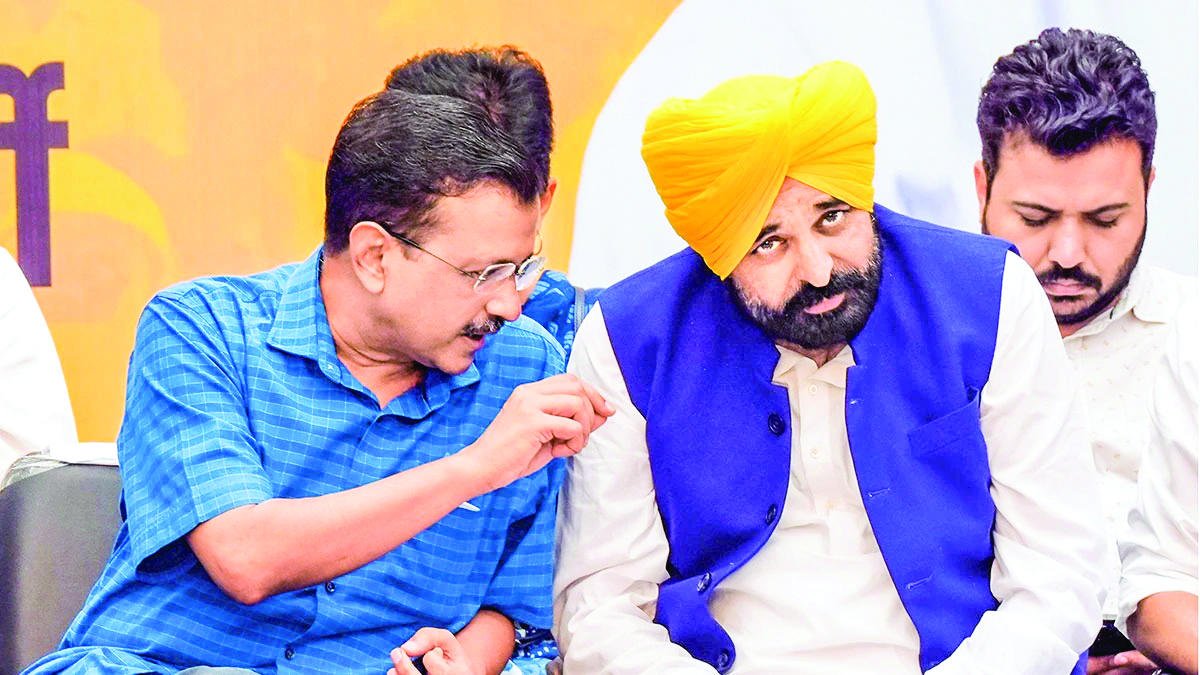
Recognizing Punjab’s centrality to the party’s future, AAP National Convener Arvind Kejriwal has chaired multiple high-level meetings in recent months with Mann, state cabinet ministers, MPs, and MLAs. During these strategy sessions, the leadership reportedly agreed to recast AAP’s national political vision—pivoting away from the now-tarnished “Delhi Model” to what is being branded as the “Kejriwal Model.”
As part of this rebranding, AAP recently launched the Punjabi edition of the Kejriwal Model book in Mohali. Speaking at the event, former Delhi Deputy CM Manish Sisodia described the model as “governance and politics for the common man.” Kejriwal added that the model’s success rests entirely on clean governance. “If a government is corrupt, this model collapses,” he said, pointing to the Punjab government’s performance as evidence of its success.
However, all is not well within the ranks. According to internal feedback, some Punjab-based leaders are uneasy with the growing influence of Delhibased strategists. There are concerns that the state unit is being sidelined, and that the Mann government is increasingly being perceived as taking orders from the central leadership in Delhi—an impression that could weaken AAP’s local connect.
For AAP, the 2027 Punjab election is no longer just about retaining power—it is a battle to preserve its political identity. With Delhi lost, the stakes have never been higher.




