
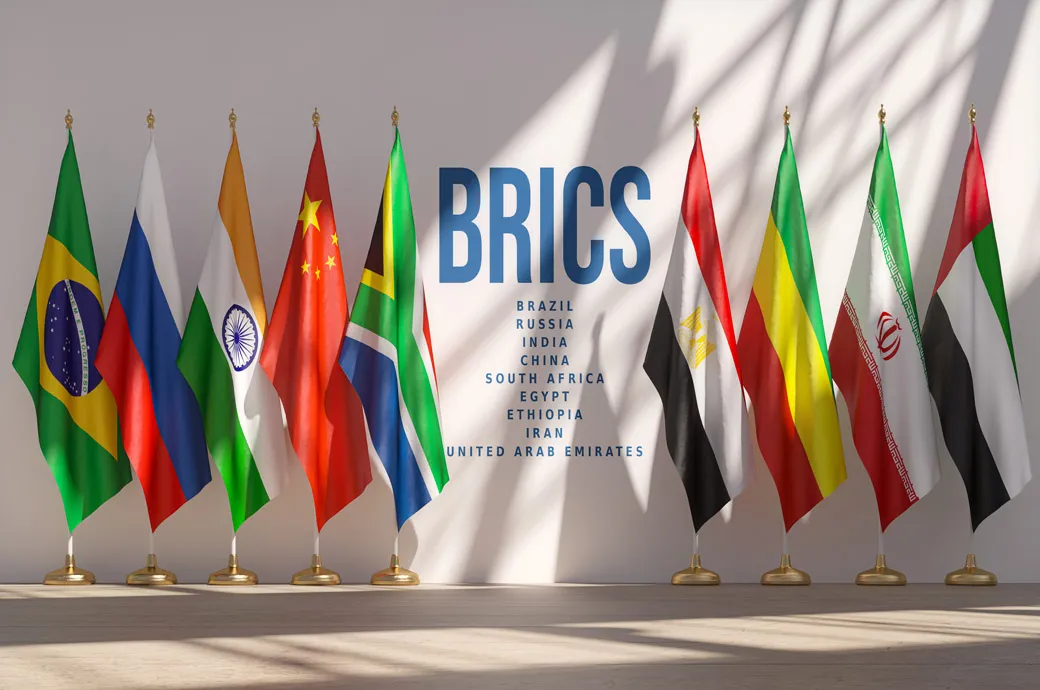
The BRIC, whose first summit was held in 2009 with the leaders of Brazil, Russia, India and China and which became BRICS with the addition South Africa in 2010 has further expanded in 2024-25 with the admission of Indonesia, Egypt, Ethiopia, Iran and the United Arab Emirates as full members. Besides, it has welcomed Belarus, Bolivia, Kazakhstan, Cuba, Nigeria, Malaysia, Thailand, Vietnam, Uganda and Uzbekistan as new BRICS partner countries. Another 30 countries including Türkiye are waiting to join it. BRICS, accounting for 50% of the world’s population, 40% GDP and 25% of global trade, is on the move. In the prevailing disrupted world, it generates two opposing reactions: unease, suspicion and resentment in the US and its Western allies, but optimism and assertion in the developing world that views it as a potent voice of the Global South.
The US remains the world’s most dominant power, and the current occupant of the White House shakes up his friends and foes alike with his unilateral and unpredictable trade and economic policies; he even bombed Iranian nuclear sites in Fordow, Natanz and Isfahan, in violation of international laws. Nonetheless, he would prefer to focus on his domestic priorities like MAGA and Big Beautiful Bill rather than getting bogged down in international quagmires. There is growing awareness in the countries of the Global South that they get short shrift in the decision making and face double standards thanks to the control of the leading international institutions by the North.
As a newspaper editorial recently said, “Herein lies a role for the BRICS to reshape itself as a counterweight to the nations of the North and hold them accountable for their actions.” A dispassionate reality check will put a big question mark against this suggestion. Yes, the Declaration of leaders at the 17th BRICS Sumit in Rio de Janeiro which adopted 126 commitments covering global governance, finance, health, artificial intelligence, climate change and other strategic areas raised “serious concerns” about imposition of tariffs which are “inconsistent with WTO rules” without naming the US and warned that this would “threaten reduce global trade, disrupt supply chains and introduce uncertainties.” It unequivocally condemned the US attack on Iranian nuclear sites and Israeli attacks in Gaza in violation of international laws.
However, BRICS’ ability to transform stated commitments into actual action is suspect given apparent differences within the group and the close relationship of several members with the US and the North. BRICS’ expansion and its economic heft do not automatically give it the necessary muscles and clout to influence decision-making in financial institution like the World Bank and the IMF or the UN. The Global South still struggles to press the developed nations to honour their financial commitments and transfer required technologies to address the menace of the climate change. In Prime Minister Narendra Modi’s view, without tech transfer and affordable financing for countries in need, climate action will remain confined merely to climate talks.
The Indian PM wants BRICS members to make supply chains for critical minerals and technology secure and not allow any country to use them for its own selfish gains or as a weapon against others, an obvious critique of China. His reference to double standards on the issue of terrorism also couldn’t have been lost on China. Ac c o r d i n g t o Mo d i , “BRICS’ diversity and multipolarity is its greatest strength”. He feels, members ought to strengthen multipolarity and cooperate on economic and AI related issues to transform the group as a guide for the multipolar world. He mentioned that under India’s presidency of the BRICS next year, the Indian government would work to define BRICS as: Building Resilience and Innovation for Cooperation and Sustainability. While some countries like India, China and Russia have done business with each other in their currencies in a limited sphere, this hasn’t developed into a phenomenon that could challenge the dollar’s global domination.
However, the very attempt to transact in non-dollar currency has infuriated President Trump, who has unleashed intimidating threats. As early as February this year, Trump had said, “We require a commitment from these countries that they will neither create a new currency nor back any other currency to replace the mighty dollar or they will face 100% tariff and BRICS will be dead because of these tariffs.” On the eve of the Rio, summit, he issued fresh warnings, “Countries aligning themselves with the anti-American policies of the BRICS bloc will be charged additional 10% tariffs without exception.” This made both Russia and China scramble to clarify that BRICS wasn’t seeking confrontation or undermining other countries. Russia emphasised, “BRICS is a group of countries that share common approaches and a common worldview on how to cooperate based on their own interests. And this cooperation has never been and will never be directed against any third country.”
In Chinese spokesman Mao Ning’s words, “BRICS advocates openness, inclusiveness and win-win cooperation.” However, the Rio Summit host, President Lula, has a different take: “The world has to find a way that our trade relations don’t have to pass through the dollar.” After Trump announced 50% tariffs on Brazilian exports citing the treatment of former President Bolsonaro, an unfazed Lula threatened to impose counter tariffs on American products and warned him against interfering in the internal affairs of Brazil. He also pointed out to Trump that in the last 15 years; the US has enjoyed the trade surplus of US$ 415 billion with Brazil, her second largest trading partner. For Lula, BRICS is “a set of countries that wants to find another way of organizing the world from the economic perspective that’s why it’s making people uncomfortable… The world has changed. We don’t want an Emperor.” India, a leading voice of the Global South, also wishes to be a valuable bridge between the latter and the developed world with her presence at the Quad, IndoPacific and G-20. Obviously, she will have to do a tightrope walk on several fronts.
The Quad foreign ministers’ meet in Washington, where External Affairs Minister S. Jaishankar represented India, didn’t say a word about the US attack on Iran or the situation in Gaza. But the Rio declaration, strongly denounced the US attack against Iranian nuclear sites and Israeli operation in Gaza. Though India enjoys warm relations with Brazil, in the thick of sensitive trade negotiations with the US, she can’t afford to be perceived as applauding Brazil. We criticise American attacks on Iran but remain silent about the Russian invasion of Ukraine.
Unlike the SCO Summit last month, the Rio Declaration strongly denounced the terrorist attack in Pahalgam. Russia, China and Iran presently face American sanctions, but we would like to get the best out of our comprehensive strategic partnership with the US, seeking cooperation in iCET, defence and security and a place on the high table. Aren’t we thus trying to sit on too many stools? Happymon Jacob, Director, CSDR, thinks: “For India, BRICS is a tool for strategic hedging in uncertain times. It helps Delhi balance and engage simultaneously, gives it some flexibility in navigating opposites while being ambiguous about where its real interest lies and managing competing interests.” That’s fine if others can’t read our strategic ambiguity. * Surendra Kumar is a former Indian ambassador.




