
Bengal, by virtue of its exposure to the British, brought in modern thought, concept of nationalism as also western principle of electoral democracy to India. And electoral democracy brought in the unavoidable issue of communalism. It was in December 1923 when Chittaranjan Das formulated “Bengal Pact”— he entered into an agreement with the nationalist Muslim members so as to join the electoral battles together.
The pact envisaged several concessions to the Muslims like banning music near mosques, unrestricted cow slaughter, job opportunity for members of the community etc. In Muslim majority undivided Bengal, Das knew political power depended a large part on support from the Muslim community. Subhas Bose also knew the political importance of the Muslims in Bengal. When he was sent packing from Congress, Bose contested Calcutta Corporation election along with Muslim League and ignored a possible winning alliance with Syama Prasad Mukherjee’s Hindu Mahasabha.
That Muslim support was not for Congress was seen even in the early days of West Bengal elections. Dr Bidhan Chandra Ray, former chief minister of West Bengal, in his second electoral battle from Bowbazar seat, nearly lost the election since Muslims did not support him. He defeated the communist candidate Md Ismail by mere 540 votes and left the constituency in the next election of 1962. But in the polite society of Bengali Bhadralok it was indecent to raise openly the issue of communal influence in electoral outcome. Taking advantage of such hesitancy, Islamisation of West Bengal politics increased, first quietly under Left Front rule and then openly under Mamata Banerjee. The result was open assault on the Hindu community in several places of West Bengal—Mothabari Samserganj, Dhulian, Mahestala, Rabindranagar to mention a few. Hindus did not receive any police protection and had to leave their home in search of safety.
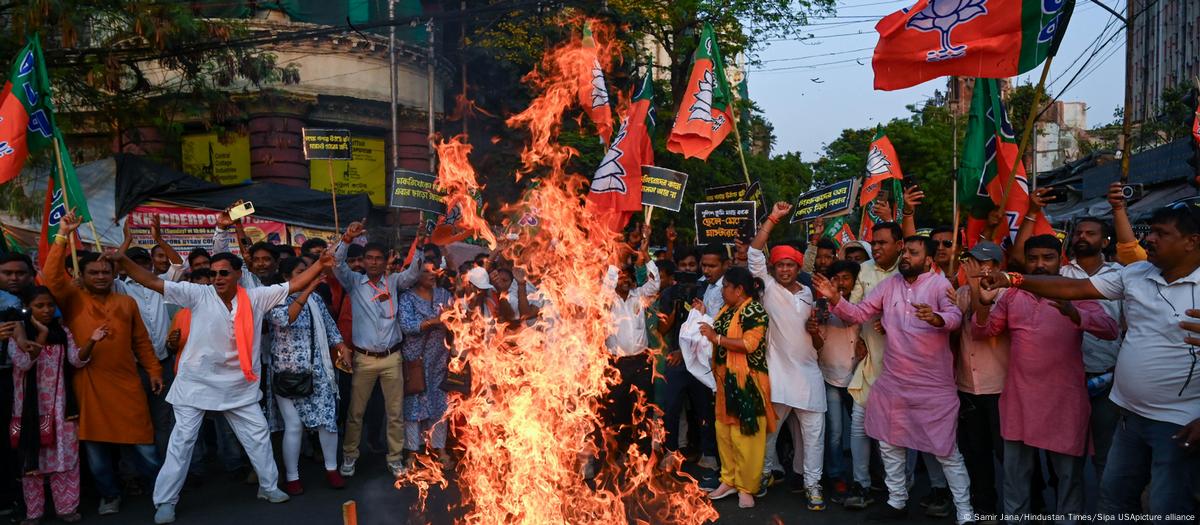
For the first time one year ago in July 2024 the state’s Leader of Opposition, Suvendu Adhikari from a BJP event openly said since Muslims did not vote BJP, the party should not seek their support. Since then he maintains the stance, with many others joining the chorus. The most recent one joining the issue in a suave language has been the newly appointed BJP state president, Samik Bhattacharya. He asked Muslims of West Bengal to look into the mirror and check how they were used as mere vote banks. For the first time in 2025, the political rhetoric in West Bengal is on communal lines—both by BJP and TMC. The ruling Trinamool Congress leader, Mamata Banerjee has been using the language of appeasement since she came to power. So bold is her political concern that she keeps saying that one has to bear a kick or two of the milch cow. Her political arithmetic is simple.
Since the emergence of the BJP, which receives virtually no support from the minority communities, her rhetoric, covert and overt support are directed only towards the minority community. In her election rallies Banerjee made it a point to invoke the “shahada’ by uttering” Laa Ilaahah Illa Allaah Muhammadur Rasool Ullaah (None has the right to be worshipped except Allah and Prophet Mohammed is the only messenger of Allah).” Suvendu’s line of polarising Hindu votes received grassroots support, which was on display in a recent assembly by-election at Kaliganj. The Muslim majority constituency saw more than 70% Hindus coming out in support of BJP candidate. The signs are now clear: BJP has gone all out in consolidating Hindu votes by highlighting Mamata’s policy of Muslim appeasement. This has put Mamata in a catch 22 situation. She needs to prove to the Hindu voters that she is not anti-Hindu, but at the same time she has to maintain an “anti-Hindu” stance to her devoted Muslim voters. Mamata Banerjee, who had said “Religion cannot be the agenda of any government” not only constructed a temple complex of Lord Jagannath in Digha but also distributed “prasad” of the temple to prove that she was not anti-Hindu.
At the same time, not to upset her apple cart of Muslim votes, Mamata was careful in placing order for prasad packets from sweetshops owned by Muslims. The tightrope walk did not pay much dividend in Kaliganj by-election. Battle lines are drawn, the polite Bhadralok likes it or not. Mamata will try all out to appease Muslims and a section of Hindus so that she can win in 2026 Assembly election.
BJP will continue pursuing its successful model of uniting Hindus against TMC rule. Corruption by the Mamata administration and its utter failure of governance are spices to be used in the main dish of Hindu communalism. For the first time in West Bengal politics, Hindu appeasement has come to the fore. Since June 1946 when all Hindu members in the then Assembly voted in favour of creating a separate state for Hindus, West Bengal did not see Hindu polarisation. The 2026 Assembly elections in the state are clearly on communal divide. It remains to be seen how much Hindu consolidation takes place and also how long poor Muslims bear with mere communal rhetoric at the cost of their economic welfare.




