
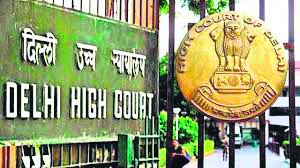
New Delhi: A division bench of the Delhi High Court—comprising Chief Justice D.K. Upadhyaya and Justice Anish Dayal—issued a stay on the scheduled July 11 release of the film “Udaipur Files”.
The stay will remain in place until the Centre decides on petitions seeking the movie’s permanent ban due to concerns that it could “promote disharmony” in society.
The bench directed petitioners to formally approach the central government within two days with their revision pleas.
“We provide that till the application for interim relief, if made by petitioner along with revision petition, is decided by government, release of the film shall remain stayed,” the court held.
Among the petitioners is Maulana Arshad Madani—president of Jamiat Ulama-i-Hind and principal of Darul Uloom Deoband—who, alongside others, asserts that the film’s trailer (released on June 26) contains dialogues and scenes reminiscent of the communal tensions that erupted in 2022. They argue the trailer “carries every potential to again stoke the same communal sentiments.”
Senior advocate Kapil Sibal, representing the petitioners, described the film as “vicious” and condemned it as “cinematic vandalism.” He urged the bench, “Where is this country going? This is not right for the country. Please don’t let this kind of malicious work go in public. This is certainly not art. It’s cinematic vandalism. Saying in national interest, in the interest of the fraternity.”
Sibal further alleged that the producer has a history of “making hateful incitements.”
Additional Solicitor General Chetan Sharma, appearing for the Central Board of Film Certification (CBFC), assured the court that any legally warranted action would be taken once the government reviews the matter. The bench noted that the producer had already re-uploaded the contested portion of the trailer, despite an earlier order to take it down.
The court mandated that, upon receiving the petitioners’ revision applications, the central government must decide within one week—after affording the producer an opportunity to be heard. Petitioners have until Monday to file their revision pleas.
During the hearing, the bench emphasized that certifying films for public release falls under the expertise of the CBFC, cautioning that “any judicial intervention should be very limited.”
The ASG further contended that “Udaipur Files” is a work of fiction, loosely based on real-life events, and falls within the filmmakers’ “limited artistic freedom.” He characterized it as:
“a crime film which actually warns people that your harmony is being disturbed by someone in a foreign country. It is not community specific, it is crime specific. Whole theme is that these seeds of communal disharmony is engineered and propagated across the border by a concerted mechanism.”




