
Come ‘Sawan mas’ and the rains arrive, bringing images of water in various forms— ponds and pools, wells and baolis, flowing or overflowing rivers, and the rituals and festivals linked to the rainy season. Since time immemorial, water bodies have been sources for daily life and an integral part of many rituals in the Bharatiya social, cultural, spiritual, and personal journey of life. The yearly ‘Kavar Yatra’ is the most eagerly awaited event.
From ‘Kuan Poojan’ to the ritual of river water ‘achman’ or bathing in holy rivers is regarded as a great blessing. Rivers, being the most significant sources of water and cradles of our civilisation, have always been the greatest repositories of stored water, thus merging with the traditions associated with them. The Nadi Sukht of the Rigveda mentions some of the most important rivers that shape the sacred geography of Bharat.
The Ganga, Yamuna, and Saraswati rivers hold special significance connected to the Triveni Sangam and in exploring the journey of our ancient civilisation, culture, and Itihasa. Ancient texts vividly recount stories of these rivers, describing their origins and the sacred sites that have grown along their banks over centuries. The Balkand of Ramayana narrates the story of ‘Ganga Avtaran’, and Garg Samhita is among several texts that tell stories about Surya Putri Yamuna or Yami and her brother Yam, the lord of Death.
The Mahabharata, along with many other ancient texts, emphasises the importance of the Saraswati River, as shown through the pilgrimage journey of Balarama, brother of Sri Krishna. Although the Greek term for the science of rivers is Potamology, we examine the factors that have sustained rivers for centuries and consider what prevents Varun Deva from rejuvenating the River Yamuna in Delhi, also known as Indraprastha. Texts mention that Yamuna was navigable for passengers and goods until at least 1948. It is well known that for over 5,000 years, these sacred rivers have been selfsustaining, nourishing, and enriching us spiritually, culturally, and economically. Nature has provided the foundation of our unique ‘Sanatan’ philosophy—the ‘eternal principles of life’.
This philosophical understanding of the universe and its relationship with living beings has offered insights into the concept of ‘Vasudhaiva Kutumbakam’. How many of us realise that this civilisation, spanning many ‘Yugas’, has survived due to the deep ‘cultural connect’ that our sages established between us and rivers, nature at large? This is how the tradition of revering rivers as mothers originated. The key question is – what allowed these sources of civilisation’s wealth to endure for centuries? Nothing other than pure natural science. This includes characteristics such as the Sun, seasons, rainfall, water, terrain, topography, plants, and trees, among others. Yamuna is appropriately referred to in texts as Surya Putri. It originates from the natural water cycle, mainly driven by the Sun. For centuries, four main factors have sustained a river.
These include the river’s original high-velocity ecological flow, the depth and self-cleaning ability of its channel, the river’s breathing space provided by floodplains, seasonal rain replenishment, and supporting water bodies such as small streams, wells, and ponds that maintain underground water levels and nourish the earth. These are further strengthened by green vegetation, including trees and plants specific to each terrain. Healthy E-Flow ensures a river’s self-cleaning process; its voluminous strength is derived from its source. Emanating from Yamotri at the Kalindi mountains in Uttarakhand, Yamuna’s original DNA and ‘blood group’, like those of any other river, give rise to specific flora and fauna unique to each river. Yamuna is identified with ‘Kachhua’. The second component of the natural depth and cleanliness of the river channel acts as a receiving vessel for sources and seasonal rain replenishment.
This facilitates uninterrupted flow and particular silt properties. It is akin to human healthy arteries being responsible for proper blood flow. A key characteristic of water is that it always seeks to find its level when it contacts the ground. It moves via vegetation roots and underground channels. Here, the water bodies, trees, and vegetation play a significant role in balancing the groundwater table, preventing underground depletion from the river’s base. In this context, a diagnosis of Yamuna in Delhi reveals significant deficiencies.
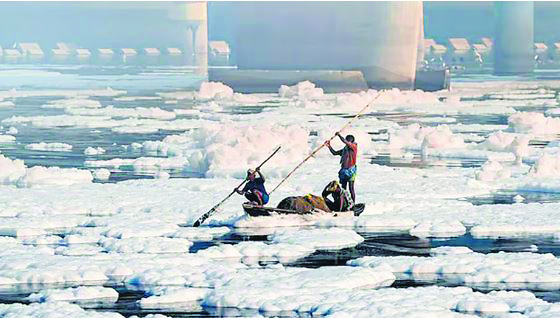
The E Flow is almost non-existent, depriving it of its natural cleansing process. The channel is filled with sewage, chemicals, and plastic waste, with numerous drains and STP discharges that weaken its depth and capacity to hold rainwater. When Varun Deva comes calling, its blessings find no place in the lap of Maa Yamuna, nor in its ‘anchal’ or floodplains, which are usurped by misguided development. The pure drops simply overflow, evaporate, or are lost in the urban jungles. Surprisingly, instead of regular desilting efforts, some officials promote the use of artificial rubber dams to hold water. How healthy is water in rubber dams? How large must a dam be? Will this not obstruct the natural system of a river? The Yamuna at Delhi (Indraprastha) is in a critical state, deprived of water, with its DNA lacking E-flow velocity and capacity to retain rainwater. It requires more focused efforts to revive it, starting with declaring it a Living Being and a National River, diverting STP/ETP water for irrigation, gardening, car washes, factory use, etc., establishing a dedicated Yamuna River Revival Authority (YRRA), and appointing a ‘Sreedharan’ to lead action.
Only then can this sacred Maa Yamuna River transform from a dumping ground for human and chemical waste into the pride of Bharat’s capital. The profound historical and cultural connection between rivers and our philosophy becomes evident when we realise that our ‘sanskriti’ stems from ‘prakriti’, and our ‘adhyatma-linked sanskars’ encompassed our development across all sectors—economic, social, political, and personal. For centuries, prior to the medieval and colonial eras, Bharat was a Vishwaguru in knowledge and economy because it thrived and evolved within the universal principles of nature, known as ‘Sanatan’ or eternal principles that govern the earth. Nonetheless, nearly a thousand years of subjugation by invaders and colonial rulers have left voids and scars in this ‘vivah’ of ‘manushya’ and ‘prakriti’.
Even after gaining independence in 1947, no significant efforts were made to restore and preserve the original course and waters of the sacred Yamuna at the historic Tirath Indraprastha, where the Yamuna flows for a distance of 22 km and spans 48 km within the NCR region. Despite numerous Yamuna action plans and budgets, it was observed that the National Mission for Clean Ganga (NMCG) was limited in its actions due to the constraints of its mandate concerning the rivers.
Neither IIT Delhi nor any other organisation has conducted a scientific study to understand the natural science behind a river’s sustainability and the importance of its original water DNA. As the river here was being transformed into a dump, the complete disconnection of the city’s residents from the cultural, spiritual, and historical value of rivers in Bharatiya civilisation became painfully evident. This is a lamentable situation because our capital city, established on the banks of the river Yamuna over 5000 years ago, is the face of the nation to the world. Incidentally, Indraprastha (the historical name for Delhi) is the world’s oldest surviving capital city, and the Yamuna River is mentioned as the second river in the Nadi Shukt shloka of the Rigveda.
Today, about 48 km, or 2%, of the Yamuna stretch in Delhi is responsible for over 98% of the pollution in the river flowing from this area, affecting even the sacred cities of Vrindavan and Mathura. Why is there such neglect leading to this miserable condition of the holy Yamuna River – the ‘Surya Putri,’ the sister of Yam, the protector from painful death, the bedrock of Sanatan philosophy, Gita Gyan, the lifeline of ancient Tiraths Mathura and Vrindavan, Indraprastha? Each period’s history is closely linked to the great rivers of Bharat, with the Yamuna being particularly significant, as Yogeshwar Sri Krishna begins his life on its banks and later establishes the Dharma Rajya of Indraprastha beside it. Can the Dwapar Itihas of Sri Krishna, along with his intellectual partner, the inspiration for Gita Gyan, Maharani Draupadi, or Dharmaraj Yudhisthira, continue to captivate without Aviral Nirmal Yamuna? The Yamuna River civilisation has played the most significant role in our culture and history since time immemorial. Not only has it nurtured us and our country’s spiritual ethos, but it has also influenced many nations worldwide.
We are all well aware that for centuries, the holy Yamuna River nourished and sustained us. Few are aware that until 1948, the river Yamuna ferried passengers and goods from Calcutta to Delhi. We must restore the pristine glory of the Yamuna. This should be a priority for the government and people of Delhi, and indeed for the people of Bharat. Neera Misra is the Founder Trustee and Chairperson of Draupadi Dream Trust. She is a scholar on ancient history, heritage, art, and culture of Bharata.




