
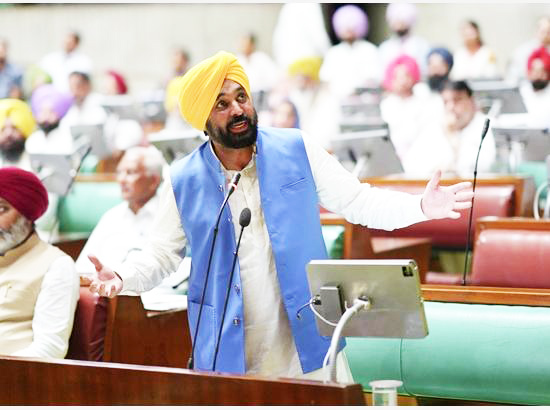
Punjab passes tough anti-sacrilege law amid rising political, religious, and social tensions.
Chandigarh: In a high-stakes political maneuver ahead of the 2027 Assembly polls, the Bhagwant Mann-led Aam Aadmi Party (AAP) government in Punjab has pushed through the Punjab Prevention of Offences Against Holy Scripture(s) Bill, 2025—promising life imprisonment for sacrilege of any religious scripture, establishment of special courts, and parole-ineligible punishment.
While the bill is being projected as a landmark step to curb communal unrest and uphold the sanctity of all religions, the timing and political messaging behind the move reveal AAP’s calculated bid to seize control of a volatile yet emotionally resonant issue in Punjab—with a clear focus on Panthic politics.
The Mann government has also made a conscious effort to appease all faiths by extending the bill’s protections beyond the Sri Guru Granth Sahib. In addition to the Sikh scripture, the bill also criminalizes tearing, burning, defiling, or insulting other sacred texts including the Bhagavad Gita, the Holy Bible, and the Quran Sharif. The move is widely seen as an attempt to signal respect for all religions and reinforce AAP’s secular credentials.
According to the bill, penalties range from a minimum of 10 years to life imprisonment for direct sacrilege and 20 years to life if such acts result in communal violence or casualties. The offence is non-bailable, parole is barred, and parents or guardians are held liable if minors are involved. Even religious functionaries face the harshest punishments if found guilty.
Given how deeply religion is rooted in Punjab’s politics, the law is also being seen as a political weapon by the Mann government to deflect attention from key issues it has failed to address—such as the drug crisis, unemployment, deteriorating law and order, and agrarian distress.
“This bill seems to be a calculated move by the Mann-led AAP government. It will not only help counter the opposition parties like SAD and Congress over past sacrilege issues, but is also seen as an attempt to win over the Panthic vote bank amid the growing popularity of separatist leader and MP Amritpal’s Waris Punjab De,” said Sangrur-based political commentator Advocate Kamal Anand.
AAP leaders are actively promoting the act as a major achievement, arguing that it was necessitated by Punjab’s history with sacrilege—marked by the 2015 Bargari desecration, police firings at Behbal Kalan, and multiple mob lynchings that deeply wounded public sentiment.
While proposing the legislation in the State Assembly, Chief Minister Mann recalled how past regimes—whether the Shiromani Akali Dal (SAD) or Congress—were accused of shielding culprits and stalling justice. By introducing this bill, Mann has positioned his government as the first to legislate decisive, inclusive, and uncompromising action.
“This isn’t just about law—it’s about restoring broken trust,” a senior AAP leader told the media, claiming Mann had delivered what others only promised.
The AAP leadership believes the bill will strike a chord with both devout Sikhs, still haunted by unresolved sacrilege cases, and urban, multi-faith voters who seek communal stability and rule of law. The bill introduces special fast-track courts to ensure swift justice—a response to Punjab’s checkered past where mob violence often replaced due process.
Since 2015, at least 14 people have died in sacrilege-related mob lynchings, many without trial. Incidents such as the lynching inside Amritsar’s Golden Temple in 2021, the Kapurthala killing, and the Singhu border murder have shown how quickly religious outrage can spiral into lawlessness.
Chief Minister Mann has publicly tied the legislation to both moral and political imperatives. Addressing ongoing protests—particularly that of Sikh activist Gurjeet Singh Khalsa, who has been camped atop a 400-foot BSNL tower in Patiala’s Samana since October 2024—Mann clarified that the government won’t allow the death penalty due to its potential for misuse, but insisted the bill’s provisions are strict enough to act as a deterrent.
However, critics argue the bill is more about optics than real reform. Punjab Congress president Amarinder Singh Raja Warring accused Mann of “remembering sacrilege only after three and a half years in power” and just in time for campaign season. Similarly, BJP leader and Delhi minister Manjinder Singh Sirsa dismissed the move as “political theatre,” pointing to the suspension of AAP’s own MLA, Kunwar Vijay Pratap Singh, a strong voice on past sacrilege cases.




