
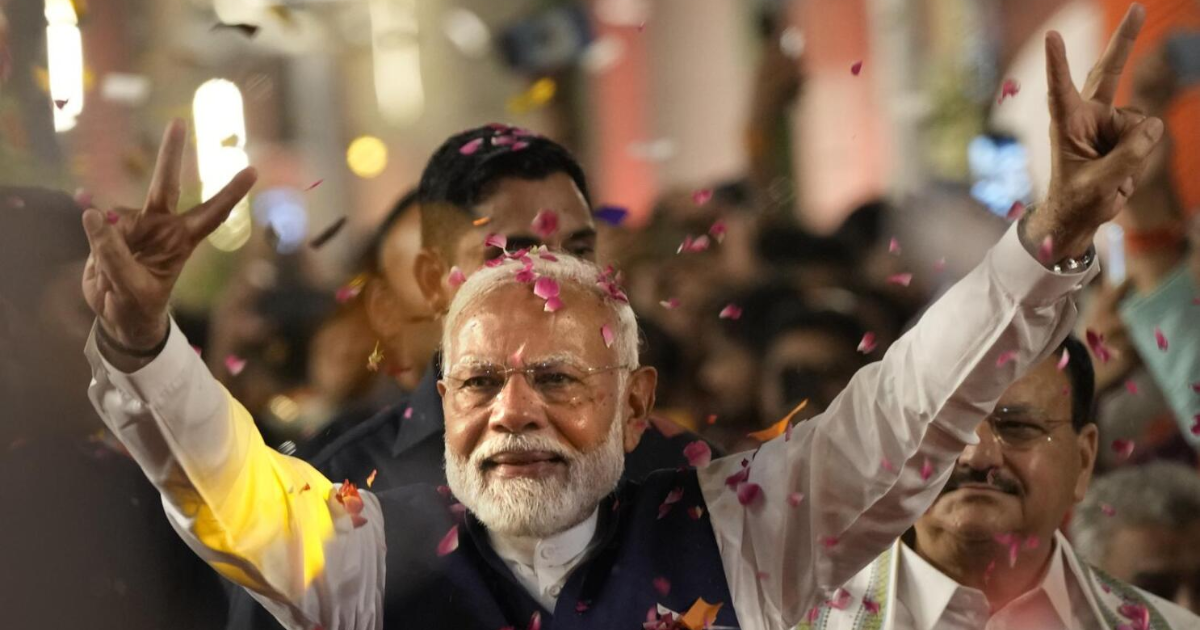
NEW DELHI: Amidst reports and the possibility of the first cabinet reshuffle of the third Narendra Modi government, attention has turned to a quieter story of continuity—10 ministers who have been part of the Modi cabinet since 2014 when the BJP under Prime Minister Narendra Modi first came to power, maintaining an unbroken ministerial tenure across three terms and multiple reshuffles.
These 10—eight from the original cabinet sworn in on 26 May 2014, and two more inducted in the first major reshuffle of November 2014—form the enduring core of Modi’s governance model. While their portfolios have changed, responsibilities expanded, and some have moved from Minister of State to full Cabinet rank, they have continued in office even as over 70 ministers have exited during the same period. It needs to be mentioned that Home Minister Amit Shah is not mentioned on this list because he joined the cabinet later in 2019.
He was BJP president at the time, and is one of the most important pillars of the government. The continuity becomes more significant when placed against the backdrop of the last 11 years of the Modi government. Since May 2014, the Union Council of Ministers has undergone substantial transformation. A total of 70 ministers have been dropped, reflecting the Prime Minister’s readiness to recalibrate his team based on performance, perception, and political necessity.
This count excludes eight ministers who either died in office, exited the cabinet for other assignments, or were dropped before their passing—such as Arun Jaitley, Manohar Parrikar, Anil Madhav Dave, Gopinath Munde, Sushma Swaraj, Ananth Kumar, Ram Vilas Paswan, and Suresh Angadi. Since PM Modi first took office, there have been seven major cabinet swearing-in ceremonies. Three of these followed general election victories—in May 2014, May 2019, and June 2024.
The other four were significant mid-term reshuffles and expansions, held on 9 November 2014, 5 July 2016, 3 September 2017, and 7 July 2021. These reshuffles have been used to realign portfolios, introduce new talent, reward performers, and retire those deemed underwhelming. Through all this reshaping, 10 ministers have remained consistently in office, adapting to shifting administrative priorities and political equations.
Among those who took oath on 26 May 2014 and have continued are Rajnath Singh, Nitin Gadkari, Piyush Goyal, Nirmala Sitharaman, Dharmendra Pradhan, Rao Inderjit Singh, Jitendra Singh, and Kiren Rijiju. They have each handled a succession of critical portfolios over the years—ranging from defence, finance, and education to commerce, internal security, and administrative reform. Rajnath Singh has remained a key figure in the government’s securityrelated ministries, while Nitin Gadkari has overseen infrastructure development through various roles.
Nirmala Sitharaman took charge of the finance ministry in 2019, becoming the first woman to hold the portfolio full-time. Dharmendra Pradhan has moved across different sectors, including petroleum and now education. Jitendra Singh has continued in the Prime Minister’s Office, largely handling personnel and administrative reforms. Kiren Rijiju has been shifted across multiple ministries—ranging from home affairs to sports, law, earth sciences, and currently, parliamentary and minority affairs. Rao Inderjit Singh has retained roles in planning and statistics, keeping a relatively low public profile. The first major cabinet expansion, held on 9 November 2014, brought in Giriraj Singh and Krishan Pal Gurjar. Both have continued in government without interruption since then. Giriraj Singh, who began as MoS for MSMEs, is now a Cabinet Minister for Textiles.
Krishan Pal Gurjar has served across various ministries—including Social Justice, Power, and Heavy Industries—and is currently MoS (Independent Charge) for Cooperation. These 10 ministers have not only weathered the churn that accompanies any long-running administration but have remained relevant through a mix of administrative versatility, political trust, and alignment with the Prime Minister’s core vision. In a system that has cycled through over 70 exits— many of them high-profile or unexpected—this group of 10 represents the deepest layer of continuity within the Modi era




