
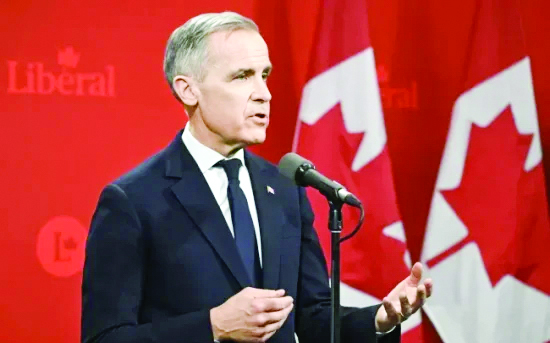
OTTAWA: Last week, I argued that Prime Minister Mark Carney’s tilt toward the IndoPacific could define his leadership legacy. From reviving the stalled CEPA (CanadaIndia Comprehensive Economic partnership) talks with India to strengthening ties with ASEAN (Brunei, Cambodia, Indonesia, Laos, Malaysia, Myanmar, Philippines, Singapore, Thailand, and Vietnam) and Japan, Carney signalled that Canada might finally be ready to diversify trade based on democratic values and not expedient deals. But this week, the story changed. Carney’s Foreign Affairs Minister Anita Anand has not so quietly begun reengaging Beijing, citing economic uncertainty and U.S. trade tensions as justification. And with Donald Trump back in the White House, promising widespread tariffs on Canadian steel, aluminum, and other non-U.S.-made goods, Ottawa appears to be reaching once again for the illusion of China as economic saviour. This is not strategy. This is surrender, masquerading as pragmatism. And it is rooted in the same sunk fallacy cost that has long warped Canada’s approach to authoritarian regimes and current diplomatic engagement.
A Dangerous Pivot
to Nowhere China remains what it has always been: a coercive, authoritarian state that violates human rights, undermines the rules-based international order, and routinely weaponizes trade and diplomacy for political advantage. We are told in every engagement to shut up and put up, but this can no longer be our posture as a Middle-power want to be. Former PM Trudeau and his key advisors from the Eurasia Group also with a firm foot in the China camp had so desperately wanted the climate and DEI agenda to be a cornerstone of that rise in status. But Xi, Modi and Trump rejected these overtures outright as they worked to move their nations forward economically with a mandate to choose exceptionalism over mediocrity, Trade of virtue signalling.
Carney knows this. His government has acknowledged China’s election interference (all be it tepid), hostage diplomacy (The Two Michaels), cyber espionage, and alleged use of transnational criminal proxies in Canada. Yet, his administration now appears ready to normalize relations, citing “stability” in trade and economic diversification. He has pledged a multi billiondollar investment in the Department of Defence so how can the PM be committed to defending our economic, industrial and intellectual capacity including the arctic with this overture to Beijing while working on a deal by the August 1rst to which the Canadian delegation from Ottawa including our Ambassador Christy Hiller has said won’t happen.
But pivoting back to China after knowing who they are and what the represent? Let’s be clear: this is capitulation, not realism. It ignores Beijing’s record — not just in Xinjiang and Tibet, but in global carbon emissions cheating, forced labour exports, fentanyl precursor trafficking, and digital authoritarianism. It disregards the painful lesson of Canada’s decadelong entanglement with Beijing, where good faith was met with manipulation, not cooperation. And worst of all, it betrays the very Indo-Pacific strategy Carney himself championed just weeks ago.
Trump Is No Excuse for a Beijing Bailout
Yes, Trump’s return has upended the global order. His new tariff plans threaten Canada’s access to U.S. markets and challenge the foundations of the USMCA. But turning to China in response is a strategic misfire. America may be volatile under Trump, but it remains a democracy — with courts, public scrutiny, and alliances rooted in shared history. China, by contrast, uses economic engagement as leverage for political control. Canada cannot hedge against a populist president by jumping into the arms of a permanent autocracy. This is a false dichotomy. The real alternative lies in the Indo-Pacific vision Carney himself laid out: India, ASEAN, Japan, and Australia. These are the democratic growth engines of the 21st century and they are not demanding Canada sell its soul in exchange for market access.
From Values-Based Strategy to ValueFree Retreat
Carney’s signature “One Canadian Economy” Act (Bill C-5) was meant to build internal resilience — a frictionless market and infrastructure spine to support foreign diversification. His outreach to India, through both policy and diplomatic symbolism, reinforced that Canada could pursue growth without moral compromise. Yet, by floating re-engagement with the PRC, Carney is undermining his own geopolitical logic. He is risking a regression to the Trudeauera fantasy that we can “constructively engage” with a totalitarian regime while upholding Canadian values. We cannot. If Carney rewards Beijing with renewed dialogue and preferential trade access without demanding verifiable reform, he forfeits his credibility and invites the CCP to re-enter Canadian institutions, campuses, and boardrooms with renewed confidence.
A Moment of Reckoning for Canadian Sovereignty
The current moment is nothing short of a geopolitical stress test and on these three points can Canada truly get the Win necessary for Canadians? Will Canada finally end its entanglement in CCP-led supply chains that compromise our sovereignty? Will Ottawa stand firm on human rights and democratic solidarity, even under economic pressure? Or will Carney’s government fall back into the trap of sunk-cost diplomacy — clinging to old relationships out of fear, greed and political payoffs, not foresight? But what is China angling for? Their list might not be extensive, but it is strategic according to Canadian author, Sinologist and former Beijing diplomat Charles Burton who articulated five key goals of the Chinese side in a conversation last week.
* Access to Canadian critical minerals in the North.
* Removal of foreign influence transparency laws.
* Permission to expand into Arctic shipping lanes.
* Suspension of Taiwan Strait and South China Sea operations.
* Open access to Canadian AI and dual-use tech.
Canada should seize the moral and ethical ground and hold ourself and China to a higher standard. China desperately needs a trade deal with Canada and our negotiators should give up nothing to the PRC and especially the Foreign Influence Registry Act but will the Carney Liberals cave to get a deal, just for false access and to appease the Beijing’s backers here in Canada. A principled foreign and trade policy would condition all future engagement with China on clear, measurable reforms: ending forced labour, decarbonizing honestly, ceasing foreign interference, and adhering to fair trade. Anything less is appeasement.
India Is the Path, Not the Compromise
Carney still has a chance to course correct. Pursuing a full-spectrum strategic partnership with India — anchored in trade, innovation, clean tech, and AI cooperation — offers Canada not just diversification, but democratic alignment. With India, the risk is manageable, and the values are shared. But he must also shed his allegiance to the Laurentian Elite corporations (Brookfield Asset Management) who have Sunk-Costs in China. It is no secret that Brookfield, the CCBC (Canada China Business Council and the Eurasia Group backed his ascendancy to the top political job in the country. These corporate and political elites need to check their egos at the door and do what is right from Canada and for humanity. It is not always about the near-term bottom line. With China, the gains are temporary, and the price is our independence.
The Stakes Could Not Be Higher
We must remember: The Asia-Pacific is not a playground for political optics; it is the arena of 21st-century power. Get it right, and Canada secures prosperity and purpose. Get it wrong, and we become a pawn in a game we lack the will to play. Carney’s next moves will define not only his legacy but Canada’s future posture in a world where trade, security, and values are increasingly indivisible. Let’s not confuse yesterday’s investments with tomorrow’s strategy. Let’s not make fear our foreign policy. Let us choose resilience over retreat — and principle over passivity.
Dean Baxendale is Publisher, CEO of the China Democracy Fund and co-author of the upcoming book, Canada Under Siege.




