
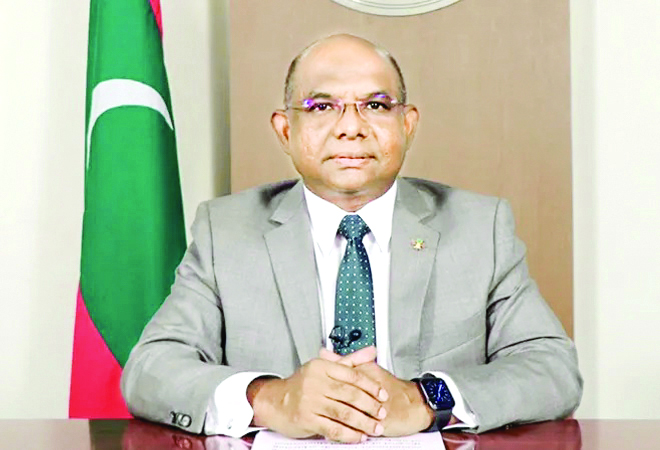
NEW DELHI: Maldives Opposition Leader and former Foreign Minister Abdulla Shahid spoke to News X/The Sunday Guardian. He sharply criticizes President Muizzu’s ‘India Out’ policy. Shahid warned that alienating India, Maldives’ long-standing and dependable partner, could jeopardize national security and regional cooperation. He called for rebuilding ties and restoring diplomatic balance in the Indian Ocean region. Below are the excerpts of the interview:
Q: Mr. Shahid, given your long and influential career at the heart of Maldivian politics, including your recent tenure as foreign minister and your known advocacy for strong Maldives-India ties, there are a lot of critical questions that I would hope for you to address. I want to begin by asking you a tougher question. There was an India Out campaign, which was significant and for many people, a deeply concerning chapter in Maldives-India relations. As someone who has consistently championed friendship with India, how personally challenging was it for you to witness that level of, what we can call, public animosity?
A: Thank you very much indeed. A very historic day here in the Maldives. Welcoming the Prime Minister, Shri Modi Ji, to our shores after the diplomatic lull that we have had because of the unnecessary narrative that the current administration has promoted during the run-up to the elections and during the last two years. It is heartening to see that we are able to hopefully put behind all these hurtful things that have been set behind in the past by the current dispensation here in the Maldives and move forward through during the five years of our government. The current governing party, the then opposition party, created this hateful narrative against our best friend, against our first responder and against a country and a people who have stood with us through thick and thin.
It was hurtful and I kept on reminding the opposition then that we should keep our own domestic issues to ourselves. We should not be using India, our best friend, as a political punching bag for political convenience. Nevertheless, the then opposition, current government, including His Excellency President Moise, did not heed to my pleas. I urged them to use restraint. Today we are seeing that when you are in office, when you have to deal with the issues at hand, when you need a friend at your side, India is always there. And the magnanimity with which Prime Minister Modi and the Indian government had dealt with this government, the government of Maldives, is outstanding. The maturity with which Indian Prime Minister and the diplomats had weathered the last two years is outstanding. I recall fondly how my dear friend, EM Dr. Jaishankar, reacted to some of the media questions regarding the then escalating tension between our two countries.
Dr. Jaishankar said that there are two things that you can’t change in reality. One is history. The history that is behind us, between the excellent relationship between our two countries, it will not be changed. It cannot be changed. And it will only flourish. The other thing that you can’t change are your neighbours. We are here to stay as neighbours and we will have to learn to live. And today we are witnessing in Maldives the reality of that, the gravity of that. We have to live together. And we have to look at history and we have to appreciate with gratitude how India has always been the first responder. Be it 1988, the mercenary attack, the terrorist attack in the Maldives, be it the 2004 Tsunami, be it the 2017 Malé water crisis, or be it the most recent, the COVID-19 Pandemic. India was the first responder. India was the most generous partner. And these are just some of the instances where we have seen how generous India has been.
Q: Mr. Shahid, I have to understand from you, Prime Minister Modi’s visit, as you also just said, is being hailed as a quote-unquote reset. Now, while symbolism is important, what tangible, concrete commitments or breakthroughs can truly be achieved behind closed doors that can assure India that Maldives is now firmly committed to its, or rather to one of its India First policy?
A: Well, today the symbolism is very important. And for Maldivian general public, we are trying to understand how Moise has made a U-turn, a complete U-turn. Maldivians remember him standing at the Republican Square when he took office and addressed the Maldivian national flag there that we will not be, our sovereignty cannot be violated. He started referring to India, ran up to the elections, accusing India that you have over 2,000 Indian military personnel in the Maldives, accusing that the UTF postcard harbour is being built as an Indian naval base. All these, and after taking office, returning from the state visit to China, coming back to Maldives and referring to India, saying that we may be small but you can’t bully us.
All these narratives that have been pushed here in the Maldives, the people remember that. The people are trying to come to terms how Dr Moise has made a U-turn. But people are also today asking, is he going to keep to his word? Because here in Maldives today, President Moise is seen as a person who pledges and who does not honour his commitments. But deep, deep inside my heart, I really hope that President Moise is not taking all of us on a ride, that he will honour his commitments, that he is not only putting this for a show, but that he believes in the fundamentals of the relationship that exists between the peoples of our two great countries.
Q: I also have to ask you then, Mr. Shahid, there must be certain circumstances within Maldives that allowed the current establishment, political establishment and administration, to may be capitalise on and therefore push the ‘India Out’ campaign. Keeping that in mind, I want to understand from you, there is significant developmental footprint that India has in the Maldives, including major infrastructure projects. How does the Maldives then want to ensure that these projects serve long-term national interests without creating any undue dependency that could in the future lead to the sort of rhetoric that we’ve seen or the sort of narrative we’ve seen in the past two years? Well, thank you.
A: It’s a narrative that has been developed to create hate. It is how you present and how the entire issue is put on perspective. We are celebrating 60 years of independence tomorrow, but tomorrow also we are celebrating 60 years of diplomatic relations with India. During the last 60 years, one of the major areas where we have benefited from India is not infrastructure projects, it is human resource development. We have every walk of life you see in the Maldives. We have thousands of people who have benefited from Indian institutions, Indian generosity on human resource development. Even during the last five years of our government, if we take it just for example, we had close to 5,000 Maldivians who had got short and long-term training. We have military personnel, we have police personnel, we have intelligence personnel who have benefited from your great institutions.
We have doctors, nurses, teachers, just name it, we have benefited. So yes, there are great infrastructure projects ongoing, but the backbone of the development assistance for the Maldives from India and one that has not been celebrated enough is the human resource development. When we look at the infrastructure projects today, two of them are going to be inaugurated, two projects that were begun during our time in office, the Ministry of Defence building just next to the President’s Secretariat. We are also going to witness the inauguration of the Hanimaadhoo International Airport, which is our international airport. It will be built in the north, which will connect all South Indian major cities to Maldives within one hour.
The ongoing Greater Maldives Connectivity Project, which was started during our time in office, with the great assistance and generosity of the Indian government, 65% of the work is already done. It is the largest infrastructure project that has ever been undertaken in the Maldives. We have the Addu Airport project, we have over 60 islands, we have the water and sanitation projects ongoing, and the majority of them are already completed. So, there are multidimensional development projects that are undergoing. If we want to accuse a good partner, a generous partner for assisting us, then yes, the current dispensation here in the Maldives and present in Maldives did succeed in making that narrative a success.
Q: But Mr. Shah, talking about resets, there are concerns regarding the Maldives’ substantial debt to China. How do you view this debt and the possibility of critical national assets becoming collateral damage, as we’ve seen in the case of Sri Lanka?
A: Yes, our debt situation is serious. We need to cut down on unnecessary political expenditures and focus on development work. I met the former Sri Lankan finance minister and foreign minister during the unfortunate incidents in Sri Lanka. He told me, he said, Minister, do you understand what is going on in Sri Lanka? I said, tell me, he said, if you are given a credit card and you go shopping, one day the bank will come asking for the money, and that is what is happening. And our government here in the Maldives will also have to understand that we are going shopping around with a credit card. And there will be a point in time when the bank will come and knock on your door.
Q: Mr. Shah, I also then want to understand from your perspective, so the Maldives is strategically located in the Indian Ocean. The current government, as I’ve just mentioned, has deepened ties with other nations, notably China. How does the Maldives then intend to balance the diverse relationships without inadvertently becoming a pawn in a larger power play that we do see taking place in the Indian Ocean region?
A: Well, the strategic location of the Maldives can never be overstated. We are here to stay and we have been given the honourable role of being the gatekeeper or the keeper of the Indian Ocean. We are regarded as the heart of the Indian Ocean. And for us, for the heart to function well, we need peace, stability and prosperity. And for the Maldives to be peaceful, for the Maldives to be stable, for the Maldives to be prosperous, we need the Indian Ocean to be prosperous; we need the Indian Ocean to be stable and peaceful. And that can only be achieved if the literal states of the Indian Ocean work together. And that is why when we were in government; we had such an outstanding relationship with India and our neighbours, making sure that we do not need foreign conflicts to be brought into our great Indian Ocean. For us, for the Maldives, it is important that we make sure we work together with our friends in the Indian Ocean to make it peaceful. Let us not make Indian Ocean be a playground for foreign conflicts.
Q: Mr Abdulla, before I let you go, I want to understand from you another important aspect. The recent tensions did impact people-to-people ties, particularly Indian tourism. What specific steps should the Maldivian government take in order to genuinely rebuild that trust and confidence amongst Indian tourists? So what would be your message to Indians who are watching this conversation? Well, Maldives is blessed.
A: We are just one hour from the world’s fifth largest economy. An economy which has reached close to four trillion US dollars. Its GDP is close to four trillion US dollars. An outstanding middle class is there in India, and a population which loves to travel. And here in the Maldives, we have the best beaches in the world, best underwater scenery, and the best environment you could ever dream of. And it was most unfortunate that three junior ministers went on that narrative and tried to attack not only the Indian leadership, but Shri Modi ji himself. And these are chapters we need to close, and we need to focus to the future. Why we built Hanimaadhoo International Airport in the north is to attract Indian tourists. We recall with great appreciation how India provided us with a bubble travel arrangement during the COVID-19 pandemic.
There was a point in time we had more Bollywood stars in Maldives than in Bollywood during the COVID-19 pandemic. That is how excellent our tourism industry was benefiting from the Indian travellers. My appeal to Indian travellers today, please come. We welcome you. Our shores are open for you. And let us hope that the Prime Minister’s visit resets the entire relationship between us and that we are able to actually close that chapter and move ahead.




