
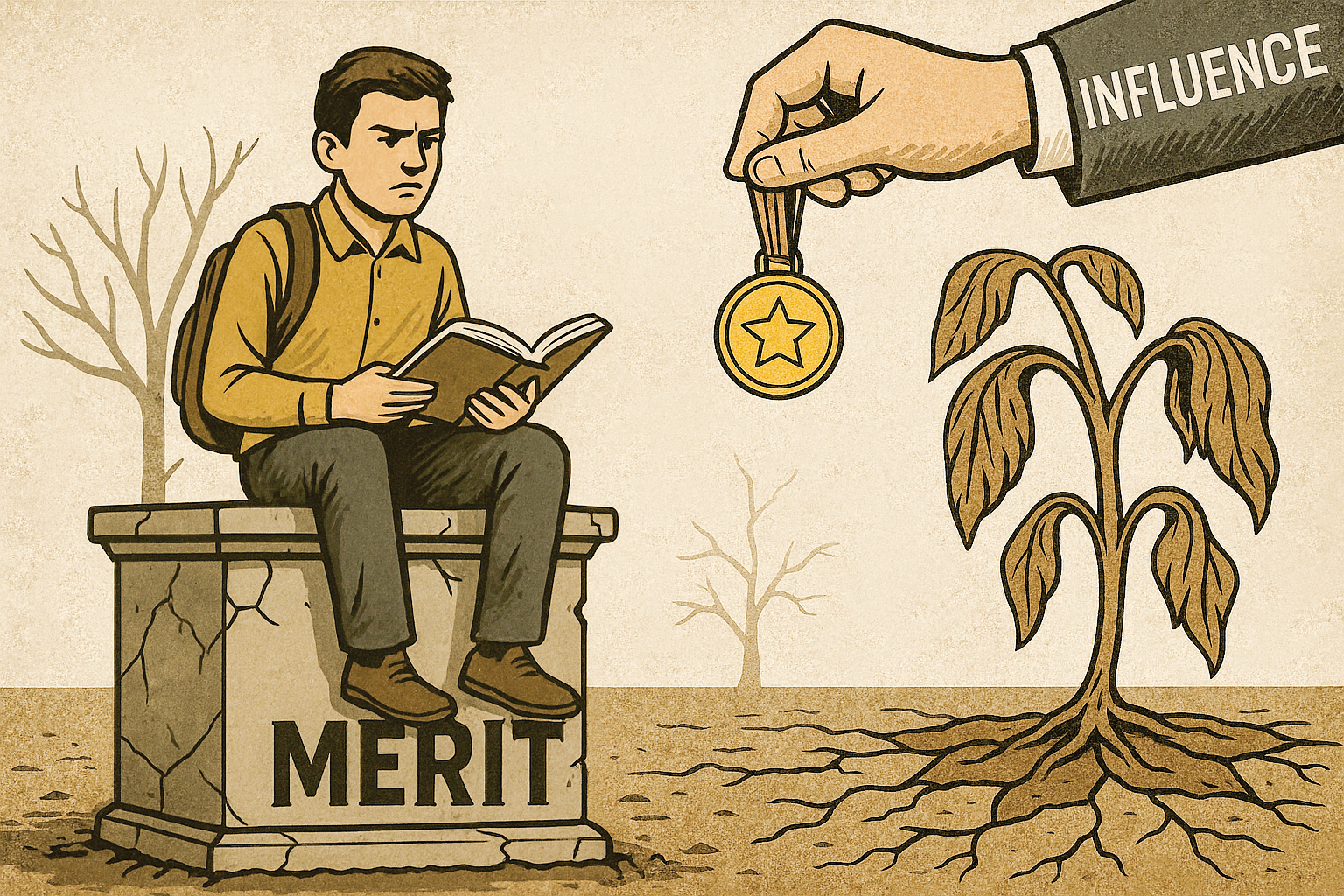
Across the country, in the hope of a better future, millions of students spend their formative years preparing for competitive exams. In their single-minded pursuit, they bury themselves in books as friendships fade, hobbies are set aside, and festivals pass unnoticed. This discipline rests on a simple belief: that sincere effort will be recognized and rewarded through a fair system. But what happens when that expectation is betrayed? When the student who trusted the rulebook discovers that the rules bend for a chosen few?
Despite years of preparation, many students are seen facing technical or logistical issues at exam centers that undermine their performance. Sometimes their admit card is faulty, or their biometric attendance fails, or their exam center is hundreds of kilometers away. In some cases, they later discover that the paper was leaked and that selection was manipulated in favour of less deserving candidates, through unfair means or powerful connections.
Such incidents spark public outrage and lead to calls for tighter regulations and corruption probes, but the foundation of these repeated failures remains untouched. The real crisis, after all, runs deeper than administrative shortcomings. It is cultural and systemic; it is a steady corrosion of our respect for knowledge and fairness.
When Merit Crumbles, So Does Character
When the honest are left behind and the dishonest rise through deceit, a quiet disillusionment begins to take hold. Students no longer see sincerity as strength; they begin to view it as naive. Putting in effort starts to feel like the wrong strategy, and integrity appears not only unrewarded but actively disadvantageous. Their inner locus of control breaks. As this belief takes root, its effects go beyond the individual. It begins to shape how an entire generation aspires and participates in the making of the nation. They study not to learn but to survive the system. A person who used to believe, “My future is in my hands,” starts thinking, “It all depends on luck or the right connections.” The centre of gravity shifts from effort to influence.
In such a scenario, knowledge loses its respect. Opportunities come to be seen not as rewards for discipline, but as outcomes of networking and allegiance to the influential. In this environment, sycophancy, once recognised as a weakness, is rebranded as a tactic for getting ahead. What should have been shame becomes strategy. The mindset that success belongs to those who can play the system is reinforced by an entire ecosystem. Many coaching centres no longer promote education as a process of inquiry or growth. Instead, they openly promise success via shortcuts and tricks and the memorising of previous exam patterns. Over time, this approach seeps into the student’s psyche, shaping how they define their future goals. The message is clear: learn the pattern, not the principle; crack the code, not the question.
The Ripple Effects of a Corrupt System
When an unjust system becomes the norm, the goal gradually shifts from genuine learning to the singular aim of securing higher scores. Learning is reduced to anticipating what will appear on the test, and the desire to grow intellectually is replaced by the urgency to clear exams by any means available, including cheating. And a field where cheating is admired will sooner or later be harvested by cheats. Gradually, the disillusioned stop trying to fit in. They start thinking: If the system won’t reward me, I’ll beat the system. Why play fair when fairness doesn’t work? They come to believe that power must be seized, whatever the means.
Over time, they begin to imitate the very forces that once oppressed them. When given even a little power, they replicate the same injustice that wounded them. The victim becomes the oppressor, and justice is no longer the goal. And a system that runs on resentment cannot nourish a nation. Resentment builds empires of retaliation, not institutions of trust.
The Security Obsessed Mind
When merit is consistently pushed aside, a quiet sense of helplessness begins to grow. Over time, this feeling hardens into a fatalistic mindset. Life starts to feel beyond control, and the individual becomes a lifelong seeker of security. Many begin to seek out jobs with the sole aim of financial security—those that promise steady pay and long-term benefits, irrespective of the quality of work. In their search for security, many also turn toward superstitions such as astrology and palmistry.
Death of Curiosity and Innovation
As fear of inadequacy grows, the mind becomes cautious and defensive, driven less by curiosity and more by the need to avoid failure. Students stop engaging with unfamiliar questions or exploring new ideas. The system rewards accuracy and repetition over independent thinking or innovation. In this setting, genuine progress becomes impossible. Scientists, artists, and reformers do not emerge from minds trained to avoid uncertainty. Innovation depends on the freedom to explore, to fail, and to begin again. But a mind shaped by fear seeks only protection and gradually loses the ability to create anything meaningful.
When the Nation Loses Its Brightest
A nation does not fall only to war. It crumbles when its own people begin to lose trust in it. When the youth no longer believe that merit leads to opportunity, they begin to lose faith in the very idea of a nation. The social contract is not printed on paper; it lives in the heart. When that heart withdraws, the contract collapses. The country no longer feels like home, but like a distant authority that enforces rules, collects taxes, and breaks its promises. Patriotism does not fade because people become selfish. It fades when they feel abandoned. Why remain loyal to a system that never stood by you?
This is why India’s brightest minds are quietly drifting away, while many who remain lower their ambitions to mere survival. What could have become scientific breakthroughs or social reform is reduced to routine work and silent resignation. When a deserving student is denied their chance, the nation loses more than a mind—it loses the future that mind might have helped create. Each lost researcher, teacher, or builder is not a statistic; it is a story unwritten.
The Need for Cultural Revival
Every leaked paper, every corrupted selection, is not just an administrative failure. It is a message to the young: your effort is irrelevant. It is not enough to ask the youth to stay honest. We must also create a system where honesty leads somewhere. A student cannot be told to hold his ground when the ground itself has been removed. The youth are carrying the weight of the nation’s future.
To betray them is to betray the country itself. When someone secures a position through power rather than ability, and society still celebrates them, what are we teaching the next generation? The consequences are already unfolding—in rising cynicism, widespread disillusionment, and the growing exodus of talent. A culture that decorates influence over integrity soon finds itself exporting talent and importing despair. A just society does not promise equal outcomes. But it must promise equal ground.
That’s what builds a healthy nation. Equality before opportunity is not charity; it is the basic hygiene of a civilisation. The Bhagavad Gita tells us: You have the right to action, not to its fruits. But this principle is meant for a mind that has already seen justice. Before we ask young people to rise above the desire for reward, we must ensure they live in a world where reward follows merit. Detachment from results is not an alibi for society to abandon fairness. Without that, we are not asking the youth to grow; we are asking them to surrender to falsehood. If we truly want to build a just society, we must begin by asking what we have been unwilling to face: Why do we continue to preach the importance of hard work, while openly rewarding those who bypass merit through influence and manipulation?
The contradiction is visible to the child. It will shape him more than any textbook. Yes, the system must be reformed. Examination boards need accountability. Oversight must be tightened. Those who abuse their power must be held responsible. But these are only the first steps. The house may need policing, but it also needs a foundation. Without returning to the core values that sustain merit—truthfulness, perseverance, and intellect—every fix will remain cosmetic. And without that revival, each step forward will only take us deeper into the dark. Reform is the gate; merit is the road. Without the road, the gate opens to nowhere. Acharya Prashant, a philosopher and teacher of global wisdom literature, is the founder of the PrashantAdvait Foundation.
A bestselling author who brings timeless wisdom to urgent modern questions, he has been recognised for his contributions to thought and ethics—with honours from PETA (‘Most Influential Vegan’), the Green Society of India (‘Environmental Leadership’), and the IIT Delhi Alumni Association (‘National Development’).




