
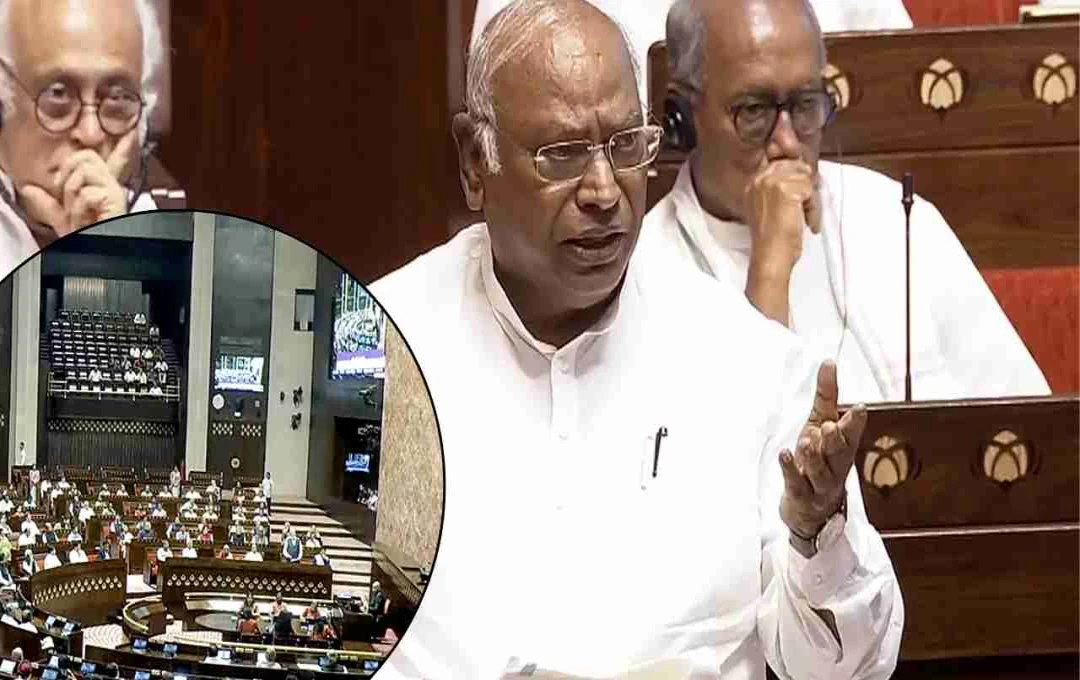
New Delhi: In the Rajya Sabha, senior Congress leader Mallikarjun Kharge condemned the deployment of Central Industrial Security Force (CISF) personnel inside the House’s well as “highly objectionable.” From August 2–5, the Opposition staged continuous protests over the issue, disrupting the Monsoon Session for several days.
Deputy Chairman Harivansh clarified that the deployment was not ordered by the government but was part of the Secretariat’s security arrangements. “The Rajya Sabha is not run by the Ministry of Home Affairs or any external agency,” he said, emphasizing that security personnel have long been a part of Parliament’s internal security system and that the move aimed to preserve the dignity of the House.
Union Parliamentary Affairs Minister Kiren Rijiju supported the deployment, stating the decision was taken by the Chairman to ensure smooth proceedings. He dismissed Opposition objections as “misleading statements based on false facts.” Rijiju highlighted that after the December 13, 2022 breach in the Lok Sabha, overall security of Parliament had been entrusted to CISF, whose role was expanded from May 2024 to include internal areas as well.
The controversy evoked memories of past parliamentary conflicts involving marshals. Notably, during the 1970s, socialist leader Raj Narain was repeatedly removed by marshals on orders of the Chair due to disruptive conduct. As a journalist covering Parliament since 1971, the author recalls these incidents which underscored the tension between protest and parliamentary decorum.
Marshals in both Houses are deployed only in exceptional situations threatening the dignity, security, or conduct of proceedings. Historical precedents include the 1989 Lok Sabha uproar over the Bofors scandal and the 2010 Rajya Sabha protests during the Women’s Reservation Bill debate, which led to rare removals of MPs.
Marshals maintain order and discipline, removing members only upon the Chair’s orders, typically after warnings. Persistent defiance can result in suspension under respective rules of the Houses. The 2021 protests by Congress and others, marked by extreme disruptions and clashes with marshals, demonstrated the delicate balance between protest rights and parliamentary order.
The government’s transfer of Parliament’s security to the CISF has modernized both technological and organizational aspects, strengthening response capabilities to threats. This reform followed the December 2022 breach—on the 21st anniversary of the 2001 Parliament attack—when protesters inside and outside Parliament raised smoke devices, exposing serious security gaps.
Some editors and experts argue for clearer distinctions between external security forces and internal order-keeping personnel, suggesting internal security staff should avoid police-like uniforms and heavy armaments to maintain the decorum of the Chamber.
Ultimately, it is hoped that parliamentary rules will be respected, and future sessions will feature robust debates, protests, and walkouts—but no confrontations that disrupt the democratic process.




