
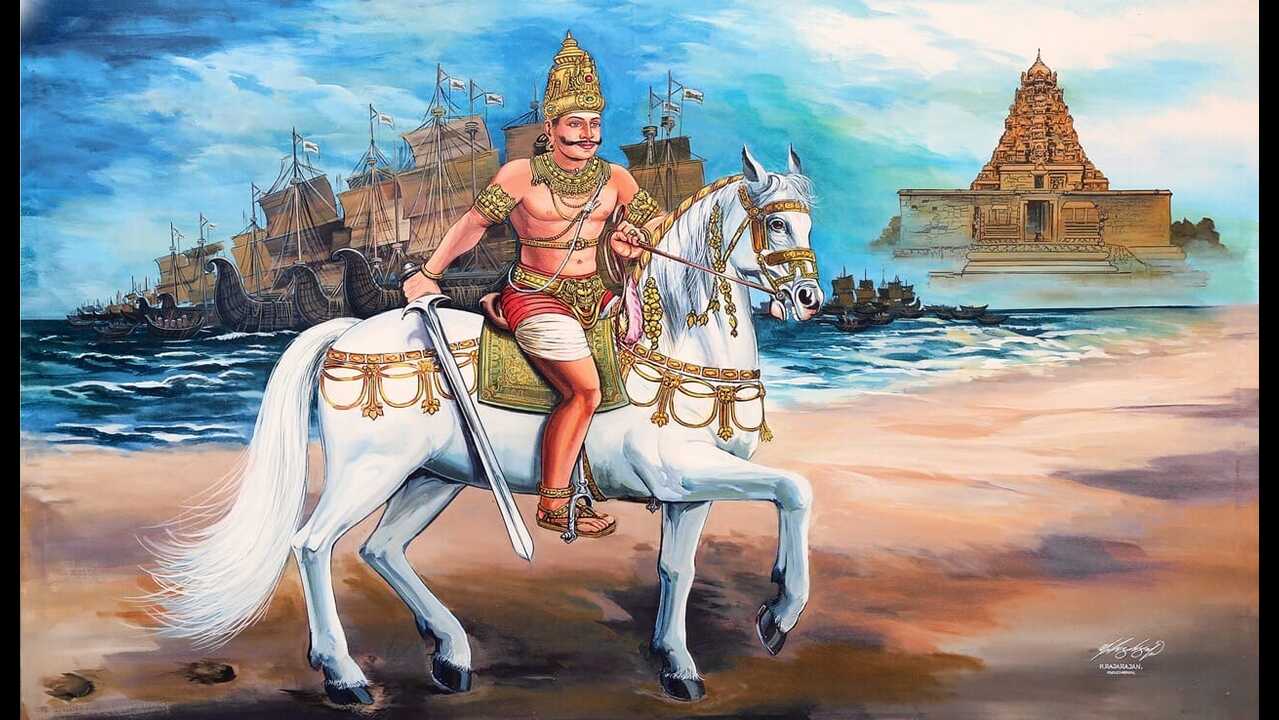
One thousand years ago, an Indian ruler carried out what was arguably the most audacious naval campaign ever launched from the Indian subcontinent. Rajendra Chola I, heir to the mighty Chola dynasty, went beyond his predecessors’ objective of defending coastlines to projecting the power across the seas. His expeditions allowed the extension of the Indian influence as far as modernday Indonesia, Malaysia, and Thailand, challenging the naval might of the Srivijaya empire and establishing robust trade links with the Song dynasty in China. Prime Minister Narendra Modi, our tallest leader, has celebrated this civilisational heritage of the world’s largest democracy recently by his visit to Gangaikondai Cholapuram, the capital of the legendary king Rajendra Chola, reminding Bharat of its maritime glory.
His vision and mission is to connect all Indians to our historical roots and unite us in this memory of our glory thereby building our national memory and connect traditions with modernity, realm with region and continuity with change, trade with commerce for Viksit Bharat. And yet, this epic chapter of maritime accomplishments in our civilizational story has remained buried under layers of colonial amnesia and wilful neglect post-Independence.
While textbooks found ample space for Mughal rulers and even their trivial routines, the legend of India’s maritime accomplishments and statecraft had been left idle as if to be forgotten. Today, as the position of the Indian Ocean as a geostrategic lens of Indo-Pacific power competition and the enhanced importance of maritime trade routes regain strategic salience, Bharat celebrates and remembers the 1,000-year anniversary of Rajendra Chola’s naval triumph as a historical milestone. However, it must be treated as far more crucial than this, as this presents an opportunity for us to reclaim and rearticulate India’s maritime identity by building on the Cholas’ accomplishments and strategic foresight.
CHOLAS AND RISE OF INDIA’S FIRST BLUE-WATER NAVY
The Chola dynasty, at its zenith under Rajendra Chola I, represented a unique fusion of land-based administration and seaborne ambition. When studied closely, his naval expeditions were meticulously planned operations, spanning from the Bay of Bengal to reaching deep into Southeast Asia. These missions were not acts of plunder as Left historians would like everyone to believe. Instead, they were deliberate efforts at controlling and expanding trade, preserving and extending political prestige, and projecting Indian culture beyond the mainland.
The colonial mindset was not and has not been part of any calculation by Indian rulers. If we look at it in modern parlance, it was soft power projection backed by hard maritime capability. This sets it apart from other expeditions like those carried out by the British, French, Spanish, and Portuguese expeditions from the 13th century onwards. In such a sense, the Cholas under Rajendra gave us the indigenous maritime vision that co-opted rather than dominated. Before Vasco da Gama or the East India Company arrived at our shores, the Cholas had worked out the diplomacy and trade through the seas far beyond the mainland.
The Chola rule illustrated that a blend of well-organised and battle-hardened naval command can work with a “good governance model” by deeply integrating coastal administration, port infrastructure, and trade guilds with a larger naval strategy. Indian temple inscriptions and copper-plate grants detail the existence of maritime corporations (such as the Ayyavole and Manigramam) that coordinated commerce and maintained linkages with Southeast Asian polities. Perhaps most significantly, Rajendra’s expeditions helped disseminate Indian art, architecture, religion, and language far beyond the subcontinent, contributing to what today is understood as the affinity of culture with Southeast Asia.
Monumental temples, Sanskrit inscriptions, and Hindu-Buddhist statecraft from Thailand to Java bear the unmistakable stamp of Indian influence, effectively making the ocean separating these territories act as a bridge.
POSTCOLONIAL NEGLECT AND A CIVILIZATIONAL COMEBACK
Despite such civilizational and practical policy accomplishments, the story of Rajendra Chola’s maritime campaigns was systematically overlooked in the post1947 national narrative. Colonial historiography had voluntarily isolated the Indian states and their history as pre-modern. Thus, the Indian civilization was effectively reduced to a landlocked history. And instead of correcting such distortions, many of which were colonial contributions, newly independent India often confined strategic thinking to borders and buffer states, neglecting the oceans that had once been sites of Indian initiative and outreach.
The result was a strategic myopia that was wilful and aimed at reducing the maritime history to colonial shipping marvels. Rajendra Chola rarely featured in naval discourse. Similarly, Indian coastal connectivity and transmission of culture struggled to find space in policymaking or foreign policy discourse. Even the naval anniversaries and curriculum mentioned the formidable sea power that emerged from the Tamil coast a millennium ago on an occasional basis.
Whether such a travesty was wilful or ignorant is hard to tell. Yet, there is now a cause for finding delight in the fact that this erasure is now gradually being reversed. In recent years, there has been a national awakening to the depth and dynamism of India’s indigenous strategic traditions. Prime Minister Narendra Modi’s consistent references to civilizational heritage, from invoking the legacy of Lachit Borphukan in riverine warfare to restoring the Indian Navy’s emblem in 2022 to reflect Chhatrapati Shivaji Maharaj’s royal seal, signal a conscious revival of Indian Knowledge Systems (IKS) in the domain of defence and security. In this larger intellectual and political shift, the Chola naval legacy serves as a foundational pillar. It challenges the deeply entrenched notion that maritime strategy and global influence were alien to the Indian experience. In truth, they were embedded in our civilizational DNA.
RELEARNING THE SEA
As India aspires to be a leading Indo-Pacific power, revisiting the Chola experience offers more than nostalgia. Instead, it provides a blueprint. First, it teaches us that maritime power must be multidimensional. The Chola fleet was not merely a military instrument. It facilitated trade, diplomacy, religious contact, and cultural flows. Similarly, India’s modern naval strategy must go beyond deterrence and incorporate humanitarian missions, sea-lane security, regional outreach, and disaster response. Second, we must invest in maritime literacy, not just naval hardware. For far too long, the sea has been absent from the Indian mind.
Academic institutions must become engines of marine research, innovation, and policy insight. As a premier national institution, the JNU intends to contribute to this endeavour with its Project Trident “Trishul.” The project seeks to develop three key specialized centres focused on maritime security and strategic studies, bearing the names of legendary naval thinkers and strategists: Chhatrapati Shivaji Maharaj Centre for Security & Strategic Studies (CSMCS&SS), Raja Rajendra Centre for Maritime Studies (RCMS), and Lachit Barphukan Special Centre for the Study of Hydrostrategic Architecture in Asia (LBSCSHAA). These institutions aim to build a robust ecosystem of scholars, strategists, and seafarers who understand India’s oceanic responsibilities and opportunities, not merely in tactical terms, but civilizational ones.
Third, we must see the Indian Ocean not as a periphery, but as a centrepiece of Indian grand strategy. From Africa’s eastern coast to the Straits of Malacca, the ocean connects us with friends, partners, and potential theatres of influence. India must reclaim its status as a “civilizational seapower,” deeply rooted in its history and confident in its outward orientation. The lessons of Rajendra Chola go beyond mere conquest. They embody an ethos of connectivity, trade-driven diplomacy, and strategic depth. His campaigns remind us that Indian strategy, at its finest, was outward-facing, culturally rich, and economically astute.
FROM MEMORY TO MARITIME DESTINY
Celebrating 1,000 years of Rajendra Chola’s naval expeditions is about commemorating the past, confronting our historical silences, and correcting our strategic vision. It is about acknowledging that the Indian Ocean is not just a geographic expression. It is a space of civilizational engagement and maritime possibility. Today’s Indian Navy sails in complex waters, from piracy in the Arabian Sea to strategic contestation in the South China Sea. Yet, its roots run deep.
They remained anchored in a time when Indian ships sailed to distant shores with confidence, purpose, and power. The new emblem of the Indian Navy, inspired by Shivaji’s royal seal, and the growing recognition of India’s maritime heritage in national discourse signal a profound civilizational reclamation. As we mark this millennium, the figure of Rajendra Chola must return, not merely as a king of the past, but as a strategist for the future. His voyages to far lands were not anomalies but manifestations of a vision. His legacy and vision, like those of many who came before and after him, stand relevant for us today to honour, to learn, and to implement.
Prof Santishree Dhulipudi Pandit is the Vice Chancellor of JNU.




