
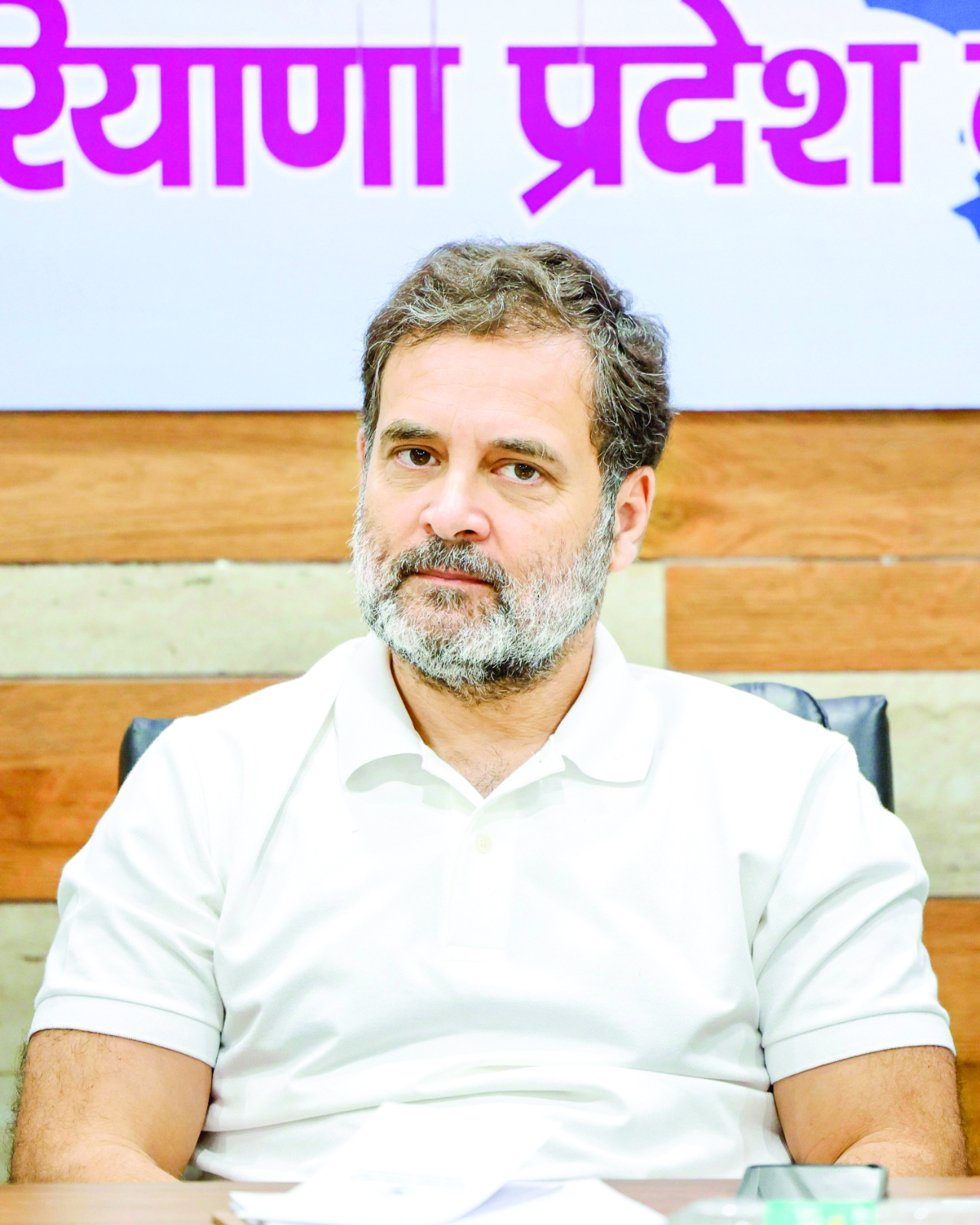
NEW DELHI: For nearly a decade, the Congress has attacked the Election Commission of India (ECI), electronic voting machines (EVMs), and voter rolls as compromised— yet has also notched significant electoral victories through the same system. That contradiction, which has raised questions within the party, was on display again this month.
On 7 August, Congress leader, Member of Parliament, and Leader of Opposition in the Lok Sabha, Rahul Gandhi held a highprofile press conference in New Delhi, accusing the ECI and EVMs of enabling “vote theft” and widespread irregularities. Days later, on 11 August, he led a protest march in the national capital after meeting Opposition MPs to forge a united front demanding greater transparency in India’s electoral process.
The allegations coincide with the party’s firm opposition to the Special Intensive Revision (SIR) exercise being undertaken by the ECI in Bihar. They mark the latest chapter in Congress’ long-running criticism of India’s electoral machinery, which it has voiced even when it has secured major wins. Over the past ten years, Congress has won key state elections in Punjab (2017), Madhya Pradesh, Chhattisgarh and Rajasthan (2018), Himachal Pradesh (2022), and Karnataka (2023). It has also increased its Lok Sabha seat tally from 44 in 2014 to 52 in 2019 and 99 in 2024.
An analysis of the party’s stand against the Election Commission, the electoral rolls, and the EVMs traces it back to the 2014 Lok Sabha elections, when the BJP’s landslide victory reduced the Congress to a historic low. Initially, Congress’ concerns about electoral fairness were muted. But by 2017, as the BJP dominated states like Uttar Pradesh and Gujarat, party lead ers began openly questioning EVM reliability, citing potential hacking risks and technical glitches.
The intensity of these claims often fluctuated with electoral outcomes: in Punjab’s 2017 victory, Congress raised few objections, but in Karnataka’s 2018 assembly polls, it alleged ECI bias and EVM tampering before the votes were even counted. In late 2018, during the Assembly elections in Madhya Pradesh, Chhattisgarh, and Rajasthan, Congress sharpened its attacks. In Madhya Pradesh, thenChief Minister Kamal Nath petitioned the Supreme Court, alleging improper voter roll deletions and lax EVM security. Yet, Congress formed governments in all three states—underscoring the curious alignment of criticism and success.
The 2019 Lok Sabha polls saw Congress’ seat count rise modestly, yet the party persisted in demanding a return to paper ballots, accusing the ECI of leniency towards alleged BJP campaign violations. Similar concerns surfaced in state elections in Maharashtra, Haryana, and Jharkhand, where Congress flagged alleged EVM malfunctions and partisan election officials while participating in coalition governments. Between 2020 and 2023, this pattern continued in elections in Delhi, Assam, Goa, Uttarakhand, Himachal Pradesh, and Karnataka. Notably, Congress’ victories in Himachal Pradesh (2022) and Karnataka (2023) temporarily silenced its criticisms, suggesting a link between electoral success and the volume of its complaints.
The criticism returned with greater force after the party’s loss in the November 2024 Maharashtra Assembly polls, which followed the I.N.D.I.A bloc’s poor performance in the Lok Sabha elections—an issue Congress still raises in various forums. Apart from the party’s tendency to scale down criticism when it wins, another question—raised even within party circles— is why Congress is not approaching the Supreme Court to resolve the issue once and for all, rather than repeatedly criticising the entire polling machinery.
Prolonged attacks, they warn, could plant the idea in voters’ minds that their ballots are being manipulated. Over time, this could lower turnout or lead to results being rejected on the ground, and may also affect India’s image abroad on the legitimacy of the electoral process. Earlier last week, a senior party leader, speaking at an informal gathering, expressed his belief that the Congress could return to power at the Centre in the near future.
However, he questioned how Rahul Gandhi and the top leadership would justify their electoral victory through the very system they have repeatedly described as “an urgent threat to India’s democratic framework. Party leaders, who share this perspective, say that by repeatedly attacking the ECI and the related ecosystem without taking these charges to any clear conclusion, the party risks creating a playbook the BJP could follow if it is ever in the opposition.




