
CHICAGO: As you immerse yourself in filmmaker Vivek Ranjan Agnihotri’s latest presentation, The Bengal Files, you are confronted with a profound realization. The film challenges, among others, the widely held belief in India’s non-violent freedom struggle, a narrative that historians and scholars have carefully crafted. This revelation, though unsettling, is a crucial step towards a more comprehensive understanding of India’s history.
After Independence, the so-called “nationalist” historians and scholars affiliated with the Indian National Congress and those of Marxist persuasion made a conscious effort to write a history of India’s “non-violent” freedom struggle. “The basic focus of the chroniclers of the Indian freedom movement,” writes Shivaji Ganguly (Indian Revolutionary Struggle, India Quarterly, October-December 1983), “has been the Gandhian non-violent struggle under the Indian National Congress.”
The narrative of a peaceful, non-violent Gandhian movement that eventually threw out the British Raj from India would then also be projected as a model for other peaceful resistances around the world, including in the US during the American Civil Rights Movement led by Dr Martin Luther King, Jr. The empowered Cabinet Mission of the British government arrived in India on March 24, 1946. Its three British Cabinet ministers—Pethick Lawrence, Stafford Cripps, and A.V. Alexander—were tasked by the British government to arrange for a peaceful “transfer of power” into Indian hands.
After three months of intense negotiations, the Mission returned home empty-handed. Their report concluded that there is “an almost universal desire, outside the supporters of the Muslim League, for the unity of India”. Mohammed Ali Jinnah of the Muslim League publicly bade “goodbye to constitutional methods and constitutionalism” (Daniel Thorner, Hindu-Moslem Conflict in India, Far Eastern Survey, April 7, 1948) and gave a call for the observance of “Direct Action Day” on August 16, 1946.
What followed in Kolkata, Bengal, and other parts of the country was an absolute horror. Reports suggest that Huseyn Shaheed Suhrawardy, the head of the pro-Pakistan government of the province of Bengal, had already ensured that no police or military arrangements would interfere in what was to happen next. The Direct Action Day rioting continued for days. By the time the dust settled, over 4,000 were killed and over 10,000 wounded, mostly Hindus, at least initially, in Kolkata alone.
Viceroy Louis Mountbatten came to Delhi in March 1947 with a mandate to end British rule over India as soon as possible, setting a deadline of August 1947. Cyril Radcliff, a British lawyer, arrived on his maiden trip to India to lead the Boundary Commission. With little knowledge of India’s history, culture, demography, and geography, Radcliff was tasked to redraw India’s map (the Radcliff Line) in a matter of days. Nearly two million people lost their lives during Partition, according to some estimates. It was the most horrific death nobody expected and none deserved.
Filmmaker Vivek Ranjan Agnihotri brings out some of the gore and the sectarian Muslim politics in India in his latest film, The Bengal Files, set before the 1947 partition of the subcontinental nation into India and the Islamic Republic of Pakistan based on religious lines. The Bengal Files, the final chapter of Agnihotri’s Files trilogy (The Tashkent Files, The Kashmir Files), is a meticulously crafted cinematic portrayal of real events. It vividly brings to life the political turmoil of 1946, including the Noakhali Hindu massacre by pro-Pakistani Muslims.
The film’s accuracy in depicting these historical events is a testament to Agnihotri’s commitment to raising awareness about our past. Agnihotri skilfully draws exceptional performances from his cast, blending seasoned veterans and novices alike, showcasing his directorial prowess. Darshan Kumar’s role as Shiva Alok Pandit, IPS, shows why he is one of the most underrated young actors of Bollywood. Mithun Chakraborty, from his powerful performance as Chatur, more than justifies his last year’s honours of Padma Bhushan and the Dadasaheb Phalke Award, the top cinema award in India.
His “We the People” monologue is a testament to his artistic genius. Anupam Kher was every bit the Mahatma, even though some Gandhians may quarrel about the politically inconvenient depiction of Gandhiji’s character. Pallavi Joshi has meticulously played the character of Mother India (Maa Bharati). The sheer pressure of playing Maa Bharati weighed so heavily on her mind that, as she conceded to your humble Chicago Diary columnist in an interview, “meri band baji hui thi.” But Maa Bharati cannot be so helpless anymore. Joshi hopes she will never have to shed tears again.
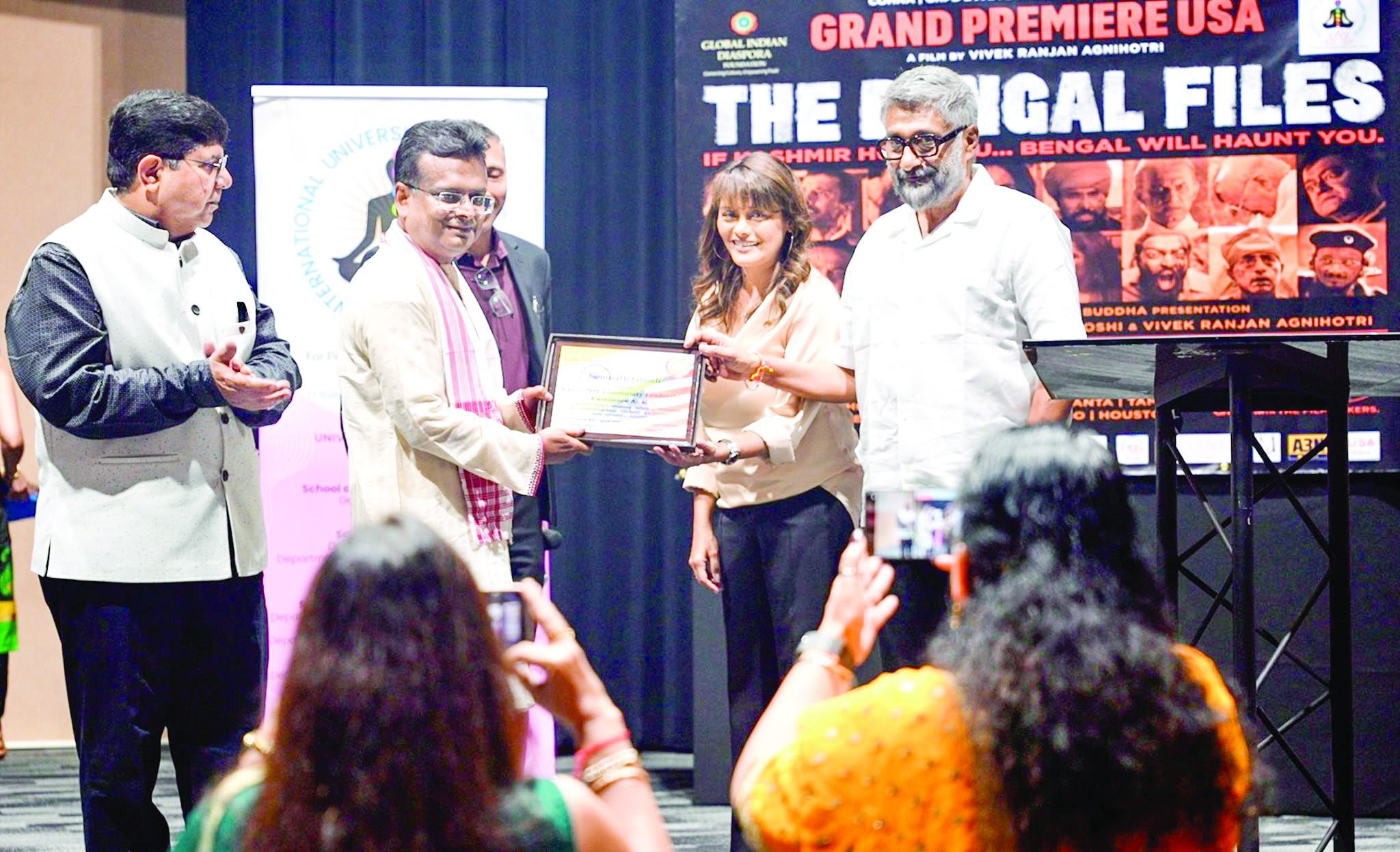
As Mr Agnihotri, accompanied by his actor-producer wife Pallavi Joshi, made their grand entrance into the theatre after the credits, they were met with a wave of emotion. The audience, many with tears in their eyes, had been deeply moved by the film’s powerful narrative. Some had travelled long distances from neighbouring states Ohio, Indiana, and Wisconsin, to experience the movie and connect with their favourite stars. The Bengal Files is a 3:20-hour-long presentation without the usual latakajhatka of a typical Bollywood film.
That did not deter the Gen Zers, like Pratyush Sinha and Atharvaraj Patil, from enjoying the movie. Both, however, were unaware of the Great Killings of Kolkata—the Hindu massacre on Direct Action Day. “Why has this part of history been conspicuously missing from our curriculum?” wondered Sinha, who grew up in India and is currently working on his master’s degree in cybersecurity at the University of Southern California, Los Angeles. People need to be aware of what those in Bengal have been through, chimed in Patil of the University of California, San Diego.
Both were in Chicago in connection with their summer internship with different companies. The Bengal Files is a brave project by Vivek Agnihotri that tells the truth and bridges the gap between the narrative and reality.
Avatans Kumar is a Chicagobased award-winning columnist.




