
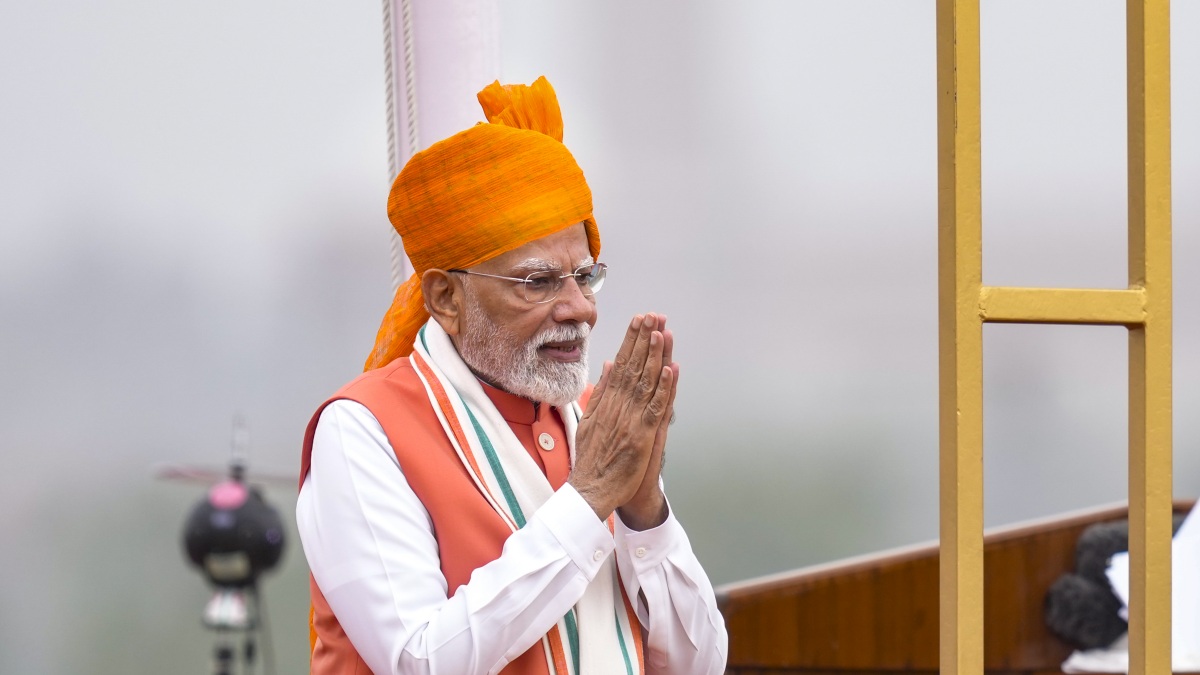
Narendra Modi’s encomiums to Rashtriya Swayamsevak Sangh (RSS) in his Independence Day speech from the ramparts of Red Fort have drawn flak from sections of Opposition. This was the first time ever that an organisation’s centennial became the subject matter of a Prime Minister’s 15 August address. Forty decades back, in 1985, at the centenary of the founding of Indian National Congress, Prime Minister Rajiv Gandhi had not paid similar tribute.
Forty years back Congress had 400 plus seats in the Lok Sabha. Since 2014 it has been decimated to Opposition benches. BJP four decades back had a mere 2 seats. Since 2014, it has been given the mandate to rule. BJP’s determination over past four decades has been matched by Congress’s meandering. BJP has steadfastly stood by its program and slogans.
Congress’s 1980 slogan, “Na jaat par na paat par, Indiraji ki baat par, mohar lagegi haath par” has been superseded by Rahul Gandhi’s penchant for OBC votes, which incidentally Congress does not feel confident enough to seek in the name of its leader, as it did in 1980 (a leader under whom they have lost three Lok Sabha elections and won only 18 of 72 assembly polls). In contrast to Modi’s praise for the organisation he hails from, in 1985 the presidential address of Rajiv Gandhi at the Centenary Session in Bombay had noted that enthusiasm of Congress workers was fettered by “brokers of power and influence” who dominated the party.
In four years, in 1989, the era of Congress enjoying a majority of its own in Lok Sabha became a subject for the archives. RSS was founded on Vijaya Dashami Day in 1925, which was on 27 September that year. This year, Dussehra coincides with the birthday of the Father of the Nation, Mahatma Mohandas Karamchand Gandhi, on 2 October. Looking back with pride and rejoicing that a Swayamsevak and former Pracharak, Narendra Modi, is at the nation’s helm, RSS is planning a grand celebration. Prime Minister’s tribute on 15 August can be seen as a precursor to the jubilee.
This is also the centenary year of the foundation of Communist Party of India. Communist movement has seen multiple splits since 1964. Once the principal Opposition, commanding up to 60 seats, it now has eight Lok Sabha members—4 from CPI (Marxist) and 2 each from the original CPI and CPI (Marxist Leninist). Splintering of the Left has coincided with consolidation of sinews of the Right, with RSS as its bulwark. Bharatiya Janata Party’s (BJP’s) precursor, Bharatiya Jan Sangh, founded in 1951 under the leadership of Shyama Prasad Mookerjee, had RSS as its anchor. RSS has many affiliates which work among different sections of the society—Akhil Bharatiya Vidyarthi Parishad (ABVP) among students; Bharatiya Mazdoor Sangh (BMS) among the working class, and so on. Bharatiya Jan Sangh (BJS) and now BJP, is the Sangh affiliate for politics. BJP’s moorings are anchored in RSS. When Mookerjee launched BJS, a Sangh nominee, Pandit Deendayal Upadhyay was assigned as the organisation head. This system of an RSS nominee being seconded to BJP for organisational work, both at the state and the central level continues till date. The RSS organiser reverts to RSS after completing his tenure.
Deen Dayal Upadhyaya’s tenure as President of BJS lasted only from December 1967 till his mysterious death on 11 February 1968. His iconic role is acknowledged not for his short tenure at the top but for his contribution as General Secretary since 21 October 1951. Links with RSS were the raison d’être for the split in Janata Party in 1979 and foundation of BJP in April 1980.
In 1977, when the then Opposition parties decided to oppose Indira Gandhi by contesting on a common symbol and managed to defeat Congress for the first time in a Lok Sabha election on 21 March 1977, they decided to merge their respective identities into a single entity called Janata Party on 1 May 1977. The juggernaut comprised Congress (Organisation), the party which had split from Congress in 1969, BJS and Bharatiya Lok Dal (formed in 1974 by merger of Swatantra Party, Bharatiya Kranti Dal, Utkal Congress, Socialist Party, Samyukta Socialist Party) as well as some defectors from Congress who had quit protesting against Emergency.
Chandra Shekhar, a former Congress Young Turk, who had been jailed during Emergency despite of being an elected member of Congress Working Committee, was made President of Janata Party. He held the post till 1988 though the party splintered—the most significant offshoot was BJP. (Chandra Shekhar was Prime Minister in 1990-91.) While Jan Sangh merged into Janata Party, sections of the new party, especially those from a Socialist background like Madhu Limaye and Raj Narain, raised the issue of “Dual Membership”—they wanted Janata Party leaders who hailed from BJS background to shun RSS links, which they refused. This sowed the seeds for fall of the Janata Party government, in July 1979.
The midterm election caused by this split saw Congress led by Indira Gandhi and organisationally controlled by Sanjay Gandhi romp back home in 1980. In April 1980, prior to the elections to several state Vidhan Sabhas, BJP was launched—it comprised former BJS leaders as well as prominent Janata Party faces, with Sikandar Bakht, a former Congress stalwart, being one of them. Speaking from the podium of the foundation session, eminent jurist Mohammad Currim Chagla (who had served in Nehru and Indira cabinets) predicted that India’s future party of governance had emerged.
The decade of 1980s saw many attempts to unite the non-Congress Opposition. Conclaves were held hosted by Chief Ministers like N.T. Rama Rao, Farooq Abdullah and Jyoti Basu. BJP was excluded. On its part, BJP tried to launch a front, which bore the same name as today’s ruling alliance— National Democratic Alliance. Indira Gandhi’s brutal assassination skewed the 1984 Lok Sabha elections in sympathy for Congress, which crossed the 400-seat mark. BJP’s tally of 2 was lower than BJS’s 3 in 1952. The 1989 election campaign saw Jan Morcha leader, Vishwanath Pratap Singh (who had rebelled against Rajiv Gandhi and quit Congress) seeking BJP support and yet shunning its company. He refused to share dais with BJP in the nationwide anti-Congress, Bofors-centric campaign.
Post elections he formed a government with outside support of BJP and the Left. BJP had identified the Ayodhya Ram temple movement as its fulcrum during its Palampur session. The Rath Yatra undertaken by Lal Krishna Advani from Somnath (Narendra Modi was principal organiser in the nascent stage of the movement) was stopped by the government of Chief Ministert Lalu Yadav in Bihar—this led to BJP withdrawing support and the fall of V.P. Singh. BJP’s untouchability continued. It contested elections alone and steadily improved its Lok Sabha tally, emerging as the single largest party in 1996.
President Shankar Dayal Sharma invited BJP’s Atal Bihari Vajpayee to form government, which could not prove its majority and collapsed in 13 days. However, M.C. Chagla’s premonition about BJP being India’s future party of governance had been set in motion. Vajpayee was back in the saddle in 1998 as the leader of the newly launched National Democratic Alliance. BJP’s untouchability was finally a thing of the past. RSS was founded by Dr Keshav Baliram Hegdewar, who, in 1919, was one of the principal organisers of the Nagpur session of the All India Congress Committee. RSS’s stance on the Quit India movement and its initial position on the national flag and the Constitution of India are cited today by its opponents.
Communist Party too had not joined the Quit India movement as in its then belief, with the Soviet Union combating Nazi Germany, opposition to the Allied war effort was counterproductive. In 1948, CPI tried to distance itself by saying “yeh azaadi jhoothi hai”. This background did not stand in the way of Congress seeking CPI support to survive, post its 1969 split. In 1971, Congress went to polls with seat adjustments with CPI. Left and Congress have been allies at the Centre. The nascent years of Independent India saw many aberrations which got corrected as the Republic matured. Guru Golwalkar’s “Bunch of Thoughts”, though revered, no longer acts as tome for RSS.
In 1963, the Republic Day parade in Nehruvian times saw a contingent of RSS march past the Presidential podium at Raj Path. The role played by RSS in organising civil defence during the 1962 Chinese aggression was the reason for this. Again, during 1965 Pakistan aggression, Prime Minister Lal Bahadur Shasti sought RSS help in civil defence duties. The corollary of these civil defence deployments in Delhi was that in 1967 Jan Sangh swept all Lok Sabha seats in the national capital and for the first ever time a Jan Sangh local government emerged when Vijay Kumar Malhotra became Delhi’s Chief Executive Councillor and Lal Krishna Advani the chairman of Delhi Metropolitan Council, precursor of the present Delhi Vidhan Sabha. The Delhi unit of Jan Sangh was the first “ruling party” in Sangh chronology. RSS has reason to rejoice its centenary. The Prime Minister’s 15 August address set the tone.
Shubhabrata Bhattacharya is a veteran columnist.




