
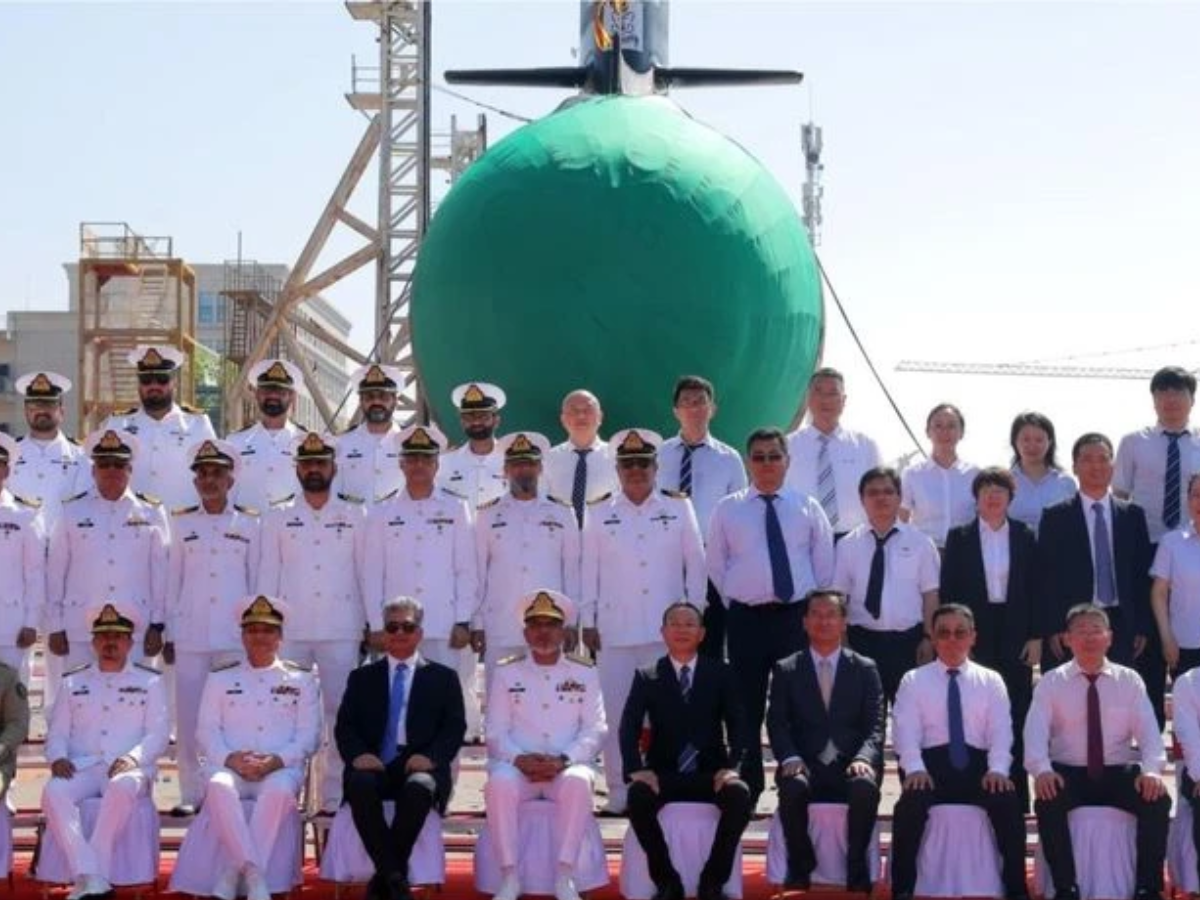
The Pakistan Navy marked the launch of its third Hangor-class submarine at Wuhan’s Wuchang Shipyard on August 15, 2025. For naval officials, the event was a milestone in modernisation, showcasing progress on the country’s largest underwater warfare programme. For many Pakistanis, however, it was a bitter contrast: billions spent on foreign-built submarines at a time when households face soaring food inflation, rising electricity tariffs and shrinking purchasing power.
The Hangor deal, signed in 2015, is valued at an estimated USD 5–6 billion. Four of the eight submarines will be built in China and four assembled at Karachi Shipyard under a transfer-of-technology package. Yet as fiscal space tightens, the trade-off between costly prestige projects and daily survival has become harder to ignore.
Defence rises, welfare stalls
Pakistan’s federal budget for FY2025–26 allocated PKR 2.12 trillion for defence, a 14% year-on-year increase. By comparison, the Benazir Income Support Programme (BISP), the flagship welfare scheme, rose only 7% to PKR 460 billion. Development spending under the Public Sector Development Programme was kept flat at PKR 1.25 trillion.
Debt servicing, meanwhile, will absorb a staggering PKR 9.6 trillion this year, outpacing combined development and welfare outlays. “Pakistan’s policy package continues to prioritise fiscal consolidation, with energy subsidy reform central to the programme,” the International Monetary Fund noted in its March 2025 staff review. That has translated into higher fuel and electricity tariffs, and tighter social spending, even as military allocations expand.
Inflation bites into households
The squeeze is felt most acutely in kitchens. Pakistan Bureau of Statistics data show food inflation at 20.3% year-on-year in June 2025, with headline inflation at 17.4%. Wheat, sugar and cooking oil prices have risen sharply, pushing 42.3% of the population below the poverty line, according to the World Bank. The World Food Programme found that 82% of households cannot afford a healthy diet, while food accounts for more than half of average household expenditure.
Electricity tariffs have climbed more than 45% since 2023 under National Electric Power Regulatory Authority determinations, forcing families to ration power amid rolling blackouts. The optics of a submarine launch in Wuhan, set against candle-lit homes and bread queues in Karachi and Lahore, are difficult to miss.
Submarines and symbolism
For Pakistan’s leadership, the Hangors are a symbol of strategic resolve. Naval officials argue the submarines will extend underwater endurance and bolster deterrence in the Arabian Sea. Yet critics note that even after three launches, induction timelines remain uncertain, engines are unproven in export service, and operational readiness could take years.
Analysts also highlight the mismatch between the Hangors’ promise and India’s existing anti-submarine warfare net. The Indian Navy already operates 12 P-8I Poseidon patrol aircraft, four Kamorta-class corvettes, a squadron of MH-60R Seahawks commissioned in 2024, and INS Arnala, a shallow-water ASW craft inducted in June 2025. For Islamabad, the undersea race is costly; for New Delhi, it is already accounted for.
A widening gap
The August 15 launch gave Pakistan’s Navy a headline, but it also sharpened the gap between elite priorities and public needs. Households contend with food insecurity, higher tariffs and dwindling reserves, while foreign exchange outflows fund Chinese shipyards.
“The scale of Hangor outlays has no direct parallel among recent naval procurements, but exact costs have not been disclosed by authorities,” Naval News observed after the Wuhan event. Transparency is scarce, opportunity costs are obvious, and the pressure on ordinary families is relentless.
Hungry families, expensive submarines—that is Pakistan’s reality in 2025.
(Aritra Banerjee is the co-author of the book ‘The Indian Navy@75: Reminiscing the Voyage’)




