
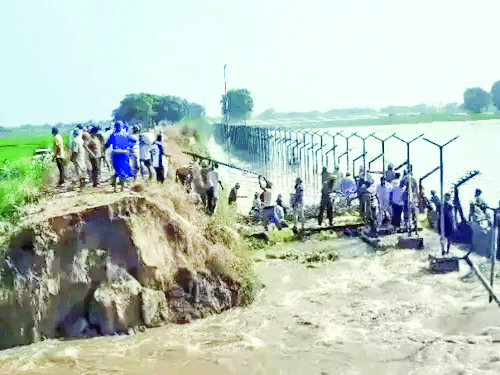
Rivers breach embankments, Madhopur headwork collapses, hundreds of villages submerged across Punjab districts.
Chandigarh: Punjab is once again battling devastating floods, drawing chilling parallels to the catastrophic deluge of 1988 and the widespread inundation of 2023. The collapse of a gate at Madhopur Headworks in Pathankot and the Ravi river swelling beyond its all-time high have plunged several districts into crisis, cutting off villages and forcing large-scale evacuations.
According to officials, nearly 250 villages have been submerged and hundreds of acres of standing crops washed away. More than 360 BSF personnel remain stranded in their camps along the border, while dozens of families have been trapped in low-lying areas. The administration has urged people to move to safer locations, warning of further rise in water levels as excess discharge continues from Pong and Bhakra dams.
On Thursday afternoon, authorities were forced to open the floodgates of the Pong Dam after the water level shot past the danger mark of 1,390 feet and reached 1,396 feet by morning. The sudden release of water compounded the situation downstream, with Beas and Ravi rivers flowing above danger levels and seasonal rivulets inundating surrounding habitations.
In Pathankot, the breach at Madhopur Headworks caused immediate flooding of surrounding areas. Former chief engineer Amarjit Singh Dullet described the collapse as a case of gross negligence. “My blood boils seeing such irresponsibility. How could the department allow this to happen?” he said, demanding accountability from the irrigation authorities.
The Ravi river touched levels never seen before, surpassing all previous flood records and breaching embankments at multiple points. Local officials said that rescue teams had been pressed into service with boats to evacuate those marooned.
The scale of impact has been severe across districts. In Gurdaspur, around 80 villages are inundated. Amritsar reported flooding in nearly 60 villages. Hoshiarpur saw 50 villages submerged, while Kapurthala and Jalandhar each recorded over 30 affected villages. Faridkot and Ferozepur have also reported breaches leading to submergence of farmland. In Patiala, water gushed into several residential colonies, forcing families to seek shelter in relief camps.
The Indian Army deployed its ATOR N1200 Specialist Mobility Vehicle (SMV)—an advanced amphibious all-terrain vehicle—to assist with rescue operations during the floods in Punjab. The ATOR N1200 is specially designed to traverse both rugged terrain and deep water, making it ideal for reaching stranded villagers in submerged areas such as Amritsar, Gurdaspur, Pathankot, and Tarn Taran. Its deployment significantly enhanced the Army’s ability to provide timely assistance in hard-to-reach locations.
Villagers recounted their ordeal as waters rose swiftly. In Gurdaspur, residents of Kalanaur said they had to leave their homes overnight without carrying essentials. “We could only save our children. Everything else is lost,” said a farmer whose standing paddy crop was destroyed. In Amritsar’s Lopoke area, families said BSF camps were surrounded, leaving jawans stranded without supplies.
In Hoshiarpur’s Tanda region, where the Swan river overflowed, villagers said they had been appealing for stronger embankments for years. “The government only comes after the floods. Nothing changes,” said a local shopkeeper.
The Punjab government has directed the local administration and departments to remain on the ground round the clock. All leave for officials and staff has been cancelled. Food and Civil Supplies Minister Lal Chand Kataruchak and Water Resources Minister Barinder Kumar Goyal visited affected areas, promising that rescue and relief operations will continue on a war footing. “Every officer is on duty. No one will be spared if negligence is found,” Goyal said.
Chief Minister Bhagwant Mann, who chaired an emergency review meeting, said that protecting lives was the top priority. “The government is fully committed to supporting every affected family. Compensation will be provided after assessment of damages,” he stated.
Opposition leaders, meanwhile, have criticised the government over preparedness. They argued that warnings about rising water levels in Pong and Bhakra dams were ignored, and that the Madhopur Headworks collapse exposed flaws in maintenance.
The Indian Meteorological Department has predicted heavy rainfall in Punjab and Himachal Pradesh for the next 48 hours, raising fears of further escalation. Officials are on high alert for fresh inflows into the already swollen rivers.
This year’s floods have revived memories of 1988, when Punjab witnessed its worst deluge in recent history, with thousands of villages submerged and infrastructure destroyed. Again in July 2023, the state faced widespread flooding that paralysed life in several districts. With the Ravi river now flowing at unprecedented levels and the breach at Madhopur Headworks worsening the crisis, experts warn the current situation could prove as damaging, if not more.
For Punjab’s farmers, the disaster comes at a time when fields are green with standing paddy. The loss of crops, combined with damaged homes and livestock swept away, has left many fearing financial ruin. Relief camps have been set up, but villagers say supplies are inadequate. “We have no food, no drinking water, and no medicines. Children are falling sick,” said a woman at a camp in Gurdaspur.
Rescue operations by the Army, NDRF, SDRF and police continue across districts. Boats, helicopters and tractors are being used to ferry stranded people. In some areas, volunteers have stepped in, providing food packets and helping with evacuations.
Even as immediate relief is underway, experts are calling for long-term planning to prevent such disasters. They argue that unchecked construction on riverbeds, poor maintenance of embankments, and inadequate forecasting systems have left Punjab vulnerable. Unless structural changes are made, floods will continue to return with greater intensity.
For now, as water levels continue to rise and more rain is forecast, Punjab finds itself caught once again between nature’s fury and human neglect—a reminder of how fragile the state’s flood management system remains.




