
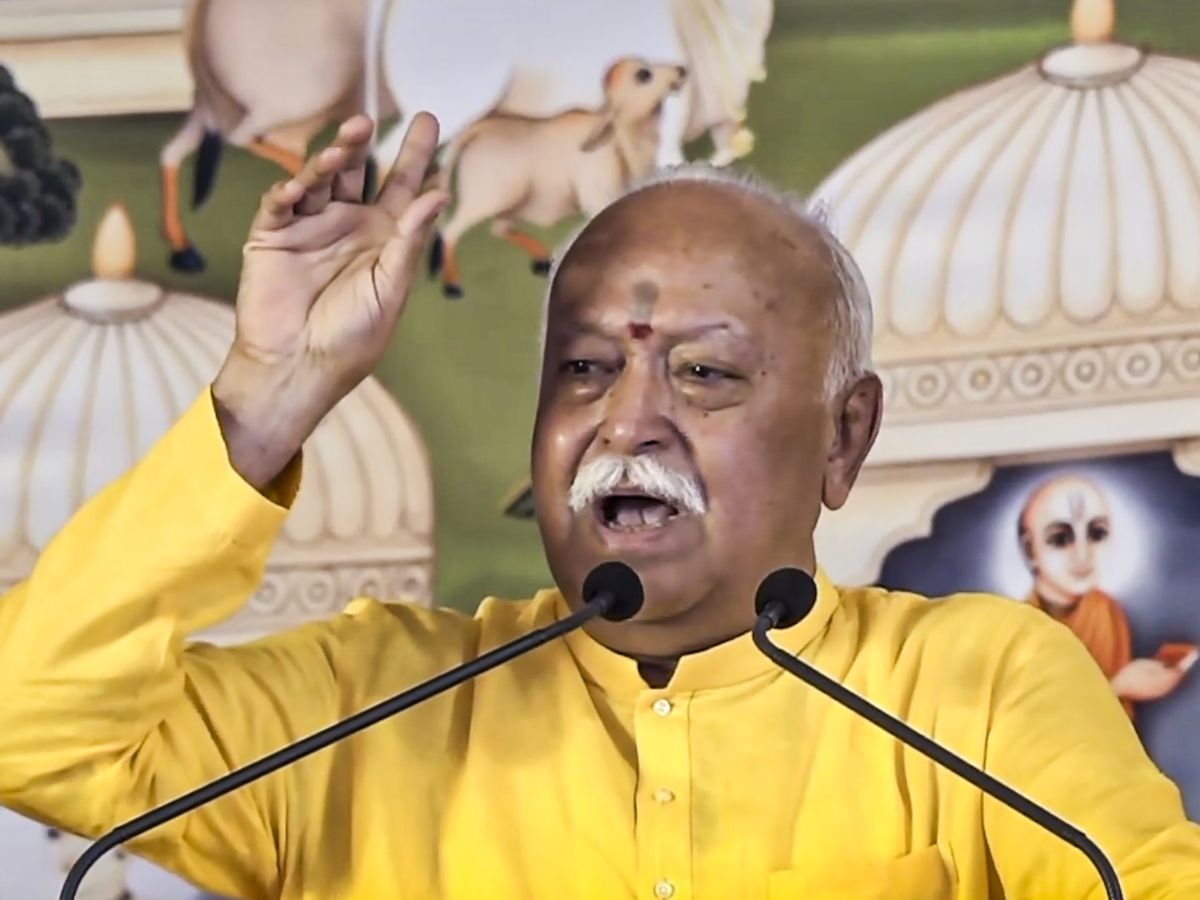
The Rashtriya Swayamsevak Sangh (RSS) Sarsanghchalak, Mohan Bhagwat, on Thursday provided ample reason to believe that while he headed a “Cultural Organisation” described by Prime Minister Narendra Modi as the “largest NGO in the world”, he was as politically astute as anyone can be.
In his interaction with the media during the centenary celebrations of the Sangh, Bhagwat clearly demonstrated that he was absolutely well versed with what was happening around us, and had his definitive views on multiple matters. He distanced himself from the BJP while admitting that he and his outfit shared the ideological DNA with its leadership.
Bhagwat’s answers to complex queries regarding the delicate relationship between the RSS and the BJP were “politically correct” and gave an insight into the clarity with which the Sangh viewed matters. He answered many questions, at the end of which, more questions were raised in the minds of those who have been following the RSS.
There were several takeaways from his briefing, the most important being that he appeared to concur with the BJP president J.P. Nadda’s remarks last year that the BJP should be self-reliant and break its umbilical cord with the RSS. Replying to a question, he underlined the delay in announcing the next party chief was not because of the RSS, which is not indecisive on key matters for a prolonged time.
In other words, he had a dig at the BJP, holding it responsible for the indecision regarding the appointment of Nadda’s successor, while maintaining that the RSS had no role to play in the matter. Many political observers also interpreted this remark as the depiction of the ground reality, where the RSS advice may have been sought on the issue, but it was entirely up to the BJP leadership to take a call on the next party chief.
On another note, it could also mean that the RSS’s opinion did not count on this subject, while in reality, it would be extremely difficult for the BJP to ignore what the Sangh felt. The impression, rightly or wrongly, in political circles over the past 11 years has been that the BJP did what it wanted to do, and merely informed the RSS about its key decisions.
Bhagwat also attempted to set to rest the controversy regarding 75 being the retirement age and the speculation that he too could give up his position in September after he turns 75. Speaking for the Sangh, he said that he was not retiring and any such decision would have to be taken by his outfit. His continuation or his retirement were subjects on which the Sangh had the final say. So far as the BJP was concerned, it was their call on the 75-age limit and the RSS had nothing to do with it.
Bhagwat also spelt his opinion on multiple matters from reservation to family planning and on the unity and diversity of the country, where he ensured that his answers were consistent with the Constitution on one hand, and his ideological commitments on the other.
He in a subtle manner conceded that there were differences on matters with the BJP but explained that the difference of opinion did not imply that there was a difference on the core issues which the party shared with the Sangh. On the whole, Bhagwat came across as someone who had a clear head on vital matters and was not willing to be drawn into any controversy regarding the Sangh’s relations with the BJP.
He admitted that running the government was the forte of the BJP and its leaders. While they could be advised, it was entirely up to them to act or not to act on this counsel. Speaking for himself, he said that, for instance, he had been running shakhas for more than 50 years and thus had developed an expertise on it. Therefore, any advice on how to run the shakhas was welcome, but he would take it keeping his own experience in mind.
Bhagwat stated that India should strive to be self-reliant and not be pressured by other nations. It should do what was in its best interest. He said that various communities in the country should live as one family and that the concept of Akhand Bharat was a reality. Those who live in India had a common background regardless of religion, and that should be the factor that should pave the way for the future as well.
The RSS pitch for Swadeshi is also shared by Prime Minister Modi, who during his Independence Day address had given a call for making India Atmanirbhar. Now with the US tariffs, it is all the more reason to ensure that the country is self-reliant.
However, vested interests need to be identified and curbed in order to achieve the objective of Atmanirbhar and Make in India. For instance, in the defence sector, there are reports that an Indian manufacturer of an Articulated All Terrain Vehicle (AATV) has written to the Union Defence Secretary on May 30, on how the indifference of BEML, a PSU, was helping a foreign manufacturer which is collaborating with an Indian company to secure a tender for Make in India product. The demand is to appoint independent evaluators and the PMO’s intervention also has been sought.
The short point is that the RSS and the BJP have many things in common, and for Bhagwat and Modi, India being Atmanirbhar is most important. Between us.




