
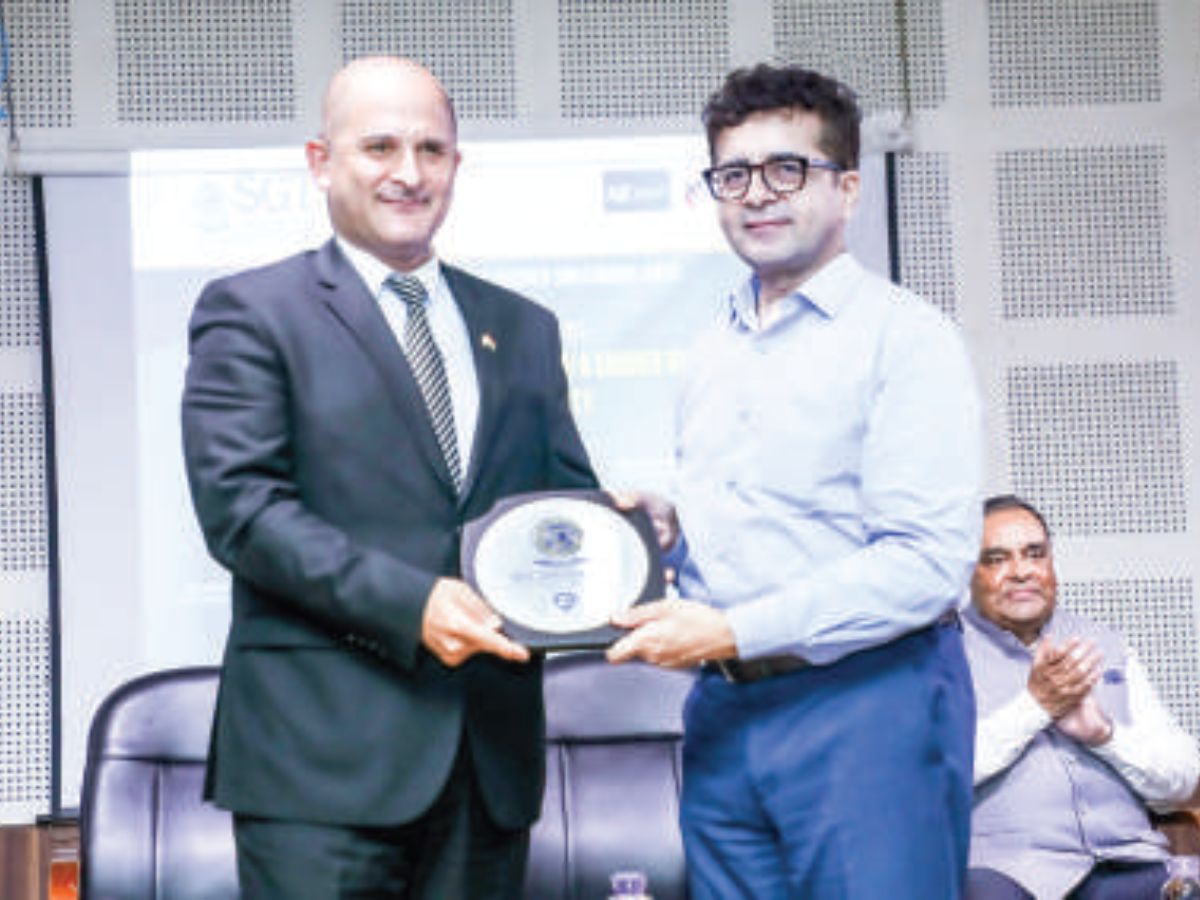
New Delhi: At a high-profile seminar in the capital titled “Bridging Horizons: India, Israel and a Shared Vision for Progress and Unity”—organised by SGT University in collaboration with the Central Coordination Cell and the American Jewish Committee (AJC)—experts, diplomats, and retired military leaders examined the evolving India–Israel partnership, its defence backbone, and the shifting geopolitics of West Asia.
The welcome address was delivered by the SGT University Vice-Chancellor, Prof. (Dr) Hemant Verma, who also felicitated the speakers.
Fares Saeb, Deputy Chief of Mission at the Embassy of Israel in India, in his keynote address highlighted three broad themes that framed the dialogue: the enduring depth of India–Israel ties, the complexities of West Asian geopolitics, and the rising tide of misinformation, anti-Israel sentiment, and anti-Semitism that challenge democratic values across the globe.
Saeb underlined that while defence and security have long formed the bedrock of bilateral ties—predating even the formal establishment of diplomatic relations—economic and technological cooperation has expanded dramatically in recent years. Israel’s Barak missile system stands as a symbol of joint defence innovation, but collaborations now span agriculture, cyber security, and advanced Research and Development. More than 100,000 Indian farmers already benefit from Israeli-supported Centres of Excellence in agriculture, while AI-driven projects and cyber cooperation point to a future of shared innovation.
Diplomatically, India has increasingly taken positions at the United Nations that acknowledge Israel’s security concerns. Regionally, initiatives such as I2U2 and the India–Middle East–Europe Corridor (IMEC) have immense potential, particularly if Saudi Arabia moves toward normalisation with Israel. Saeb, however, cautioned that threats from Iran-backed groups and a parallel “narrative war” complicate Israel’s pursuit of peace.
On Gaza, Saeb reiterated Israel’s immediate priorities: securing the release of hostages, dismantling Hamas, and working toward long-term peace. Yet he warned that disinformation campaigns—where anti-Israel narratives converge with anti-Semitic tropes—pose dangers not only to Israel but to democratic societies worldwide, exploiting freedoms that democracies themselves are bound to uphold.
Lt. Gen. Dushyant Singh (Retd.), Director General of the Centre for Land Warfare Studies (CLAWS), traced the turning point in bilateral relations to Prime Minister Narendra Modi’s landmark 2017 visit to Israel, which “de-hyphenated” Israel from the Palestine issue. Today, Israel is among India’s top five defence suppliers, with cooperation spanning drones, missiles, artificial intelligence, and cyber security. Joint ventures with Indian majors like Adani, Tata, and Mahindra, along with counter-terrorism cooperation intensified after the 2008 Mumbai attacks, have cemented Israel’s role as a critical security partner.
Singh recalled that Israel had provided India crucial supplies in the wars of 1962, 1965, and 1971, and during the 1999 Kargil conflict, supplied ammunition, satellite intelligence, and other vital support. Since 2001, India has procured over $4.2 billion worth of defence equipment from Israel.
Ambassador Y.K. Sinha (Retd.), drawing on his diplomatic postings across Egypt, Saudi Arabia, the UAE, and Pakistan, placed current India–Israel ties in the broader historical trajectory of Israel’s engagement with the Arab world. From President Anwar Sadat’s 1979 peace treaty with Israel to the Abraham Accords of 2020 that normalised relations with the UAE, Bahrain, Morocco, and Sudan, Sinha described a dramatic shift from boycott to burgeoning cooperation in trade, tourism, and people-to-people links. He noted that Saudi–Israel rapprochement seemed imminent before the Hamas attacks of October 7, 2023, but progress now hinges on resolving the Gaza conflict. Without that, regional projects such as IMEC cannot be realised.
Maj. Gen. Dhruv C. Katoch (Retd.) focused on the October 7 attacks and their aftermath. Describing the Hamas assault as indefensible, marked by kidnappings, mass killings, and sexual violence, he questioned global critiques of Israel’s “disproportionate” response. If India, with a population 140 times larger, had suffered an equivalent assault, he argued, the toll would have been 150,000 deaths in a single day. “Evil cannot be measured in proportions—it must be destroyed,” Katoch said.
Looking ahead, he identified Iran as Israel’s most formidable challenge. A regime change in Tehran, he suggested, could dramatically alter the regional landscape, as Israel and Iran might be natural allies once current leadership barriers are removed.
The discussion concluded with a shared recognition: India–Israel ties today are multi-dimensional, expanding across defence, agriculture, technology, and diplomacy, yet deeply enmeshed in the turbulence of West Asia. For India, the central challenge will be balancing its growing partnership with Israel alongside its historic ties in the Arab world, while seizing the opportunities of new global alignments to secure its place as a trusted partner in an unstable region.




