
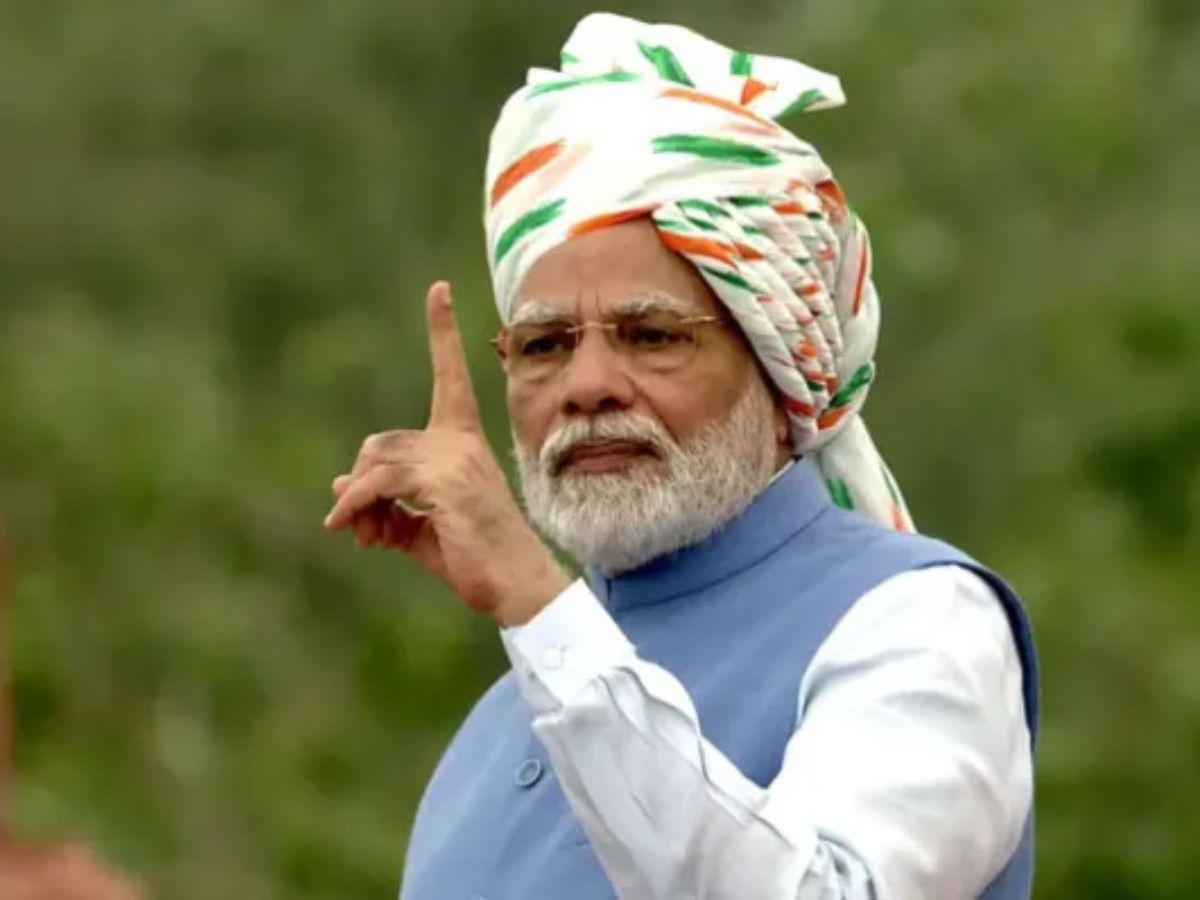
Born in 1950 in the modest town of Vadnagar, Gujarat, Prime Minister Narendra Modi turns seventy-five this year. His life is a testament to what selfless service, resilience, and unyielding conviction can achieve. It is not a story of privilege or entitlement but of a man who has changed the world around him by first transforming himself, and then carrying millions along with him. For him, public life has never been about power for its own sake, but about responsibility, a commitment to making possible what others thought impossible. That is the enduring thread of his journey: to take adversity head-on and to turn it into an opportunity for the nation.
His early years shaped him in ways no elite upbringing could have. Coming from an economically modest OBC family, he understood deprivation firsthand. That experience gave him both empathy for the struggles of ordinary Indians and determination to create change. The discipline and training of the RSS sharpened this spirit, moulding a leader who rose through responsibility, not inheritance. It gave him a rare quality, an instinct for accountability, and an ability to translate conviction into results. These traits remain visible even today, in the way the Prime Minister carries himself as a karmayogi, dedicating his life not to self-interest but to the service of Bharat Mata.
When he entered office in 2014, the atmosphere was one of despair. Investors had turned their backs on India, rating agencies had written us off as a faltering economy, and the diaspora had quietly given up hope. Within India, banking was mired in crisis, corruption scandals had hollowed out governance, and there was a sense that the country had lost momentum. A decade later, the transformation is stark. The Insolvency and Bankruptcy Code ended the culture of impunity in the financial sector. The introduction of GST created a unified market and reset the relationship between states and the Union on the foundation of cooperative federalism. These are not small changes, they redefined the structure of the Indian economy. Even when the pandemic struck, India endured. While much of the world fell into a prolonged slowdown, the Indian economy bent but did not break, and bounced back with resilience. That recovery was not luck; it was the product of the institutional strength the Prime Minister had built into the system.
But his legacy is not confined to economics. From the Red Fort, twelve times now, the Prime Minister has addressed the nation, surpassing every predecessor. He has used those occasions not for rhetoric but for resetting priorities. He spoke of dignity, of nari shakti, of cleanliness, of taboos too long left untouched. The construction and inauguration of the Ram Mandir was another such moment. While critics sought to reduce it to a communal spectacle, the Prime Minister used it to speak of Amrit Kaal, of national renewal, and of India’s youth as architects of a Viksit Bharat. It was not the politics of division, but the politics of transformation.
The same spirit runs through his work for farmers. Programmes like PM-Kisan, the Fasal Bima Yojana, and others are not handouts, but mechanisms of dignity and protection. The Prime Minister has made it clear that farmers must be shielded from exploitation, both domestically and globally. This is why his economic diplomacy is not about tariffs alone, but about ensuring that Indian agriculture cannot be undermined by the designs of others. Behind the numbers lies a simple principle: farmers’ welfare is central to India’s future.
For women, his leadership has been equally transformative. Schemes like Matru Vandana, Ujjwala, and Swachh Bharat were designed not just as welfare but as interventions in dignity. Toilets for women in villages, gas connections to free them from smoke-filled kitchens, and financial inclusion that allowed them to step into economic life have altered the daily reality of millions of households. The one-third reservation in legislatures and the push for women-led development take this further. In his vision, women are not passive beneficiaries of development but active leaders of it. For him, the Amrit Kaal cannot be realized unless it involves “women-led development.”
The Prime Minister’s approach to national security has been firm and pragmatic. He began with gestures of friendship towards neighbours, extending a hand of cooperation. When these were rebuffed, he recalibrated without hesitation. Terrorism, once a constant wound on the nation’s psyche, has been decisively confronted. The abrogation of Article 370, long considered untouchable, was carried out with clarity of purpose to restore equality, justice, and integration. Insurgencies in the North East and the Red Corridor have diminished. Defence modernisation, long stuck in red tape, has gained momentum with “Make in India” opening the sector to private innovation. These are not symbolic measures but represent a structural shift in India’s security posture. Globally, India is now a leader in counterterrorism diplomacy, forging consensus on zero tolerance, not by bullying others but by building trust.
Infrastructure has been another area of silent revolution. Road construction has more than doubled, connectivity has expanded, and the physical shape of India is changing. The Gujarat model that once defined him has been eclipsed by the scale of national development. Foreign policy, too, bears his personal imprint. The Prime Minister’s ability to build trust across ideological divides, from Putin to Zelenskyy, Iran to Israel, has elevated India’s status. Under his leadership, India expanded BRICS, led the G20 presidency with vision, and launched global initiatives like the International Solar Alliance. At a time of fractured global politics, India has emerged as a pivot because of the credibility of its leadership.
Threaded through all this is a deeper philosophy. From education reforms and the promotion of Indic Knowledge Systems to cultural revivals like Tamil Sangam, the Prime Minister has shown that development is not only about material growth but also about civilizational confidence. For him, highways and heritage are not contradictions but complements. Modernisation and tradition move together when anchored in service.
As Prime Minister Modi turns seventy-five, his record is too vast to be catalogued in a single article. Banking reforms, farmer welfare, women’s empowerment, and defence modernisation, foreign policy triumphs, and cultural renewal could define a leader’s legacy. But what binds them together is his character: patriotism, relentless work ethic, discipline, and above all, selfless service. He is not a leader who treats the office as an entitlement, but as a duty. He has given India confidence in itself, a sense of destiny, and a vision of Viksit Bharat. At seventy-five, the Prime Minister is a statesman of the present and a shaper of India’s future. His journey reminds us that when leadership is guided by conviction and service, transformation ceases to be a dream and becomes the lived reality of a nation.
Prof Santishree Dhulipudi Pandit is the Vice Chancellor JNU.




