
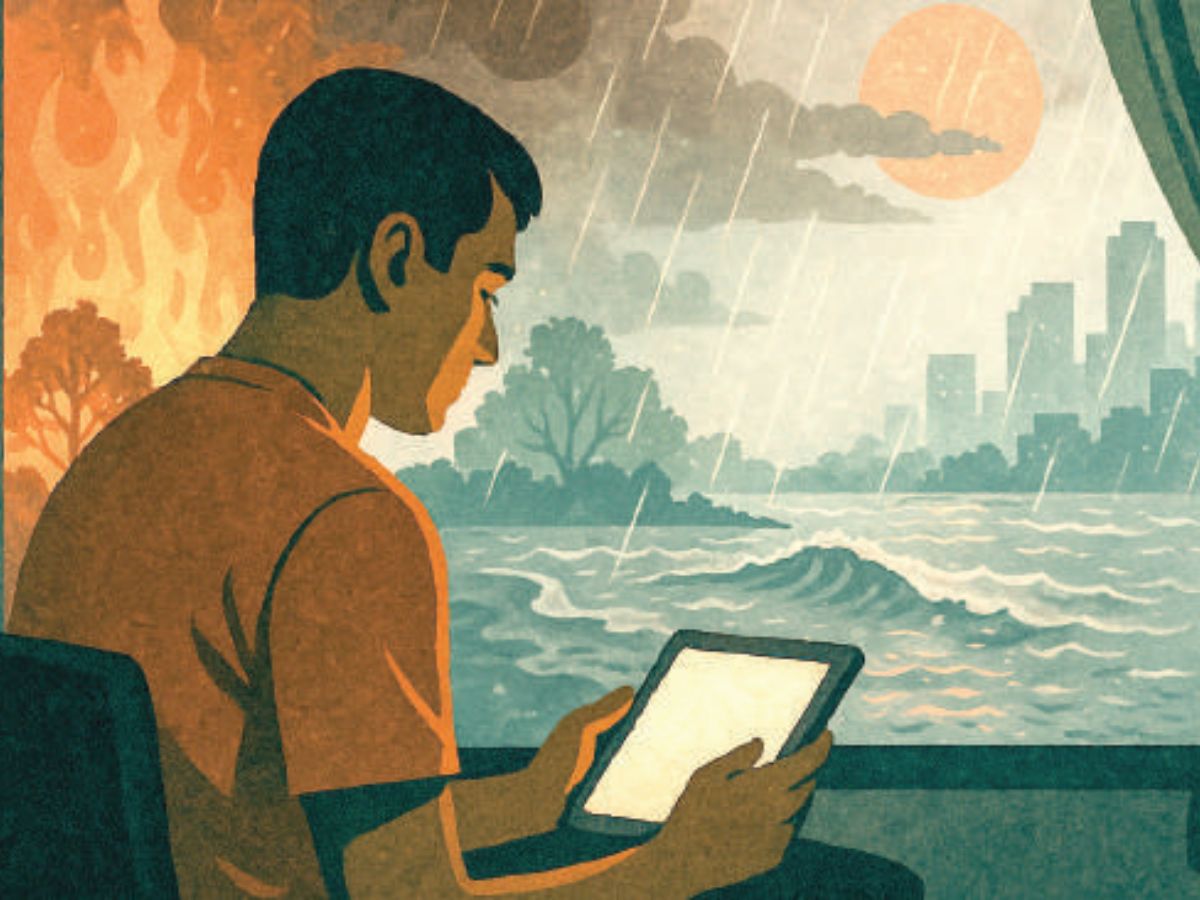
In conversations about the planet’s future, one question keeps surfacing—sometimes in honest uncertainty, sometimes as provocation: Is climate change a hoax? The question lingers in public debate, even as the planet grows warmer and weather patterns grow more erratic. Some continue to raise such doubts, claiming the crisis is exaggerated or imagined.
Their disbelief cannot simply be brushed aside. For if the threat is real, and all evidence suggests it is, then the deeper issue is psychological: Can the proof still reach a mind that has resolved not to see?
And the proof is not hidden. It sits across databases, research journals, news headlines, and lived experience. While not all of it makes it to prime-time screens, its clarity is sobering: the pace of climate disruption has outstripped even the more conservative estimates of recent years. Global temperature rise, projected to hover around 1.3 ± 0.4 degrees Celsius by the end of 2025, is already nearing its upper bounds.
The signals come from every direction: heatwaves and floods in India, wildfires in Europe, droughts in Australia, floods in China, hurricanes in Mexico, and storms in the United States. These are not rare occurrences anymore. They are patterns.
The pattern across continents
In California, January wildfires ravaged forests during what should have been a quiet season. A mix of intense heat, dry leaf fall, insufficient rainfall, and strong winds fed flames of unprecedented scale. On the East Coast, cities wilted under an unusual and prolonged heatwave. Southeast England, too, recorded 32 degrees Celsius—a temperature that historically should occur only once in 2,500 years, now made a hundred times more likely due to human-induced climate change.
Australia’s spring this year was bone dry, and fire followed. Without moisture to hold the soil or slow the wind, flames tore across the landscape. What was once called bushland became ash. China and India, meanwhile, were brought to a standstill by days of rain that left cities submerged and streets unwalkable. Mexico has seen increasingly intense tropical cyclones in recent years. And in the United States, sea levels continue to rise, quietly reclaiming land that people still call home.
These are not isolated incidents. They form a pattern too widespread to dismiss, touching every continent, unsettling every economy. The world is not changing in parts; it is changing as a whole.
India’s warming reality
If the global scale feels abstract, India offers a closer lens. This year alone, India endured its longest heatwave spell since 2010, with 2024 logging 536 heatwave days nationwide; 2025 again brought prolonged, intense heat. Over 44,000 heat stroke cases were reported, according to the CEEW’s May 2025 report. The year began with four unrelenting months of heat, followed by unseasonal and heavy rains in May—the wettest in decades. This was followed by severe floods in August-September, which submerged and devastated the north of India.
Weather extremes have now become the norm. Dry spells stretch longer, and rainfall, when it comes, arrives in fierce bursts. The root cause is clear: Asia is warming at nearly twice the global average (WMO)—and India reflects this regional warming pattern.
While the global mean temperature has risen by about 1.5 °C above pre-industrial levels, recent heatwaves have pushed parts of northern India to experience spikes of 5–8 °C above their seasonal norms.
And the impact is not limited to weather. Hospitals overflow during heatwaves. Schools shut down. Construction workers collapse at job sites. Livelihoods across sectors are being quietly but steadily eroded. Electricity grids fail under pressure. Food supply chains snap under stress. And the rural poor, with the least insulation, bear the brunt of this chaos.
This is no longer at the doorstep. It is inside the house. It is speaking in the language of drought and flood, fever and famine. It is not just a climate problem; it is a civilizational one.
The price of denial
So the question is no longer whether the data exists. The real puzzle is: How can something so glaring remain so conveniently ignored?
It is not ignorance but a kind of self-imposed blindness. As the saying goes, you cannot wake someone who is pretending to sleep.
And this denial has consequences. India, one of the most climate-vulnerable countries, remains among the least responsive in public awareness. Climate change rarely enters everyday conversations, and even less so the electoral discourse. That silence rises: from households, to headlines, to government halls. A crisis that demands attention meets with a collective shrug instead.
When the public remains indifferent, governments take cues. Environmental policies remain tokenistic. Emissions targets are pushed further out. Polluters are given soft landings. And slowly, but surely, the window for action narrows.
We also risk becoming desensitized. When every summer brings a new record high, when every monsoon wreaks unexpected havoc, the unusual begins to feel routine. And once that happens, even disaster loses its power to shake us.
Economic growth or mirage?
Beneath this denial also lies a false hope that the economy can keep growing regardless. But the very growth we claim to protect is built on ecological stability. Without it, the edifice collapses. International reports have outlined the risks clearly: climate change will hit India harder than most. The losses will spread across agriculture, healthcare, infrastructure, the informal sector, and national security.
Take agriculture, which supports the majority. Our farms are rain-fed, not irrigation-backed. Unpredictable rainfall and glacial melt mean that first come floods, then droughts. Without stable water, crops fail; when crops fail, income vanishes. What follows is not just migration but mass displacement: millions scrambling for food and water.
The collapse does not stop at the farm. When crops fail, manufacturing slows. When incomes dry up, services, from tourism to retail, begin to contract. Cities like Mumbai face rising seas; Delhi battles unlivable heat. A single flood can destroy crops, displace families, wreck roads, halt transport, and set off a chain reaction across the economy. The costs are not theoretical. They are already appearing in insurance claims, food inflation, and disrupted supply chains.
Climate change does not merely dent economic progress; it threatens the very soil it stands on. What we call growth, if not grounded in ecological and social balance, is simply momentum in the wrong direction.
Resilience or recklessness?
Faced with this, some invoke the past: “Humanity has overcome many crises; we will adapt again.” It’s a comforting story, but the climate does not respond to narratives. This is not a matter of morale but of physics. Belief cannot alter the melting point of ice. Confidence does not hold ice solid at 50 °C.
This isn’t pessimism; it is precision. Thermometers don’t exaggerate. Satellites don’t play politics. Facts remain facts, even if inconvenient. Hope, too, must be honest. Resilience is not the same as complacency. True resilience begins with perception: seeing the threat for what it is. Without that, what we call “adaptation” is merely delay. And delay, in this case, is not harmless. It is destructive. Every year we postpone serious action, we deepen the hole we’re in, making future efforts more costly and less effective.
Seeing clearly
The climate crisis isn’t rooted in a lack of data, but a lack of honesty. The information is public, and the signs are visible. What is absent is the willingness to acknowledge. Even the educated often resist. Denial is rarely due to ignorance; it is more often due to attachment: to convenience, comfort, or custom. We push aside what disturbs. That is not innocence; it is evasion.
Until honesty is valued as much as external success, we will raise generations who are informed but not awakened. Climate denial, then, is not just a policy issue. It is a crisis of attention, of sincerity, of willingness to respond. And the crisis will not wait for us to agree. It does not negotiate. It proceeds, hour by hour, indifferent to our narratives. The only question that remains is: when the truth knocks, will we answer, or pretend not to hear?
Acharya Prashant, a philosopher and teacher of global wisdom literature, is the founder of the PrashantAdvait Foundation and a bestselling author who brings timeless wisdom to urgent modern questions.




