
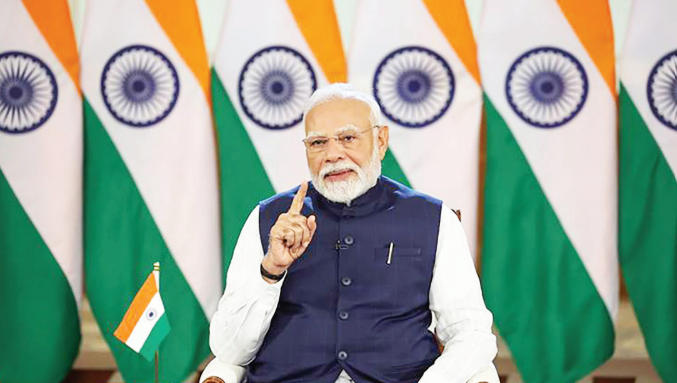
PM Modi Birthday: On the last Sunday of every month at 11 AM, some- thing extraordinary hap- pens across India. In tea shops of Varanasi, village squares of Kerala, drawing rooms of Mumbai and mountain hamlets of Himachal Pradesh, one hundred crore Indians pause to listen. Not for entertainment or news, but for their Prime Minister speaking directly to them, not as voters but as family. When Prime Minister Narendra Modi first stepped up to the microphone at All India Radio on October 3, 2014, nobody imagined that a simple radio broadcast would transform how democracy works in the world’s largest republic. What began as a monthly radio show has quietly created what might be the biggest experiment in direct democratic communication the world has ever seen. A decade later, the numbers tell an incredible story. Ninety-six percent of Indians know about Mann Ki Baat. One hundred crore citizens have listened at least once. Twenty-three crore people tune in regularly. These aren’t just statistics. They represent something political scientists struggle to define, what we might call democratic osmosis where governance seeps into public consciousness naturally, bypassing traditional barriers of formal political structures. But Mann Ki Baat goes beyond its original idea. This isn’t just the Prime Minister’s thoughts anymore. It’s become ‘Jan Ki Baat’, where citizen’s voices shape democratic conversation. Prime Minister Modi has made clear, “Mann Ki Baat signifies addressing the collective aspirations of the nation; acknowledging the na- tion’s accomplishments; and contemplating on the enduring strength of the populace.” It also signifies addressing “the dreams of the youth and the aspira- tions of contributing to national citizens.” This shift from a leader’s monologue to a national debate symbolises a significant development in democratic communication. This is a Samvad Revolution that has revolutionised the functioning of democracy in the age of digitisation via the perennial medium of radio, generating an exceptional connection between governance and the people of the nation.
The Democracy of Proximity
Traditional democracy faces an interesting prob- lem. As more people get the vote, their represen- tatives become more distant from them. Mann Ki Baat has tried to solve this through participative intimacy, letting millions feel personally addressed by their Prime Minister while maintaining the reach of mass communication. The program’s brilliant design shows this intimacy at a massive scale. Broadcast in 22 Indian languages and 29 dialects through over 500 All India Radio stations. It creates capillary democracy, where governance flows through India’s complex communication networks. The show reaches globally too, available in 11 languages including French, Swahili, Tibetan and Arabic, establishing India’s civilisational influence worldwide. But here’s what makes it fascinating. This isn’t traditional broadcasting but broadcasting evolved into symphonic democracy. Before each episode, millions of citizens send their thoughts through the MyGov portal, creating a massive flow of grassroots feedback that the Prime Minister’s Office carefully reviews and incorporates. What starts as a monologue becomes real dialogue, creating meaningful democratic participation. Sixty percent of the listeners increased interest in nation building, while seventy-three percent feel the country is moving in the right direction. These numbers represent continuous consent, democracy seen as ongoing conversation rather than occasional electoral exercise.
The Continuum of Ancient Wisdom
To understand Mann Ki Baat’s revolutionary nature, we must look back to Kautilya’s Arthashastra, where ancient political wisdom laid the groundwork for this modern phenomenon. The text spoke of ‘Praja-Ranjaka’ governance, prioritising public satisfaction over mere authority. It established ‘Raja-Praja Samvad’ as governance where the ruler’s main duty is listening to citizens rather than just giving orders. Mann Ki Baat brings this ancient wisdom alive through 21st century technology, creating ‘temporal synthesis’, the seamless blend of timeless principles with cutting edge tools. The program embodies Deendayal Upadhyay’s ‘Antyodaya’, ensuring every section of society gets representation and recognition. Farmers dis- cuss innovation, students share achievements, artisans preserve traditions, entrepreneurs build futures. This creates digni- tarian space for everyone in democracy that prioritises recognition before redistribution, dignity before development. This cultural integration shows clearly in the program’s celebration of India’s civilisational heritage. Episodes promoting local crafts like Khadi, encouraging millets as ‘Shri Anna’ or supporting ‘Vocal for Local’ initiatives create heritage democracy, where cultural preservation becomes active civic participation. Citizens see their local traditions reflected in national conversation, building a deeper connection to democratic belonging than mere political engagement can provide . This demonstrates identity validation on an incredible scale, something Western democracies, increasingly divided by cultural differences, struggle to replicate.
From Policy to People’s Movement
Mann Ki Baat’s greatest achievement is its unique ability to transform government initiatives into genuine social movements. This is an endogenous mobilisation; a governance approach where citizen enthusiasm drives program success rather than government enforcement, enabling lasting change across communities. The evidence of this transformation is compelling across several major initiatives. Consider Swachh Bharat Abhiyan. What started as a policy initiative became a national obsession after consistent, emotionally resonant episodes through Mann Ki Baat. Similarly, the program’s messaging transformed ‘Beti Bachao, Beti Padhao’ from a bureaucratic scheme into a cultural movement, while Digital India gained tremendous momentum through program discussions that addressed the digital divide through awareness rather than force. This phenomenon illustrates what could be called effective policy implementation, where the government succeeds through emotional connection rather than regulatory compliance. Research conducted by IIM Rohtak reveals the underlying mechanism. Fifty-eight percent of regular listeners report improved quality of life, while fifty-nine percent express increased tr ust in government. These aren’t just correla- tions but evidence of causation through perceptual policy impact, where changed citizen perceptions of government initiatives trigger behavioral change, creating a positive cycle of engagement, trust and social transformation that conventional policy implementation rarely achieves.
Collaborative Model of Democracy Beyond Opposition Politics
Indian political discourse has traditionally been trapped in the ‘Paksha- Vipaksha’ binary inherited from Westminster democracy, an adversarial model based on opposition and conflict. Whereas Mann Ki Baat introduces a different concept: ‘Sahyoga Discourse’. It is collaborative dialogue that transcends party lines to build constructive national conversation. This innovative approach creates sacred democratic space, an arena untouched by electoral calculations where genuine national discourse can emerge naturally. The program’s non political nature enables trust regeneration in de- mocracy’s capacity for renewal through direct engagement rather than political manipulation. Mann Ki Baat uses a unique storytelling for mat that enables vicarious participation, allowing listeners to see their own struggles and aspirations in other’s stories, building democratic empathy, a sense that individual success serves collective good. The impact of this approach is measurable. When sixty-three percent of listeners develop more positive views of government, we see democracy transforming from duty based to aspiration-driven engagement. This democratic innovation is apparent in the program’s evolution across multiple platforms. The architecture is platform agnostic, meeting human beings wherever they come into contact with media, though 37.6% of people consume material through mobile devices and 44.7% do so through television. This makes sure that no citizen is left behind because of new technological impedi- ments by implementing democratic redundancy or multiple avenues. Con- sumption democracy, in which people actively select their preferred form of involvement, is revealed by the fact that 62% of young people pre- fer watching television. Anticipatory Democracy, that deals with new citizen expectations before they become crises, would be proposed by the future integration of artificial intelligence for sentiment analysis.
India’s Democratic Gift to the World
Mann Ki Baat shows what India’s unique approach to democracy looks like. It’s a way of governing that stays true to our ancient values while embracing modern technology. This blend offers real solutions to problems that Western democracies face today, where people feel increas- ingly cut off from their leaders and societies are becoming more divided along cultural lines. The program’s inter- national scope generates unique possibilities for democratic exportabil- ity permitting India to disseminate governance innovations to budding democracies globally. Mann Ki Baat, through the broadcasts in many mul- tiple languages such as French, Swahili, Tibetan as well as Arabic showing governmental excellence to global audiences and celebrating democracy’s potential for cultural au- thenticity. This means an original way to define internation- al influence born not from financial advantages or military might, but from democratic innovation itself. It represents the essence of civilisational soft power: the capacity to motivate other nations by exemplifying effective governance models that respect both tradition and modernity. As democracies globally contend with polarisation and institutional deterioration, India’s Mann Ki Baat initiative presents a pragmatic model for re-establishing citizen engagement with democratic architectures as part of authentic argumentation, cultural commemoration and technological evolution.
The Renaissance of Democracy
As India approaches its centenary of independence in 2047, Mann Ki Baat offers a compelling model for mature democratic governance. It’s inclusive enough to hear all voices while maintaining decision-making efficiency required by modern governance, sophisticated enough to honor ancient civilisational wisdom while embracing technological possibilities. When 100 crore Indians pause to listen on the last Sunday of each month, they’re participating in something truly remarkable: democratic discourse across the world’s most diverse society, conducted in dozens of languages, blending centuries of wisdom with cutting edge technology. In that moment, the ancient ideal of government by and for the people becomes visible as both achievable today and the natural evolution of democratic practice. This is the dialogue revolution. The conversation between Indian democracy and its own future. And it’s just beginning.
Sunny Singh is a Research Scholar associated with Dr. Syama Prasad Mookerjee Research Foundation, with expertise in Geopolitics and Global Governance




