
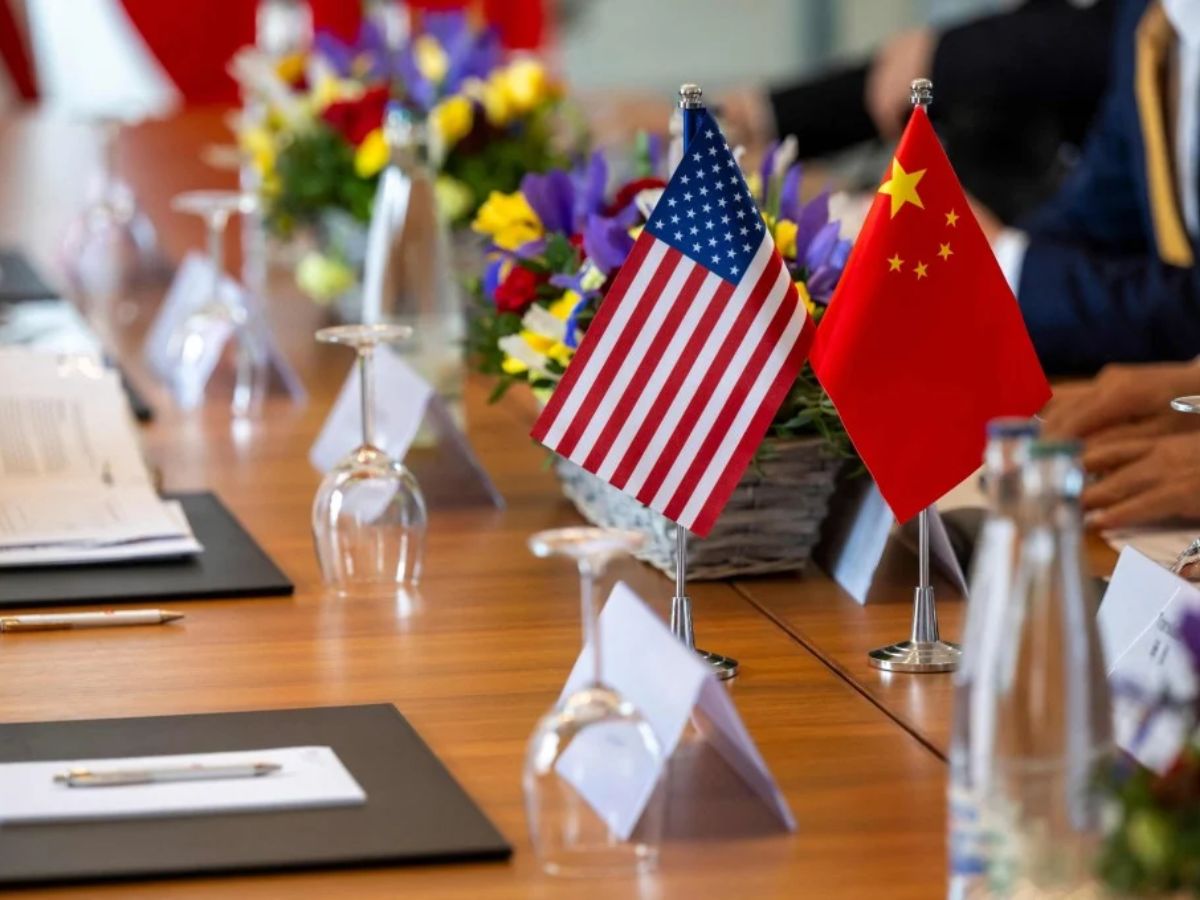
b.r. DeepakWhen Xi Jinping rolled out tanks and drones at a thunderous parade in Beijing on September 3, it wasn’t just a show of military hardware. The messaging was loud and clear: It is the twilight of Pax Americana and the dawn of Pax Sinica, marked by the ascendancy of emerging powers. Xi Jinping declared from the rampart of the Tian’anmen that the Chinese nation is “never intimidated by any bullies” (不畏强暴)… Today, humanity again has to choose between peace and war, dialogue and confrontation, win-win cooperation and zero-sum game.”
It is hardly surprising that US President Donald Trump and his close associates reacted with indignation, denouncing the bonhomie between Xi Jinping, Russian President Vladimir Putin, and North Korean leader Kim Jong Un as a conspiracy directed against the United States. On September 5, Trump further remarked, “It looks like we have lost India and Russia to deepest, darkest China.” This was in response to the bonhomie displayed by Russia, India and China (RIC) in Tianjin during the SCO Summit.
India has also been subjected to sharp criticism from officials such as Peter Navarro and, more recently, US Commerce Secretary Howard Lutnick, who warned India to “stop purchasing Russian oil, withdraw from BRICS, and support the United States and the dollar, or face a 50 per cent tariff.” In a notable reversal, on September 7, President Trump declared, “India and the United States have a special relationship; there is nothing to worry about.” Such inconsistency underscores a departure from the more predictable patterns that traditionally characterized US foreign policy. Or is it a reflection of US paranoia over China’s rise, which is increasingly casting a shadow over the so-called American century?
This, however, is not the first time the world has watched power migrate from one shore to another. In the 19th century, Britain’s empire enforced what became known as Pax Britannica, a system of global trade and stability anchored in London’s industrial might and naval supremacy. By the mid-20th century, exhausted by two world wars, Britain ceded leadership to Washington. Pax Americana was born, built on the dollar, the Bretton Woods institutions, and America’s unrivalled military projection. For nearly eight decades, the United States stood as guarantor of the global system. But today, the arithmetic of power tells another story.
In 1945, China’s economy represented only a small fraction of Europe’s. Even on the eve of Deng Xiaoping’s reforms, China accounted for merely 2.7% of global GDP, compared with 25.4% for the United States and 28.8% for Europe. By 2024, however, this distribution has shifted considerably: China’s share rose to 16.9%, while that of the United States and Europe stood at 26.3% and 17.3%, respectively. In relative bilateral terms, China’s GDP was approximately 13% of that of the United States in 1945, a proportion that has risen dramatically to 64% in 2024.
In the domain of manufacturing, the disparity is even more pronounced: China now contributes roughly one-third of global manufacturing output, surpassing the combined output of the next nine countries. Meanwhile, the United States, once the preeminent manufacturing and trading power, now accounts for less than 17% of global manufacturing value-added. Since 2012 China has trounced the US as the largest trading partner of most of the countries around globe. Forecasts from the United Nations Industrial Development Organization (UNIDO) suggest an even sharper shift by 2030: China’s share could rise to approximately 45% of global industrial production, while the US share may decline to around 11%. These shifts are far from marginal; they constitute tectonic structural changes in the global economic order.
And yet, the global institutions of governance remain stuck in the past. The IMF gives Washington 16.49% of voting rights, a veto share. China has only 6.4%, while India just at 2.7%. According to Tricontinental Institute of Social Research, “each person in the Global North is worth nine people in the Global South.” The UN Security Council still grants permanent seats to Britain and France, countries whose influence no longer matches their privileges. This mismatch between reality and representation is driving Beijing to build its own institutions. The Asian Infrastructure Investment Bank (AIIB), the BRICS New Development Bank (NDB), and now the SCO Development Bank are not just lenders, they are tools for legitimacy, signalling to the Global South that there are alternatives to Washington’s order.
The multilateral blocs led by China tell the same story. The expanded BRICS now represents about 30% of global GDP in nominal terms and 35% in purchasing-power parity, rivalling the G7. More crucially, a forecast by EFG International indicates that from 2024 to 2029, the BRICS group is expected to contribute approximately 58% of global GDP growth, while the G7’s share is slated to fall to around 25%. The SCO, stretching across Eurasia, represents a GDP of more than $30 trillion and includes the majority of the world’s population. What was once dismissed as a talk shop is becoming a core platform of the post-Western world.
But the symbolism in Tianjin and Beijing went far deeper. With the expansion of Beijing’s Global Development, Security, and Civilization Initiatives (GDI, GSI and GCI), China announced the Global Governance Initiative (GGI), signalling that it is no longer content to play by the rules of a US dominated order. It is building one of its own. Xi Jinping has been painstakingly building the Sinic narrative of global order that could be seen in China’s foreign policy.
The larger framework of China’s diplomacy is based on so-called two central pillars—“to build a community with a shared future for humanity” (人类命运共同体) and “a new type of international relations” (新型国际关系). The latter has two distinctive flanks—major country diplomacy and China’s relationship with the Belt and Road Initiative (BRI) countries/Global South. The above “Five Initiative” have been fed to the basic framework together with the Chinese Style Modernisation (中国式现代化), thereby redefining the discourse power in the 21st century.
While such ideas may seem abstract in Washington, they resonate strongly across the Global South. Where the West often attaches conditions, Beijing delivers ports, highways, power grids, and trade through the BRI. Although critics warn of “debt traps,” most participating states report tangible benefits. China frames development as the foundation of cooperation, aligning its narrative of shared destinies with developing countries’ aspirations for peace, inclusivity, and sustainability in contrast to US unilateralism, protectionism, and coercive practices. Under President Trump, tariffs, executive orders, and the public disparagement of allies further eroded perceptions of the United States as a reliable partner.
Pax Americana thrived not just because of US military might and dollars but because Washington offered an idea of freedom and prosperity, and soft power that resonated globally. That narrative has lost its shine. Backed by strong government support, a thriving streaming sector, and a rapidly evolving film ecosystem, China has built the world’s largest and most influential movie market, eclipsing Hollywood. Washington’s tariffs on global partners have only reinforced the shift in audience sentiment. The Chinese animated feature, Ne Zha 2, has achieved remarkable commercial success, grossing 15.2 billion yuan (approximately US $2.11 billion) at the domestic box office within just 12 weeks of its release in 2025, according to China Daily.
The West, meanwhile, clings to institutions designed in 1945, as though arithmetic can be wished away by inertia. But history teaches otherwise. Pax Britannica ended not because Britain wanted it to, but because it could no longer afford its empire. Pax Americana is unravelling for the same reason: America cannot command the global economy, the institutions, or the narrative as it once did. The SCO Tianjin Summit and Beijing parade was not simply an anti-US spectacle. It was a declaration that a post-American order is already here.
Of course, a Pax Sinica is not inevitable. China’s ascent could be constrained by economic headwinds, demographic decline, and strategic resistance from the United States and its allies. Historical precedents suggest that transitions in global leadership are rarely smooth. Britain’s handover to the United States was facilitated by war fatigue, shared culture, language, and ideology, conditions that do not exist between Washington and Beijing.
The risk of a “Thucydides Trap,” in which a rising hegemon confronts an entrenched hegemon, remains real. Flashpoints such as Taiwan, Senkaku and the South China Sea could serve as catalysts for conflict. Nonetheless, the broader trajectory of China’s rise appears difficult to ignore—unless Beijing fails to sustain economic growth, becomes consumed by internal factional struggles, or forfeits political legitimacy in the face of mass domestic unrest.




