
Magical realism reveals a captivating reality, if only we pause long enough to experience it. Rishab Shetty’s film ‘Kantara’ had stirred up interest in our native tales of magic realism. I had just interviewed Stephen Huyler, an American anthropologist who has explored folk ethnographies in India.
When I told our family priest in February that I planned to visit the Sri Krishna Temple in Udupi, he told me not to miss the biennial Dakke Bali ritual underway at Padubidri. The timing was serendipitous, and I set forth to witness it.
Dakke Bali is a form of snake worship practised by the Tulu community in the Dakshina Kannada district, especially in Padubidri. Dakke is a drum, and Bali means offering. The locals come in a procession from the Mahalingeshwara Mahaganapath to a clearing at the edge of the village — Khadgeshwari Brahmasthana — where the ritual is conducted. It starts after 11 pm and goes on until the early morning.
Each evening during the month is hosted by a well-to-do person who also invites the entire neighbourhood for lunch. It’s considered a great honour to be granted the opportunity to host it, and people wait years for their turn. The devotion runs deep; families pass down this privilege through generations, viewing it as both a blessing and a responsibility.
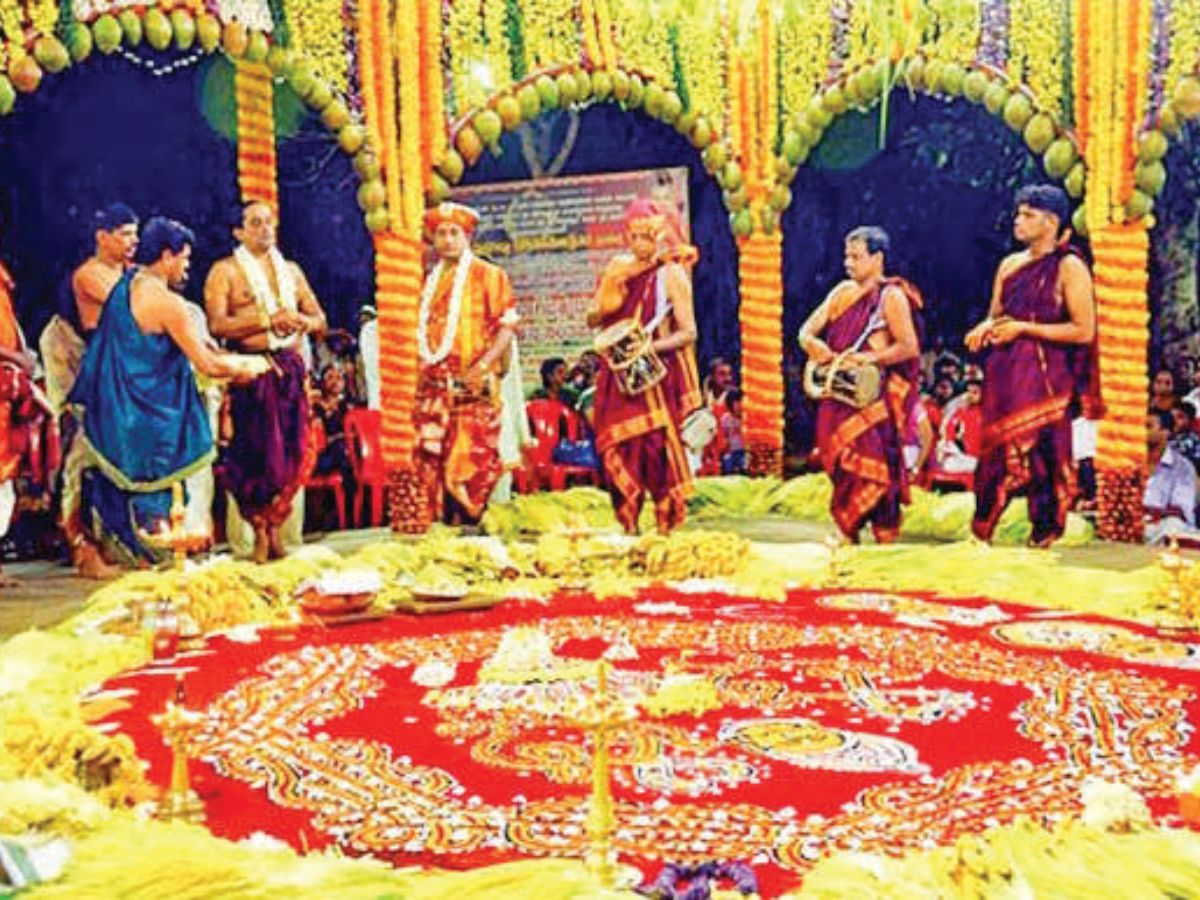
Ahead of the ceremony, local volunteers bedeck the area with just palm fronds and flowers, with the pingara, the white flower of the areca tree, being most favoured. These delicate pale strands create a sacred boundary between the mundane and the mystical. The next morning, the decorations are cleared away, leaving no trace, and everything is as it was in nature. This ephemeral beauty speaks to the philosophy of impermanence and respect for the natural world.
The venue was dimly lit with oil lamps; electricity is barred, as are mobile phones and photography. This deliberate disconnection from modernity seems to create a portal to ancient times. The flickering flames cast dancing shadows that seemed to breathe life into the painted serpent mandala on the ground. It was drawn using natural colours — yellow (turmeric), red (turmeric with white lime), white (white mud), green (leaf powder), and black (roasted paddy husk).
Everybody, rich or poor, sat on the ground, though there were subtle caste boundaries. All the Brahmins sat together in front, away from the rest of the congregation. Where would we sit? I wondered. As an aunt uncharitably pointed out, I am a ‘trishanku’ — a Brahmin married to a Catholic, I am neither here nor there apparently. But in the face of the divine, such distinctions felt petty and meaningless.
Our priest’s aunt didn’t bat an eyelid before sitting with the hoi polloi to give us company. We were warmly welcomed by the women who were seated on the outer perimeter. They scooted over to make space, their eyes twinkling with knowing smiles as they saw me fidgeting to sit cross-legged. “Shilpa Shetty also sits on the ground when she comes here,” they whispered to me. Alas, if I were as flexible as she! I vowed to start yoga.
We were agog as the ritual unfolded in a thrum of vibrant colour and sound. The person playing the dakke was from a specific family of vaidyas. He was dressed as a serpent woman (Naga Kannika). The sound of the dakke beat and his verbal exhortation built up the tension. The rhythm started slow, almost meditative, then quickened. The vaidya led the four pathris to move around in circles around the place of worship.
The sequence of movements was an appeasement to the snake god, Naga. He cajoled and provoked the pathris to the point that spirits entered the pathris. The frenzy built up as the possessed pathris continued to follow the movements of the vaidya, their dance a primal conversation between human and divine. The possession intensified. One of the pathris became an oracle and spoke what the community understood as messages from their serpent deities. They were specific answers to questions by the family that hosted the evening’s ritual.
After an hour or so, the pathris collapsed, their bodies spent. They rested for a while, bathed in cold water and revived, gently returning from the otherworld. Then came the second part of the Dakke Bali, which shares elements with the Nagamandala ritual. This was the divine union of male and female snakes, depicted through mesmerising dance and movement around the serpent mandala.
The pathris, now in deeper communion with the divine, embodied this cosmic union while the community witnessed the sacred marriage of opposing forces — a celebration of fertility, balance, and the eternal cycle of creation. At the end, the pathris covered themselves with pingara as symbolising the offerings of the gathering. I found myself transported by something ancient and profound.
The mystical experience reminded me how far we have moved away from our roots. In our craving for luxurious city life, we spurn something far more layered and primal — our connections with nature and the ways of our ancestors. These traditions are under threat as there are very few people who play the dakke anymore. And fewer still who become pathris. The art requires not just skill but a spiritual calling that modern life seems to discourage.
Being without a pathri puts the community under great duress. The pathri plays a significant role as mediator between the human and divine realms, offering guidance, blessings, and caution to the community. Not everyone can become a pathri as it is believed that the deity chooses them. Sometimes there are several pathris; one time there were none. The whole village beseeched the deity of the forest several times before a name was revealed; their unwavering collective faith answered.
What the Female Gaze says: I reflected on why women don’t play a more active role in the worship, and remembered what an elderly woman said — while the men enact the divine drama, the women hold the continuity, passing down the songs, preparing the offerings, maintaining the oral traditions that keep these practices alive. In a patriarchal ritual structure, women hold onto a living thread connecting us to our deepest roots.
— Sandhya Mendonca, author, biographer, and publisher at Raintree Media, offers a distinct female gaze of the world in this column.




