
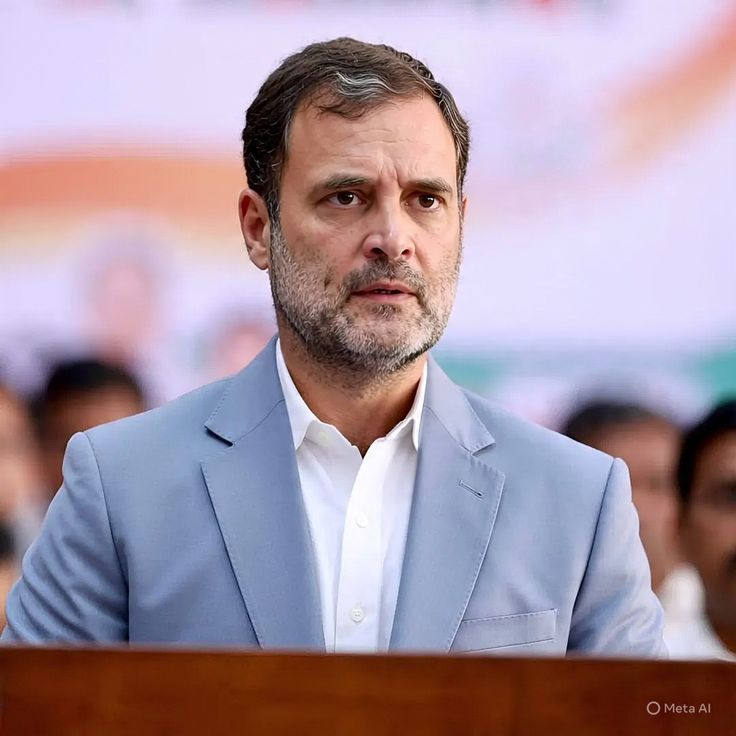
NEW DELHI: Congress leader Rahul Gandhi once again, during his visits to Colombia and other Latin American countries, made several baseless and serious remarks about India’s democracy and economy. He claimed that India’s democracy has collapsed, freedom of expression is being suppressed, and the economy is in crisis. But if one looks at statistics and reports of international institutions, the reality appears entirely different.
On foreign platforms, Rahul Gandhi alleged that the voice of freedom in India is being stifled, opposition voices are being persecuted, and institutional independence is under threat. He claimed that investment has declined, unemployment is rising and inflation is out of control. His accusation is that the government is increasing economic and social inequality, and policies benefit only a select class. Abroad, he argued that India is heading toward authoritarianism, and Prime Minister Modi’s government is weakening democracy. Taken seriously, these accusations appear aimed at political gains while undermining India’s international image.
On the other hand, India’s diaspora is not only contributing to the progress of developed nations through their hard work, talent, and innovation, but also strengthening India’s economic, social, and cultural image globally. Indians settled across the world today play leadership roles in various fields. In technology, industry, finance, education, healthcare, and politics the diaspora’s influence is growing. That is why they are considered the most powerful representatives of India’s “soft power”. The global Indian diaspora is estimated to number about 35 million, spread across countries like the US, UK, Canada, Australia, the Middle East, and Europe. Their work has strengthened developed economies while bringing pride and recognition to India.
The reality is that India’s Constitution still remains the supreme authority of the country, upholding institutions like the judiciary, Election Commission, electoral officers, and an independent media. Regular elections are held. Several states have non-BJP governments that frequently confront the Modi government at the Centre on various issues. If democracy had truly weakened, these institutions would not have survived open criticism and statutory review. Media in India still criticizes the government; negative reports, dissenting positions, and coverage of people’s movements are still published in newspapers and digital platforms. If democracy were genuinely weakened, such media freedoms would have been entirely curbed.
Not merely claims by the government or BJP, but the International Monetary Fund, in its July 2025 report, projected India’s real GDP growth rate at 6.4%. According to the report, India could record 6.4% growth in both 2025 and 2026. The report further stated that India could surpass Japan in 2025 to become the world’s fourth-largest economy. It also highlighted that between 2022 and 2024, India’s average real GDP growth was 8.8%, the highest in the Asia-Pacific region. India has faced challenges like global trade tensions, US tariff hikes, and investment instability. In August 2025, the US imposed up to 50% tariffs on imports from India. Yet, India’s economy absorbed these external shocks—domestic consumption and investment kept stability intact.
The role of people of Indian origin in America’s technological and economic rise is extremely important. Nearly 30% of Silicon Valley startups were founded by entrepreneurs of Indian origin. Leaders like Sundar Pichai (Google), Satya Nadella (Microsoft), and Shantanu Narayen (Adobe) prove that Indian talent gave America new direction. Indian doctors, engineers, and professors have strengthened America’s healthcare and education systems. With policy shifts in the US and Europe, several big entrepreneurs and young professionals are now returning to India to start ventures. Wealthiest industrialists like Lakshmi Mittal have even purchased luxury residences in Delhi.
The Indian government also recognizes the contributions of its diaspora. It not only promotes their honor but also encourages investment and innovation opportunities in India. Prime Minister Narendra Modi has often said that the diaspora are India’s “national ambassadors”. In the future, NRIs will play a bigger role in India’s economic growth, technological advancement, and global image building. Through programs like Startup India, Digital India, and Make in India, the diaspora can provide both capital and expertise.
In Britain, people of Indian origin hold top positions in both politics and business. Rishi Sunak becoming Prime Minister of Britain was not only an acceptance of Indians in its politics but also a recognition of Indian origin talent globally. Major Indian business groups based in London have invested heavily in the British economy. Canada’s parliament has a significant number of MPs of Indian origin. Meanwhile, Indian youth are dominating Australia’s IT and education sectors. In the Gulf, Indian workers and entrepreneurs have had a deep impact on the construction and services economy. The contributions of Indian engineers, architects, and entrepreneurs to the growth of cities like Dubai and Abu Dhabi are considered historic.
Industrial groups like Tata, Ambani, and Adani are expanding not only in Asia but also investing heavily in Europe, America, and Africa, building strong global credibility. The Hinduja Group is one of the world’s largest and most influential business conglomerates, with operations in finance, automobiles, energy, IT, healthcare, and real estate. The Hinduja brothers’ wealth is estimated in the hundreds of billions of dollars. In India, they have invested heavily in infrastructure, healthcare, and education, strengthening the country’s global image. Lakshmi Mittal, called the “steel king,” is chairman of ArcelorMittal, the world’s largest steelmaker. He elevated the steel industry in Europe and the US to new heights. In India, Mittal invested in energy and infrastructure. His global stature has given Indian industry a strong international reputation. While Ambani and Adani are not NRIs, their business empires are heavily funded by diaspora investors. Indians settled in the Arab world and Europe have invested in their projects. The diaspora not only financed but also powered India’s IT revolution, branding India globally. Indian IT professionals in the US and Europe helped India earn the title of the “world’s IT hub”.
The diaspora has strengthened India’s identity not only economically but also culturally and diplomatically. They are taking Indian culture, yoga, Ayurveda, and spirituality to every corner of the world. Indian festivals—Diwali, Holi, Ganeshotsav, and Durga Puja—are now celebrated with grandeur in the US, UK, and Australia. The rise of leaders of Indian origin in world politics has also bolstered India’s image. Be it US Vice President Kamala Harris or Indian-origin MPs in Canada’s parliament, all are playing important roles in enhancing India’s global stature.
The Indian diaspora is not only shining abroad but also investing heavily in India, giving momentum to its economy. NRIs send billions of dollars in remittances each year, fueling development in both rural and urban areas. According to the World Bank, India is the world’s largest recipient of remittances. In addition, NRIs are investing in startups, real estate, energy, education, and healthcare in India, creating jobs and positioning India as a leader on the global investment map
The Hinduja Group is one of the world’s largest and most influential business conglomerates, with operations in finance, automobiles, energy, IT, healthcare, and real estate. The Hinduja brothers’ wealth is estimated in the hundreds of billions of dollars. In India, they have invested heavily in infrastructure, healthcare, and education, which strengthens the country’s global image.
Lakshmi Mittal, known as the “steel king,” is chairman of ArcelorMittal, the world’s largest steelmaker. He elevated the steel industry in Europe and the US to new heights. In India, Mittal invested in energy and infrastructure. His global stature has given Indian industry a strong international reputation.
While Ambani and Adani are not Non-Resident Indians (NRIs), their business empires are heavily funded by diaspora investors. Indians settled in the Arab world and Europe have invested in their projects.
The diaspora not only financed but also powered India’s IT revolution, branding India globally. Indian IT professionals in the US and Europe helped India earn the title of the “world’s IT hub”.The diaspora has strengthened India’s identity not only economically but also culturally and diplomatically. They are taking Indian culture, yoga, Ayurveda, and spirituality to every corner of the world. Indian festivals—Diwali, Holi, Ganeshotsav, and Durga Puja—are now celebrated with grandeur in the US, UK, and Australia.
The rise of leaders of Indian origin in world politics has also bolstered India’s image. Be it US Vice President Kamala Harris or Indian-origin MPs in Canada’s parliament—all are playing important roles in enhancing India’s global stature.




