
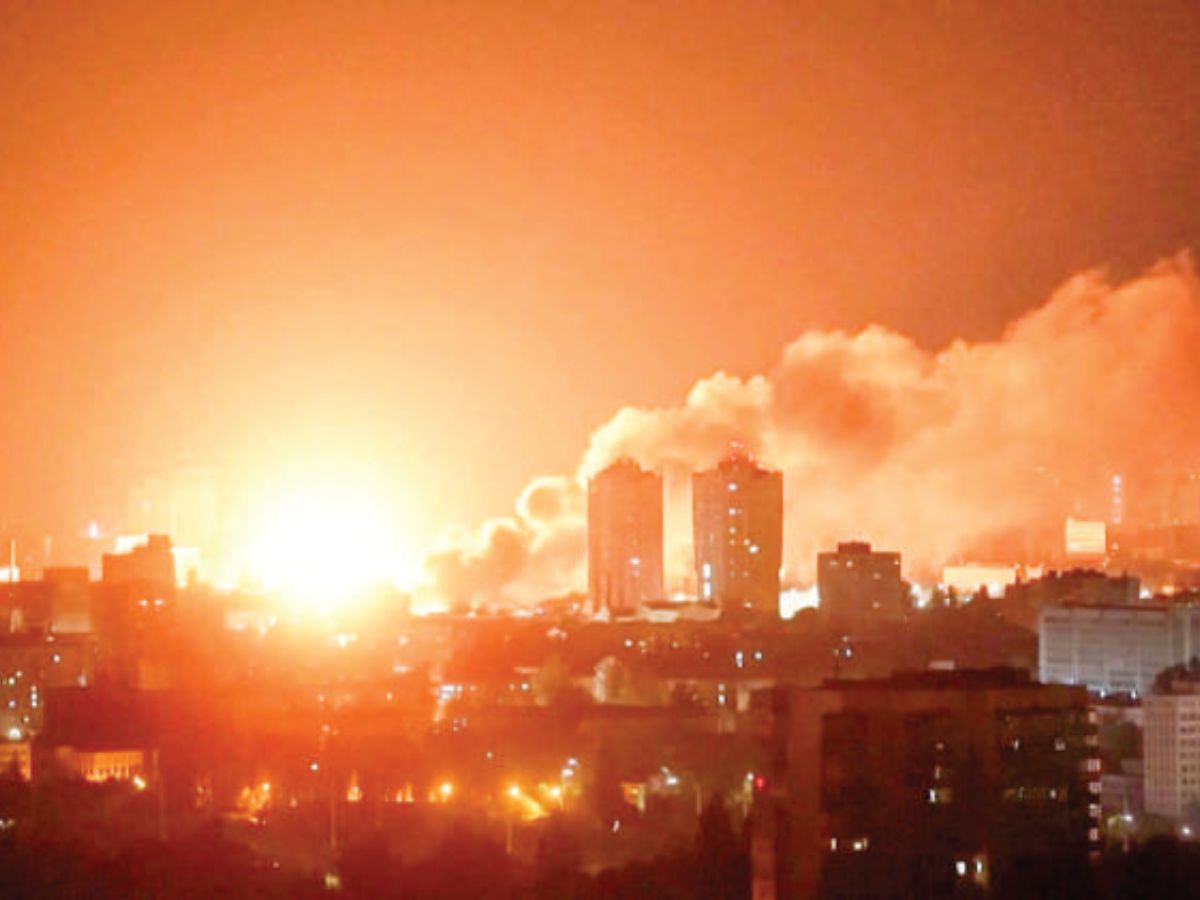
London: Last Monday, Ukraine launched a major drone attack over 14 regions in Russia, as well as Crimea and around the Black Sea. Targets included a major ammunition plant, a key oil terminal and an important weapons depot. One goal was the Sverdlov ammunition plant in the Nizhny Novgorod region of western Russia, which supplies Russian forces attacking Ukraine with aviation and artillery ordnance, aviation bombs, anti-aircraft and anti-tank weapons. Throughout this year, Ukrainian drones and missiles have successfully targeted many Russian oil refineries. According to BBC Verify, 21 out of Russia’s 38 large oil refineries have been hit and damaged over the past 12 months, resulting in an economic cost to the Kremlin of up to $10 billion, if you take into account the damage, downtime and lost revenue. Because of the strikes, Russia’s refinery production has dropped by around 10 percent compared to earlier in the year, leading to shortages at the pump as well as sharp increases in price. An alarmed Russian government has taken steps to ban or restrict exports in order to conserve supply for domestic markets.
Damage caused by Ukrainian strikes is just one factor affecting Russia’s economy, brought about by Vladimir Putin’s rash and impetuous decision to attack his neighbour more than three years ago. As the war continues, Russia’s economy is deteriorating fast. The World Bank recently revised its forecasts and growth estimates for Russia downwards from earlier in the year, with GDP growth downgraded from 1.4 percent to just 0.9. For 2026, instead of an earlier prediction of 1.2 percent, the bank now predicts 0.8, and for 2027 it’s now 1 percent instead of 1.2. If you consider that before the invasion, Russia’s GDP was regularly in excess of 4 percent, it’s not difficult to understand the disastrous effect the war has had on the economy.
Western sanctions, clearly aimed at weakening Russia’s ability to fund and sustain the war, have played a significant and complex role in this downwards movement, and while they have not stopped the war, they have had major economic, technological and geopolitical impacts. Major Russian banks were quickly cut off from the secure SWIFT system that financial institutions use to send and receive payments, thus limiting Russia’s ability to engage in international finance. Around $300 billion of Russia’s foreign reserves were also frozen early in the war, and the EU and G7 introduced price caps and embargoes on Russian oil and gas. Though Russia redirected some energy exports to Asia, it has suffered price discounts and logistical challenges because of the invasion.
To get round energy sanctions, Russia has built a network of some 1,430 old tankers to transport its oil around the world, estimated last year to total about 4 million barrels of crude oil per day. Many of these ships are ancient, lack maintenance and are mostly uninsurable, operating with invalid registration or documentation. Owned by shell companies, the ships transfer oil into another vessel at sea which then sails under a different name, making them difficult to track down. Major oil spillages causing significant pollution are not uncommon. Although estimates vary, experts believe that Russia’s revenues from oil and gas have dropped by around 30 percent relative to what they might have been without the war. In the first seven months of this year alone, revenues were 5.52 trillion roubles, down 19 percent year-on-year from 6.78 trillion roubles. The Kremlin has had to revise its full-year 2025 oil and gas revenue estimate down by about 24 percent. While some of the decline is down to lower global prices, heavy discounting to find buyers as well as increased shipping costs have played their part.
Like many governments, Russia tends towards rose-tinted forecasts, presuming no strengthening of sanctions and constant or even higher oil prices—$70 per barrel in 2026 compared to today’s $65. The US Energy Information Administration expects oil prices to be around $51 per barrel next year, and if this materialises, the Kremlin will have to weaken the rouble to collect its planned oil revenue. This in turn will increase inflation, already at 8 percent, and prevent any easing of interest rates, currently 17 percent. Apart from the defence industry, everything is grinding to a halt. Russia is entering a long period of lethargic or even negative growth.
Sanctions and export controls have also blocked the sale of advanced semiconductors, machinery and dual-use goods to Russia, with the result that Russian arms producers have struggled to replace precision components. Civilian industries like aviation, automotive and electronics have been hit due to the lack of western technology, with the result that Russia has resorted to smuggling sanctioned components through third countries, an inefficient and costly process. Trade is now rerouted through countries like Turkey, Kazakhstan and the UAE, complicating enforcement. The West has introduced secondary sanctions to pressure companies and countries helping Russia bypass sanctions, although enforcement remains incomplete and uneven across jurisdictions. Nevertheless, sanctions are slowly strangling Russia’s high-tech sectors and long-term growth is being choked by isolation from global innovation.
Despite their economic toll, sanctions have not deterred the Kremlin militarily, which has moved Russia’s economy on to a war footing. In 2024, military spending reached nearly 7 percent of GDP, the highest since the Soviet era. Factories which previously were lying empty in the rust-belt regions are now working around the clock producing weapons for the army and creating millions of jobs. Locals are delighted with the war as their pay cheques are now three times more than in peacetime. But, of course, any war-driven economy propped up by military spending is not productive investment and isn’t sustainable. Once the war ends there’s a serious risk of collapse in the sector and mass unemployment.
The economic outlook for Russia is grim, and it’s all due to Vladimir Putin. He failed to realise back in February 2022 that wars are expensive and sustaining operations over such a long period of time requires substantial budget outlays. It wasn’t meant to be like this, of course, as Putin fully expected the invasion to be over in a few weeks with a resounding victory over Ukraine. Now Russia faces slower growth for many years compared with what might have been possible without the war. Shrinking private sector investment, especially in high-tech and export-oriented industries, will lead to a greater reliance on the state, with inevitable cronyism and inefficiency—just like the old days of the Soviet Union. Russia is already suffering major demographic issues, caused by mass emigration because of the war, fewer births and the huge number of war casualties. Having been cut off from leading-edge technology, Russia will find itself well behind major world economies, which will have a knock-on effect in many sectors. There will almost certainly be persistent fiscal strain in the economy, due to the cost of reconstruction, necessary subsidies and meeting social obligations under harder conditions.
The invasion of Ukraine has been a disaster for Russia’s economy, but because of the incisive decision-making of Russia’s astute central bank chief, Elvira Nabiullina, the country has so far avoided total economic collapse. But when Vladimir Putin goes to bed at night, he must constantly regret not fully appreciating all that time ago Kyiv’s determination to resist being swallowed up by Russia.
John Dobson is a former British diplomat, who also worked in UK Prime Minister John Major’s office between 1995 and 1998. He is currently a visiting fellow at the University of Plymouth.




