
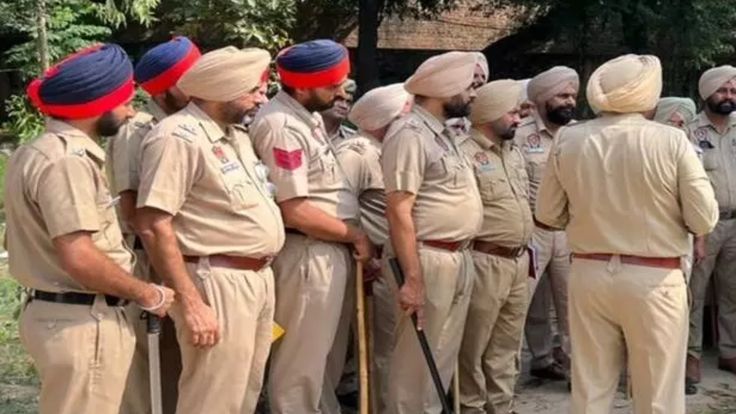
Chandigarh:The Punjab Police have arrested three individuals linked to the banned organisation Sikhs for Justice (SFJ) for writing pro-Khalistan slogans on the walls of government schools in Bhissiana and Mannawala villages of Bathinda district. Officials said the activity was carried out under the directions of SFJ leader Gurpatwant Singh Pannu, who operates from the United States and has been declared a terrorist under the Unlawful Activities (Prevention) Act (UAPA).
DGP Gaurav Yadav confirmed that the accused have been taken into custody and that preliminary investigations reveal a clear link to foreign funding. “The trio was carrying out anti-national activities at the behest of overseas handlers,” Yadav said, adding that their interrogation has already begun.
Bathinda SSP Amneet Kondal said the accused were in constant touch with one Pawanjit Singh alias Deep Chahal, a close associate of Pannu who coordinates from abroad. The men told police they were paid merely Rs 2,000 for painting the walls with pro-Khalistan slogans. “It is shocking to see how little money it takes to lure vulnerable youth into anti-national propaganda,” the SSP said.
Police sources revealed that these acts were not isolated. Earlier this year, several similar cases surfaced where Pannu’s supporters tried to spread separatist and hatred messages across different districts by offering small sums to local youth. Four FIRs were already filed in such cases, and twelve people have been arrested under provisions of the Bhartiya Nyaya Sanhita (BNS), the UAPA, and sections related to sedition and public disorder.
The Bathinda case mirrors a pattern that has been emerging in Punjab over the past few years, where graffiti and wall slogans are being used to provoke unrest, often under the influence of SFJ’s social media campaigns.
In May 2025, pro-Khalistan and “SFJ Zindabad” slogans were found painted near Dashmesh Public School in Faridkot. The police later discovered that the youth involved were paid around Rs 3,000 each for the task. They were promised more if they posted the photos online and tagged SFJ’s accounts. The case was registered under sections related to defacement of public property and sedition.
In December 2023, Himachal Pradesh Police arrested three men from Punjab who had written pro-Khalistan slogans near the Mata Chintpurni temple in Una district. Their interrogation revealed that they were working under directions from overseas handlers and were promised Rs 25,000 each. According to officials, they had been in contact with SFJ members through encrypted messaging platforms, receiving both instructions and money transfers from abroad.
Similarly, in 2021, a group of youths was arrested from Ludhiana, Khanna, and Fatehgarh Sahib for painting pro-Khalistan slogans and distributing pamphlets under the “Referendum 2020” banner. Police had then recovered spray-paint cans, stencils, and English-Punjabi pamphlets bearing SFJ’s name. Investigations found that the group received between Rs 35,000 and Rs 50,000 to execute their work and circulate videos on social media.
These repeated incidents show a well-organised network that runs on meagre payments. Local youths are being recruited for petty sums, often ranging from Rs 2,000 to Rs 50,000, to carry out graffiti, post posters, or share photos online, creating an illusion of widespread separatist sentiment.
According to intelligence agencies, these low-cost propaganda drives are funded from abroad. Pannu and his associates have been using social media to incite young men, especially in rural Punjab, where economic opportunities are limited. Investigators believe that the combination of unemployment, social frustration, and digital exposure has made such youth easy targets.
Officials have also traced small, unregistered transactions that are being routed through digital wallets and hawala channels. These are typically below the threshold that would alert financial regulators, allowing the funding to move discreetly. Once the money reaches the recipients, they are asked to paint slogans, paste posters, or record short video clips pledging support to the “Referendum 2020” campaign.
A senior intelligence officer told The Sunday Guardian, “It is not about ideology anymore. For most of these young men, it’s quick money. They don’t even realise they are part of a larger propaganda effort being directed from abroad.”
In February 2024, just ahead of the anniversary of Operation Bluestar, pro-Khalistan slogans were found painted on a statue of Dr. B.R. Ambedkar near Phillaur. The SFJ later took responsibility through a social media post. That incident, too, was part of a pattern — the attempt to stir communal tension before significant dates.
Police records show more than 14 cases of similar graffiti or poster campaigns in Punjab since 2021. Most were traced back to SFJ-linked handlers, who continue to exploit Punjab’s rural belts to project an image of revival of separatist sentiment.
In almost all these cases, police have found no ideological commitment from those arrested — only financial motivation. The youth involved were often daily wage earners, unemployed, or small-time workers. The Bathinda arrests fit the same pattern, showing how the radical “business” of separatism is being run cheaply, with low investment and high psychological impact.
The Punjab Police have stepped up surveillance in districts bordering Haryana and Rajasthan, where SFJ has been trying to expand its propaganda. Posters, graffiti, and social media videos are being tracked jointly with central agencies. The DGP has urged citizens to report any suspicious graffiti or defacement of property.
State police sources say they are working to identify the funding chain and online handlers who supply material and coordinate propaganda tasks. A special team is analysing digital trails left by the accused to establish how long they have been in contact with SFJ operatives abroad.
The government has already forwarded several dossiers on Pannun and his network to Interpol and requested the U.S. authorities to take action against the SFJ’s online activities that target Indian youth.
From Ludhiana to Bathinda, the story repeats itself — small money, big consequences. The lure of a few thousand rupees has turned graffiti walls into weapons of propaganda. As Punjab Police tighten their grip on these low-cost radical operations, the challenge ahead lies not just in arrests, but in shielding vulnerable youth from becoming easy tools in the hands of separatist networks operating from abroad.




