
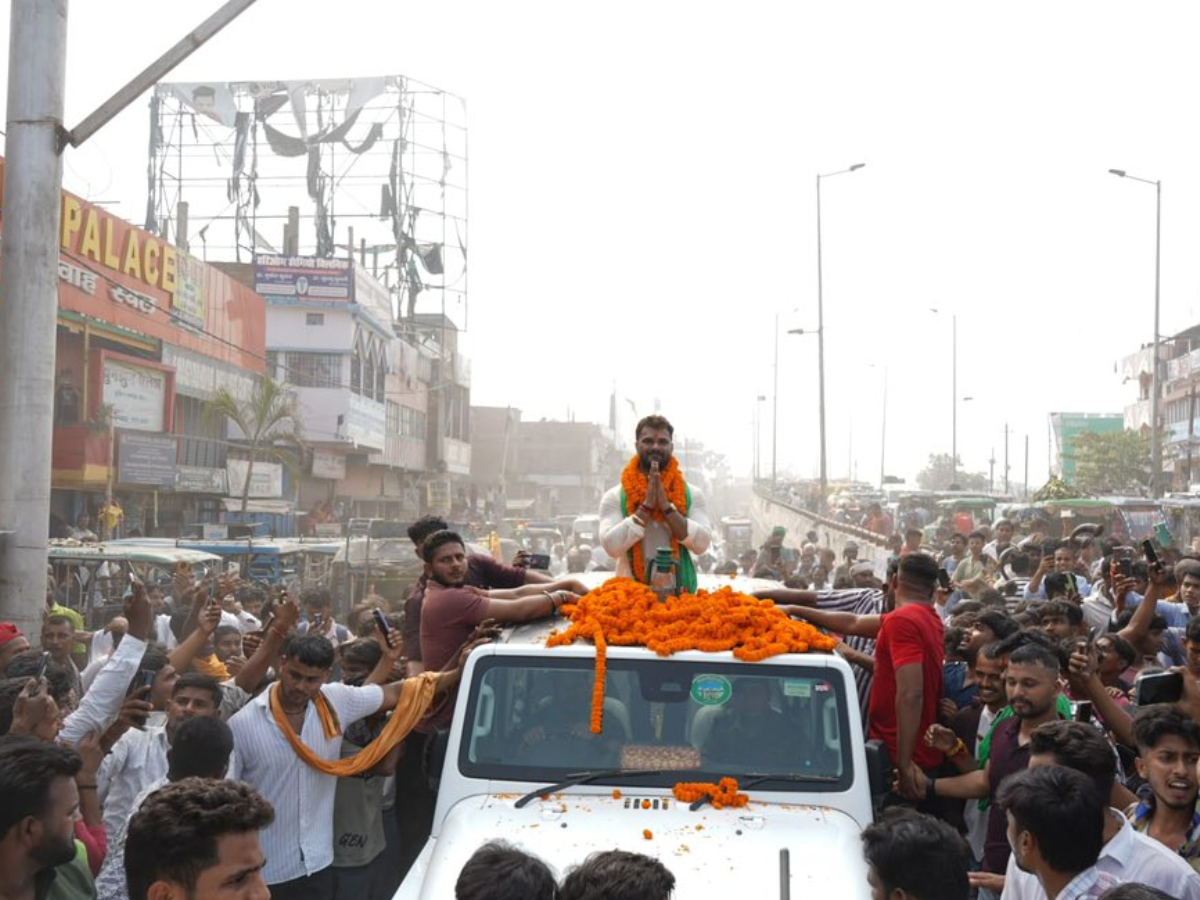
New Delhi: The Chhapra Assembly constituency has emerged as one of the most closely watched and high-stakes contests in the Bihar Assembly elections. Scheduled to vote in the first phase on November 6, the seat is witnessing a multi-cornered battle featuring RJD’s Bhojpuri superstar Khesari Lal Yadav, BJP’s Chhoti Kumari, and Jan Suraaj Party’s Jai Prakash Singh.
Adding further intrigue, Rakhi Gupta, a former municipal council mayor and BJP rebel, has entered the fray, making the contest even more unpredictable and threatening to split traditional BJP votes a challenge for the party’s internal equation.
The RJD’s decision to field Khesari Lal Yadav has thrust Chhapra into the media and public spotlight. The actor’s immense popularity across towns and villages has injected glamour into the race. Yet, as political experts emphasize, Chhapra’s electoral dynamics go far deeper than celebrity appeal they are rooted in complex caste equations and entrenched vote banks, both of which could pose formidable challenges to Khesari despite his mass following.
A longtime BJP bastion, Chhapra has remained a stronghold for the saffron party over the past decade. Veteran BJP leader Dr. C.N. Gupta won back-to-back victories in 2015 and 2020, solidifying the party’s influence and groundwork in the area. This enduring legacy gives the BJP’s new face, Chhoti Kumari, a strong organizational edge and network of loyal cadres to rely on. Falling under the Saran Lok Sabha constituency, Chhapra has continued to favor the BJP at both state and national levels.
In 2020, Dr. C.N. Gupta defeated RJD’s Randhir Kumar Singh by 6,773 votes, while in the 2024 Lok Sabha elections, Rajiv Pratap Rudy of the BJP defeated RJD’s Rohini Acharya by 13,661 votes. Previously, in 2015, Gupta had retained the assembly seat for the BJP, whereas in the 2014 by-election, RJD’s Randhir Kumar Singh secured victory. Going further back, BJP’s Janardan Singh Sigriwal triumphed in 2010, underscoring the party’s consistent dominance.
Caste composition continues to define Chhapra’s political landscape. The Baniya community holds a significant presence with around 90,000 voters, followed by 50,000 Rajputs, 45,000 Yadavs, 39,000 Muslims, and nearly 22,000 voters from Scheduled Castes and other artisan groups. Historically, Rajput and Yadav candidates have dominated the constituency, with every MLA between 1965 and 2014 belonging to one of these two groups.
By contesting from Chhapra, Khesari Lal Yadav is challenging this long-held pattern. Backed by his cinematic stardom and the RJD’s Muslim-Yadav (MY) alliance, he hopes to consolidate a diverse voter base. However, the contest remains three-cornered, with caste loyalties, local grievances, and voter expectations all playing decisive roles. The BJP’s decision to field Chhoti Kumari, a member of the Bania community, aims to strengthen its trader vote base, yet the presence of Rakhi Gupta as a rebel candidate has complicated this strategy, creating the possibility of vote fragmentation within the community.
At the grassroots, voter opinions reveal a tug-of-war between popularity, performance, and promises. Nitish, a 30-year-old resident, told The Sunday Guardian that although Khesari Lal Yadav is immensely popular because of his films, “stardom can’t provide jobs.” A graduate still searching for employment, he said he plans to support whichever party can offer real job opportunities to Bihar’s youth an issue that has become central to the local discourse.
In contrast, Rameshwar, a 70-year-old farmer, voiced his support for the NDA government, citing schemes like PM-Kisan Samman Nidhi, which provides direct financial aid to farmers. “Nitish Kumar has brought development, and I’ll continue to stand with him,” he affirmed.
Among women voters, the NDA also appears to hold significant appeal due to measures such as the liquor ban and reservations for women in government employment. However, law and order remains a persistent concern. Lakshmi, a 25-year-old woman, observed that “safety continues to be a major issue in Bihar; women still don’t feel secure after dark.”
These varied perspectives highlight that while Khesari Lal Yadav’s star presence has energized the Chhapra contest, voters are primarily focused on core issues like employment, development, and safety. The election will test whether celebrity charisma can transcend caste and ground realities, or whether traditional voting patterns will once again dictate the outcome.
As polling day approaches on November 6, anticipation is building across Bihar. The result, to be declared on November 14, will not only determine Khesari Lal Yadav’s political future but could also redefine the balance of power in one of the state’s most politically charged constituencies.




