
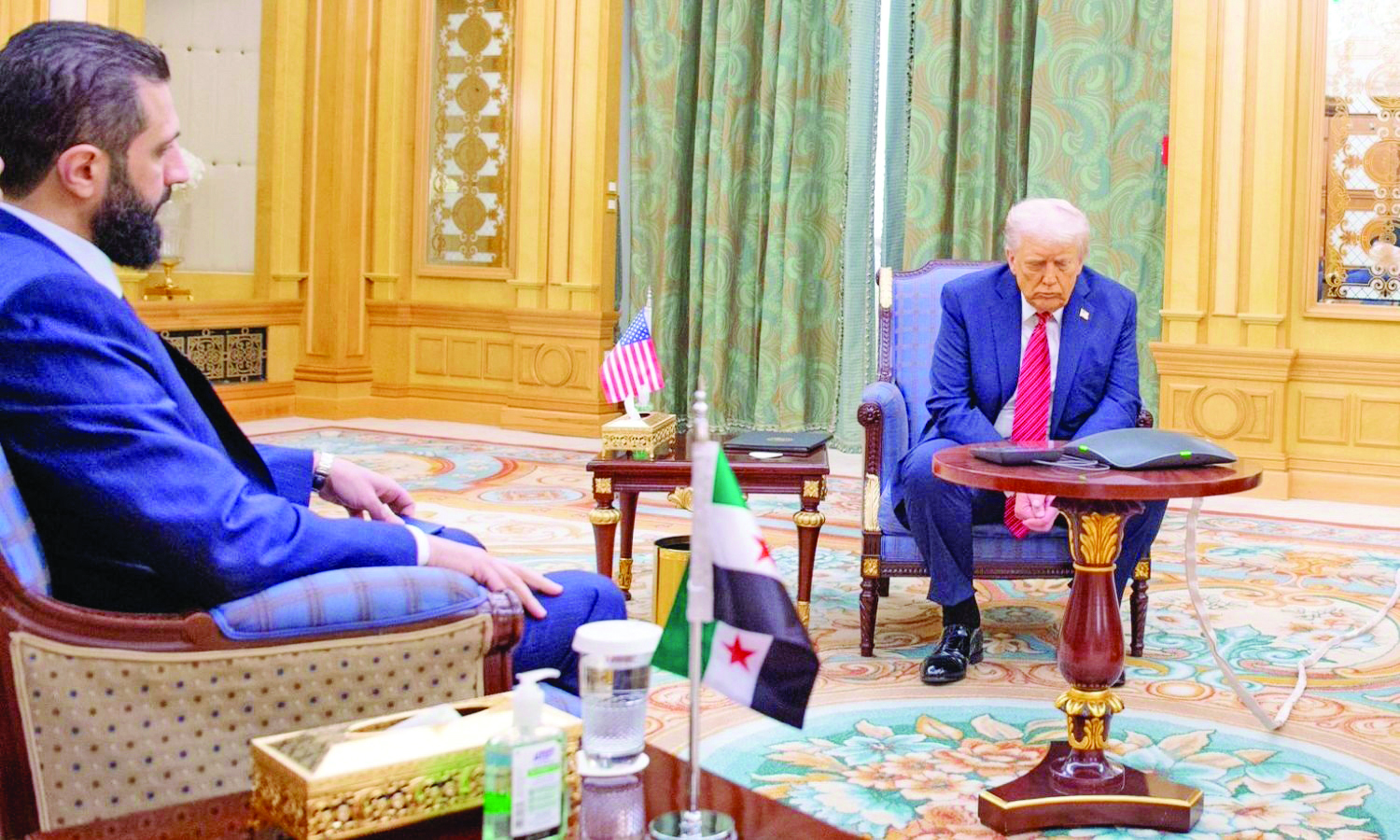
LONDON: In the swirling turbulence of the Middle East’s longest-running conflict, the figure of Ahmed al-Sharaa stands out as one of the most dramatic transformations in recent history. Born in Riyadh in 1982, al-Sharaa would later emerge as the leader of a rebel insurgency and in a lightening campaign in December 2024, claim the presidency of Syria following the overthrow of Bashar al-Assad’s regime. Last Monday he was a guest of President Donald Trump in the White House, the first ever visit by a Syrian president to Washington. Only days earlier, al-Sharaa was officially regarded by America as a “specially designated global terrorist”!
Al-Sharaa’s early years are shrouded in the secretive milieu of jihadist networks. According to his biography, he spent time fighting in Iraq as a member of the affiliate group of al-Qaeda, then returned to Syria as the state unspooled into civil war. In 2016, he publicly severed formal ties with Al-Qaeda by re-branding his group and shifting towards a more self-styled governance role. From 2017 onwards, al-Sharaa directed the group Hayat Tahrir al-Sham (HTS) and oversaw its consolidation of power in north-western Syria, particularly the Idlib region. Under his watch, HTS established a parallel administration in the form of the Syrian Salvation Government that delivered public services, issued identity cards, and collected taxes, activities once the exclusive domain of the state.
It was in November last year that al-Sharaa seized his most consequential moment. Exploiting the withdrawal and weakening of pro-Assad forces, HTS launched a rapid campaign that toppled regime control in Aleppo, Homs and finally the capital Damascus itself. In the aftermath, he was officially named Syria’s transitional president on 29 January 2025. His ascent triggered sweeping institutional changes: the 2012 constitution was suspended, the old Ba’ath Party dissolved, and all armed factions were instructed to integrate into a new national army. For a leader who began as an insurgent, the shift to head-of-state status was astonishing.
Internationally, al-Sharaa has worked to reset ties. He attended the United Nations General Assembly in New York in September this year, becoming the first Syrian head-of-state to do so in nearly 60 years. Meanwhile, Arab states have publicly congratulated his appointment, signalling his acceptance in the region, though the depth of acceptance remains under scrutiny.
Al-Sharaa’s immediate task, however, is confronting the lingering threat of the extremist group Islamic State (ISIS). Al-Sharaa has publicly claimed that he is “ISIS’s biggest victim”, arguing his forces have been engaged in the fight against the group for years. Analysts suggest his forces have conducted 75 counter terrorism operations against ISIS between 2017 and the present. In May, for example, Syrian security forces under the interim government announced raids on ISIS sleeper-cells in Aleppo, killing militants and arresting others. In retaliation, ISIS have made two separate attempts on al-Sharra’s life, according to the Kuwait Times last Monday. The reported plots, said the newspaper, came to light as Syria is poised to join a US-led global anti-Islamic State coalition, exemplifying Syria’s shift since the fall of Assad from being a key ally of Russia and Iran towards closer ties with the Western and Arab camps. The Kuwait Times also reported that over last weekend, the Syrian interior ministry launched a nationwide campaign targeting 15 cells across the country, apprehending more that 70 suspects who, according to Syrian intelligence, were planning operations against government and Syrian minority groups. It was also intended as a message that they had deeply penetrated the group and that joining the coalition would bring a major asset to global operations against the militants.
Syria’s relationship with Moscow is also high on al-Sharaa’s agenda. It was Russia’s 2015 military intervention in Syria’s civil war that kept former President Assad’s brutal regime in power and came at great cost to the Syrian people. A 2020 UN investigation into atrocities committed in Syria accused Russia of direct involvement in war crimes for indiscriminate bombing of civilian targets such as medical facilities. Russia’s backing of Assad allowed it to expand its influence and establish several key military facilities in Syria. The fate of Russia’s two main military bases in Syria was thrown into doubt after Assad’s dramatic fall, and its presence there has been sharply reduced. The sites hold an outsize importance to Russia. The Tartus naval facility gives Moscow access to a warm water port, while the Kremlin has used the Khmeimim air-base as a staging post to fly its military contractors in and out of locations in Africa.
Al-Sharaa travelled to Moscow on 15 October for talks with President Vladimir Putin, marking their first meeting since the fall of Assad and his subsequent exile in Russia. The talks underscored Moscow’s efforts to safeguard its military foothold in Syria and forge relations with Damascus. For al-Sharaa, the Moscow visit marked an effort to diversify his alliances and project a more moderate state-building image. Speaking in the Kremlin after the meeting, al-Sharaa said his government respected all previously signed agreements between Damascus and Moscow, indicating that Russia would be allowed to retain its military bases in Syria, although the exact scale of their presence remains unclear. Syria may also view Moscow as a counterweight to Israel, which has repeatedly bombed Syrian military facilities over the past year.
Now 42, Ahmed al-Sharaa, who once had a $10 million US bounty on his head and was detained by US forces in Iraq for his earlier militant affiliations, is rebranding himself as a reformer and statesman. He’s having some success. The US formally dropped HTS’s terrorist designation after al-Sharaa met President Trump in Riyadh last July and lifted sanctions on the new government. Trump hailed the Syrian leader as “young, attractive, and tough” in an interview after the meeting, and also encouraged him to recognise Israel under the Abraham Accords. Al-Sharaa later made waves in a highly unusual appearance on US TV talk programme, “60 Minutes”, when he was interviewed by CBS News correspondent Margaret Brennan. When asked about Trump’s description of him as young, attractive and tough, al-Sharaa replied with a flirtatious smile “have you any doubt about that?”. Clips of the exchange racked up millions of views on social media within hours, with users joking about the Syrian president’s demeanour and dubbing him “President Rizz”. In Gen Z slang, “rizz” is short for “charisma”, and the term usually implies a man’s ability to attract women.
Charismatic though he may be, al-Sharaa’s presidency is not without profound contradictions and heavy burdens. His past as a militant leader continues to cast a shadow over his legitimacy. The entry of HTS into government raises tensions about whether Syrian governance under him will be genuinely inclusive or dominated by his former movement. He has pledged a new political transition, national dialogue and elections, but has said it could take three to four years. Domestically, al-Sharaa faces the immense task of rebuilding a fractured society ravaged by years of conflict. Reports of mass killings of minority communities and sectarian backlash pose serious tests of his ability to protect rights and restore stability. His promise of pluralism – that diversity in Syria is “strength, not weakness” – will be weighed in the years ahead.
Perhaps the most striking thing, however, is the pace of al-Sharaa’s evolution: from jihadist combatant, to rebel commander, to head of state. His story captures the paradoxes of Syria itself – a country torn by war, reordering itself under new leadership, with both hope and warning signs in equal measure. Whether al-Sharaa’s rule becomes a genuine new chapter in Syrian governance, or a reversion of old dynamics, remains the defining question of his presidency.
John Dobson is a former British diplomat, who worked in UK Prime Minister John Major’s office between 1995 and 1998. He is currently a visiting fellow at the University of Plymouth.




