
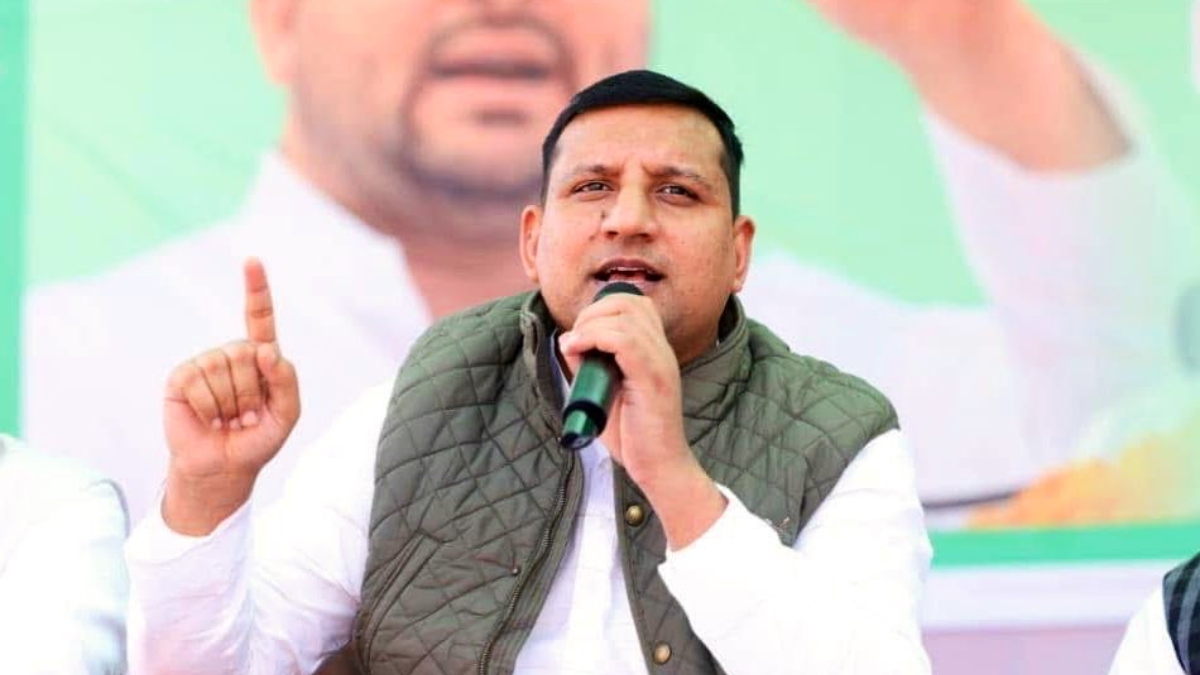
NEW DELHI: The Rashtriya Janata Dal finds itself engulfed in a political storm following the Bihar Assembly election results declared on 14 November, with all eyes turning to a figure who has long operated in the shadows: Rajya Sabha MP Sanjay Yadav. Once a low-profile adviser, he now stands at the epicenter of the party’s internal turmoil, his influence and decisions under the harshest public scrutiny the RJD has witnessed in years.
The controversy exploded into full view on the very day results were announced. Rohini Acharya, daughter of RJD supremo Lalu Prasad Yadav, posted a stunning message on X declaring she was “quitting politics” and “disowning her family”. In her emotional outburst, she directly blamed Sanjay Yadav and another adviser, Rameez, for pushing her to this breaking point. This latest upheaval marks the culmination of months of simmering discontent within the RJD.
His trajectory is unconventional by any measure. According to his Election Commission affidavit, he hails from Todarmal Colony in Najafgarh, Delhi, where he lives with his father Prabhati Lal Yadav. Armed with Bachelor’s and Master’s degrees in Computer Science from Makhanlal Chaturvedi University, he seemed destined for a conventional career in technology until fate intervened through cricket.
His entry into the RJD’s inner circle came through friendship with Tejashwi Yadav during the latter’s cricketing days. When Lalu Prasad was jailed in the fodder scam in 2013 and the family urgently needed Tejashwi back in Patna to begin his political innings, the young scion turned to one of the few people he trusted deeply: his Haryana-born friend, Sanjay Yadav. What began as friendship evolved into something far more significant. Sanjay became Tejashwi’s strategist, sounding board, troubleshooter and, over time, one of the few people who could influence him both politically and personally. Those close to Tejashwi acknowledge that the “new” Tejashwi who emerged in recent years more disciplined, articulate, and organized was shaped significantly by Sanjay’s structuring, planning, and messaging.
His proximity was neither subtle nor hidden. It was constant, visible, and increasingly powerful. When the RJD sent him to the Rajya Sabha in April 2024, it was widely interpreted as Tejashwi’s acknowledgement of his indispensability. But power exercised from the shadows, especially by someone outside Bihar’s traditional political networks, inevitably breeds suspicion. Within the extended Lalu family and parts of the party, murmurs began that Sanjay had too much access, too much influence, too much say.
The first public rupture came in September 2025 during Tejashwi’s Bihar Adhikar Yatra. A single photograph went viral: Sanjay sitting in the front seat of Tejashwi’s campaign bus. What might have been dismissed as trivial ignited a political firestorm. Rohini Acharya publicly rebuked him on social media, accusing him without naming him directly of acting “above the top leadership” and declaring that the front seat was reserved for the leader, occupied or not. A day later, Tej Pratap Yadav escalated the attack, branding him a “Jaichand” a reference to the legendary traitor and warning that Sanjay wanted to usurp Tejashwi’s position.
As election season intensified, the anger surrounding Sanjay took a more serious turn, this time tied directly to ticket distribution. Kochadhaman constituency in Kishanganj became the flashpoint. On the eve of results, an RJD ticket aspirant made explosive public allegations: that Sanjay had demanded Rs 5.5 crore from him for the party ticket. He claimed he spent days in Patna lobbying, requested that he should be allowed to contest due to his electoral strength, and warned he would run as an Independent if his request is denied. When the ticket was denied, he did exactly that—filing as an Independent, later withdrawing, and then actively supporting AIMIM to defeat the RJD.
On 14 November, the results delivered a crushing blow. AIMIM’s Md. Sarwar Alam won Kochadhaman by a massive margin of 23,021 votes. Many in the Seemanchal region interpreted the defeat not merely as an electoral setback but as a revolt against internal decisions and, implicitly, against Sanjay’s role in the ticket allocation process. The same day brought the emotional eruption from Rohini Acharya that laid bare just how deeply the crisis had penetrated the family’s core.
Yet amid the cacophony of criticism, another narrative persists—one acknowledged even by some of his detractors. Sanjay Yadav has remained unfailingly loyal to Tejashwi. His closeness, his central role, his unprecedented access all stem from a genuine belief that Tejashwi represents the future of both the RJD and Bihar politics. Those who defend him argue that he has consistently made decisions with Tejashwi’s interests paramount, even when those choices angered powerful factions within the party. They contend that much of the backlash stems not from genuine missteps but from jealousy, insecurity, and the old guard’s fundamental discomfort with a non-Yadav, non-Bihari confidant wielding such influence over the heir apparent.




