
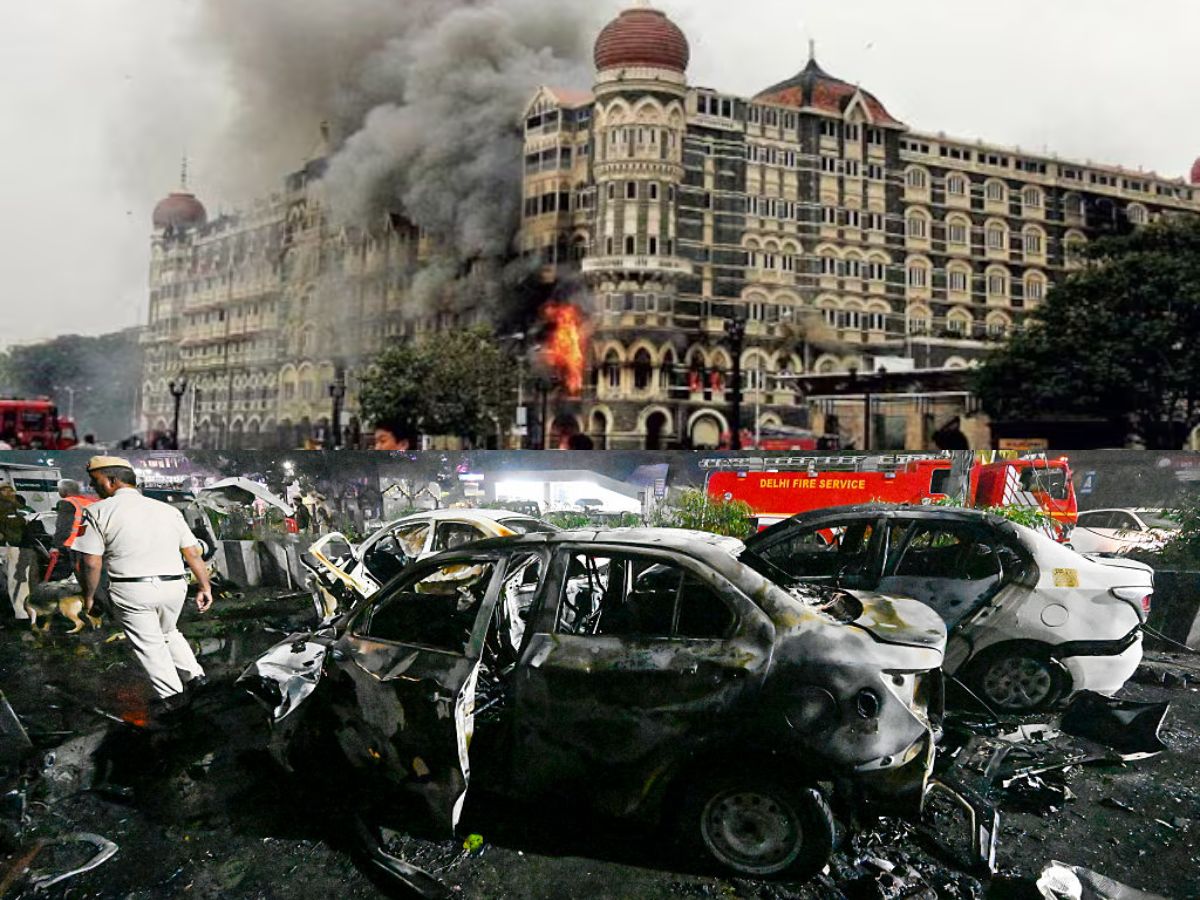
New Delhi: On the night of 26 November 2008, Mumbai was held hostage for nearly 60 hours. Ten Lashkar-e-Taiba operatives landed on Indian shores after months of preparation, coordinated from Pakistan, guided in real time by handlers in Karachi. Their attack on hotels of national importance, a railway terminus of national importance, cafés and a Jewish centre killed 166 people and left many more wounded. The siege was not only a moment of national grief but also the clearest demonstration of a system that India had warned the world about. Terror directed from Pakistani soil, supported by its networks, and executed with military-style precision.
17 years have passed since that night. The weapons have changed, the targets have shifted, and the groups have rotated recruits, but the skeletal structure that enabled 26/11 has continued to operate. Each major attack that has followed reflects the same pattern. Planning in Pakistan. Training in Pakistan. Infiltration across the Line of Control or through maritime routes. Execution by groups that function as arms of Pakistan’s strategic doctrine.
In the years after Mumbai, India faced a series of major attacks that carried the same signature. The 2010 Pune German Bakery blast was linked to networks with operational bases in Pakistan. The 2013 attack on a CRPF camp in Bemina was conducted by men trained across the border. In July 2015, gunmen attacked a police station in Gurdaspur. In January 2016, the attack on the Pathankot Air Force base involved infiltrators guided by handlers in Pakistan. These were not isolated bursts of violence. They were fragments of a continuous flow.
The attack in Uri in September 2016 was one of the most direct examples of cross-border infiltration. Militants crossed from Pakistan-occupied territory into the Uri sector and targeted an Indian Army brigade headquarters, killing 19 soldiers. Intercepts, GPS data and recovered equipment pointed to clear Pakistani origin. India’s response, through precision strikes on terror launch pads across the Line of Control, marked a shift in posture. Yet even that shift did not alter the underlying reality. Groups like Lashkar-e-Taiba and Jaish-e-Mohammed remained active within Pakistan, protected by layers of state bureaucracy, charitable fronts and intelligence patronage.
In February 2019, the Pulwama suicide bombing killed 40 CRPF personnel. The attack was claimed by Jaish-e-Mohammed. The bomber was local, radicalised through networks whose digital footprint extended into Pakistan. The explosives and the planning process once again traced back to handlers operating from Pakistani safe zones. International pressure rose briefly, but Pakistan responded with its familiar cycle of denial and token measures that never addressed the system itself.
India’s intelligence agencies continued to intercept communications, track recruitment channels and map funding routes. Each time, the threads led back to Pakistan. Training camps in Pakistan-administered Kashmir. Financial flows routed through charities and informal networks. Recovered weapons with Pakistani markings. Recruits moved to and from seminaries in Lahore, Bahawalpur and Karachi. Despite global scrutiny, these networks continued to regenerate, protected by the very institutions that claim to fight terror.
In June 2025, the Pahalgam attack once again exposed the continuity of this machinery. Militants targeted an Indian Army convoy in Kashmir, killing several personnel. Forensic examination of the communication devices recovered from the site indicated connectivity with numbers traced back to Pakistan. The field commanders involved belonged to a group operating under Lashkar’s umbrella. Their infiltration route was consistent with previous patterns, crossing into Indian territory through mountain passes used for decades by Pakistan-based groups. The digital trail, like so many before it, returned to the same geography, the same safe houses, the same supervisors.
These recurring attacks demonstrate not evolution but persistence. Pakistan’s intelligence establishment has allowed designated groups to operate with impunity. Leaders of these organisations move freely. Their training facilities remain functional. Their propaganda channels operate openly. Crackdowns occur only under external pressure and are reversed quietly once scrutiny fades. The groups change their names, shift their bank accounts, rotate their cadres, but the core structure remains intact.
For India, the anniversary of 26/11 is a moment to mourn, but it is also a moment to recognise a truth that has not changed since 2008. Mumbai was not the beginning of cross-border terror. And unfortunately, it was not the end. It was the most visible chapter in a long sequence. From Mumbai to Pathankot, from Pulwama to Pahalgam, India has faced a consistent threat that originates not in isolated extremist pockets but in a system embedded within Pakistan’s strategic apparatus.
The world has begun acknowledging this pattern. International organisations have designated the groups involved. Multiple countries have raised concerns about Pakistan’s safe havens. The Financial Action Task Force has documented funding routes and support structures. Yet Pakistan continues to position itself as a victim of terror, insisting that its territory is used without its consent. The repeated recovery of Pakistani weapons, training manuals, communication devices and GPS coordinates inside India contradicts that claim.
17 years after Mumbai, the lesson is clear. Terror organisations do not survive for decades without systemic support. They do not train openly without protection. They do not cross borders repeatedly without cooperation from those tasked with monitoring them. India’s vigilance has increased, its capability has grown, and its responses have strengthened. But the core problem lies across the border, within a structure that treats terror as an instrument of statecraft.
The memory of 26/11 carries the weight of loss. It also carries the clarity of evidence. The pattern that produced Mumbai has continued without interruption. The Pahalgam attack shows that India still faces the same adversary, operating through the same channels, sustained by the same state-backed apparatus. Remembrance, therefore, must be tied to recognition. 17 years may have passed, but the system responsible remains unchanged.
Ashish Singh is an award-winning senior journalist with 20 years of experience in defence and strategic affairs.




