
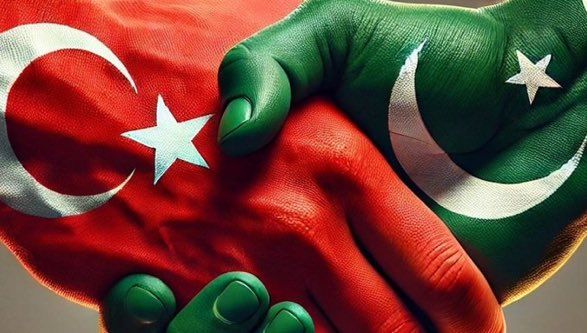
NEW DELHI: Turkey has emerged as the operational pivot for Pakistan’s Inter-Services Intelligence with the two countries intelligence services now moving from quiet liaisoning to visible coordination, with multiple real-world cases now pointing to a pattern of cooperation that extends from counter-terrorism tracking to cross-border manhunts.
The most recent and publicly acknowledged in-stance came in 2025 when Turkey’s National Intelligence Organisation, MIT, and Pakistan’s ISI jointly moved against Islamic State operative Özgür Altun, also known as Abu Yasir al-Turki. Turkish intelligence had been tracking Altun’s movements through digital surveillance and regional networks and concluded that he was attempting to cross into Pakistan via the Afghanistan route. MIT alerted ISI, which then carried out the on-ground operation near the Pakistan-Afghanistan border. Altun was arrested and subsequently handed over to Turkish authorities.
Turkish reports explicitly stated that the operation was conducted with the “full support” and cooperation of ISI, marking one of the clearest examples of live coordination between the two agencies.
This was not the first time the two intelligence services were reported to be work-ing together.
An earlier and more politically sensitive case involved Ehsanullah Ehsan, the former spokesperson of the Pakistani Taliban, who mysteriously escaped from a safe house of the Pakistani army in early 2020.
Later ISI sought the assistance of MIT to trace Ehsan’s movement after intelligence inputs suggested he may have fled towards Turkey. On ISIs request, MIT detained and questioned individuals suspect-ed of facilitating his escape and transit, and shared the details with Pakistani intelligence. Although Ehsan himself was not recaptured, the case became a much quoted example of operational-level cooperation between the two agencies in tracking and attempting to intercept a high-value figure across borders.
Further indications of this growing coordination have emerged through multiple intelligence-linked detentions in Turkey involving individuals connected to South Asia. Turkish authorities have, over the past few years, detained suspects accused of aiding armed movement between Afghanistan, Pakistan and Europe, with security sources indicating that some of these actions were informed by intelligence passed through Pakistani channels.
While official statements often avoid naming ISI directly, the pattern has been acknowledged in Turkish and regional reportage as part of Turkey-Pakistan security coordination.
The shift is now seen by analysts as structural rather than incidental. Turkey provides ISI with a geo-graphically strategic stag-ing environment that al-lows Pakistani intelligence to extend its operational reach into the Middle East while maintaining distance from direct exposure. An-kara sits at the intersection of Europe, the Levant and Central Asia, making it a natural chokepoint for monitoring the movement of militant operatives, finances and facilitators linked to conflict zones in Syria, Iraq and Afghanistan. For ISI, embedding coordination with MIT allows access to these corridors through an allied intelligence service that has deep penetration and operational freedom in the region.
This emerging pattern also aligns with wider de-fence and security cooperation between Ankara and Islamabad, which in recent years has expanded beyond rhetoric into practical coordination. High-level strategic consultations, increased defence production collab-oration and joint military exercises have created an enabling environment for deeper intelligence sharing. The visible joint counter-terror operation and the behind-the-scenes coordination on cases like Ehsanullah Ehsan indicate that intelligence cooperation has become a functional component of the bilateral relationship.
Security officials and analysts tracking armed net-works note that Turkey’s role is particularly relevant in the context of Afghanistan’s, where travel dispersal routes increasingly intersect with transit hubs in the Middle East and Eu-rope. By operating through Turkey, ISI is able to monitor, influence and intercept networks linked to Afghanistan without relying solely on direct, Pakistan-based channels, which are more vulnerable to scrutiny and diplomatic pressure.
The practical implication of this cooperation is that Pakistan’s intelligence operations in the Middle East and Afghanistan are no longer confined to its immediate neighbour-hood but are being routed through a partner with geo-graphic, political and operational depth. This allows ISI to pursue targets, track suspects and coordinate responses with reduced visibility, while Turkey enhances its own counter-terror reach through access to Pakistan’s ground-level intelligence and regional knowledge.
The growing reliance on Turkey as a coordination base signals a recalibration in ISI’s external posture at a time of heightened regional volatility. Rather than rely-ing exclusively on Gulf partners or direct outreach from Pakistani soil, Islamabad appears to be leveraging Ankara’s strategic location and intelligence infrastructure as a forward operational platform. In doing so, it has quietly positioned Turkey as a central node in its intelligence engagement with the Middle East and Afghanistan, marking a shift with clear implications for regional security dynamics.
Turkey now functions as both facilitator and operational partner for Pakistan’s expanding external intelligence footprint.




