
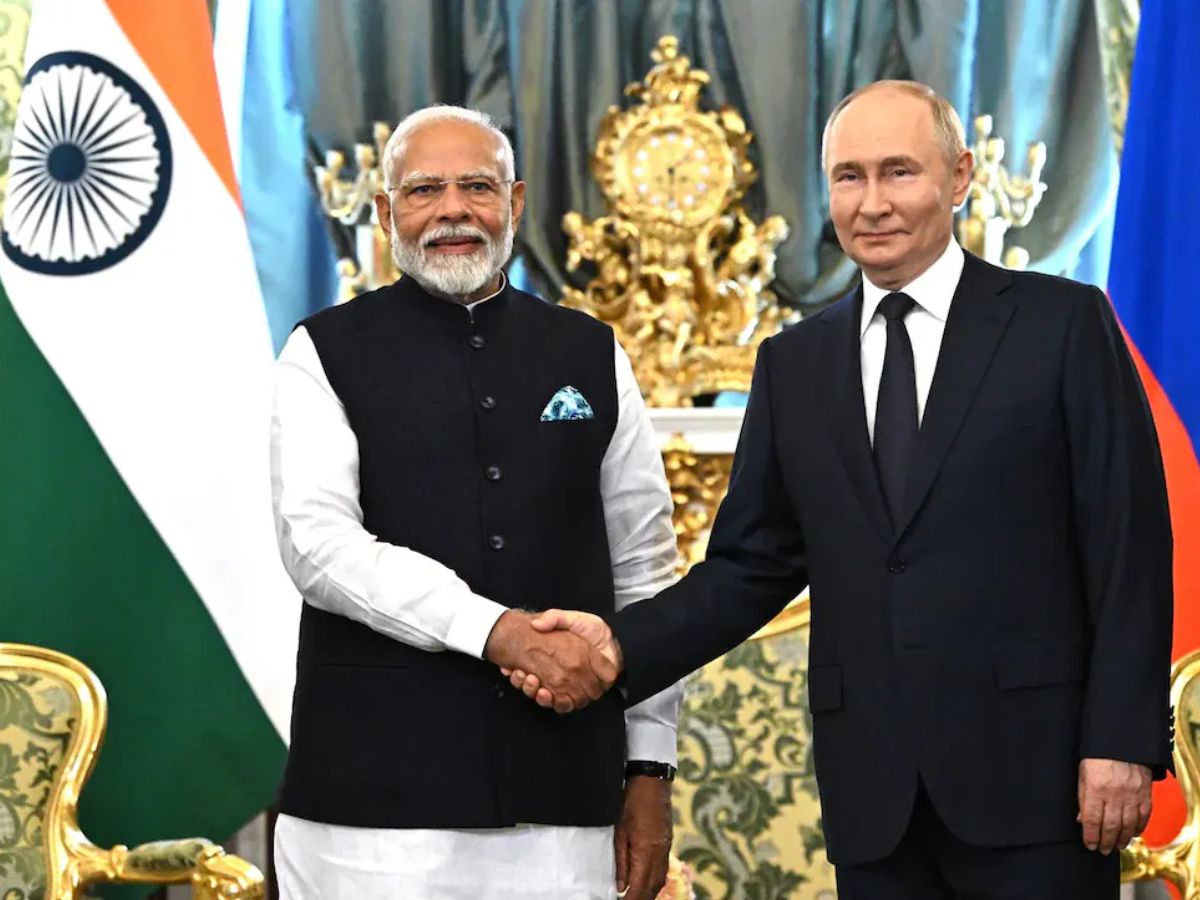
New Delhi: India and Russia on Friday unveiled one of their most wide-ranging cooperation packages in recent years, signing agreements across migration, mobility, health, food safety, maritime training, fertilizers, customs, academia and media exchanges, even as Prime Minister Narendra Modi and President Vladimir Putin reaffirmed the “time-tested” and “Special and Privileged Strategic Partnership” during the 23rd Annual Summit in New Delhi. The agreements were accompanied by a detailed Joint Statement and the adoption of a long-term Programme for Strategic Areas of Economic Cooperation till 2030.
Putin, who paid a State Visit to India from December 4–5, held extensive discussions with Modi on political, security, trade, defence, energy, nuclear, space and regional issues. Marking the 25th anniversary of the Strategic Partnership, the two leaders said the relationship had remained resilient despite global geopolitical turbulence and continues to serve as an anchor of peace and stability.
A major part of the outcomes involved mobility and labour cooperation. India and Russia signed two agreements governing temporary labour activity of citizens in each other’s territory and a separate agreement to combat irregular migration — signalling a push to regulate legal movement while tightening action against trafficking networks. Health and food safety cooperation was strengthened through agreements between the health ministries and food safety regulators of both countries. Maritime collaboration received a boost with MoUs on training specialists for ships operating in polar waters and another between India’s Ministry of Ports, Shipping and Waterways and the Maritime Board of Russia, underlining India’s growing interest in Arctic navigation.
To support India’s agricultural supply chain, a multi-party MoU was finalised between UralChem and three Indian fertilizer PSUs — RCF, NFL and IPL — ensuring long-term and stable fertilizer supplies. Trade facilitation will improve through a protocol enabling exchange of pre-arrival customs information and a separate agreement between India Post and Russian Post to deepen postal and commercial cooperation. Academic partnerships expanded with new collaboration between the Defence Institute of Advanced Technology (Pune) and Tomsk State University, as well as an agreement involving the University of Mumbai, Lomonosov Moscow State University and the Russian Direct Investment Fund’s management company. Media cooperation saw an unprecedented expansion, with six MoUs between Prasar Bharati and leading Russian broadcasters — Gazprom-Media, National Media Group, Big Asia, TV-Novosti and TV BRICS — aimed at content exchange, co-production and wider dissemination.
India announced 30-day e-Tourist visas on a gratis basis for Russian nationals, alongside gratis group visas. Both sides also cleared an agreement for the Moscow exhibition “India. Fabric of Time,” and Russia formally adopted the Framework Agreement to join the International Big Cat Alliance (IBCA), marking a notable convergence on wildlife conservation.
According to the Joint Statement, both leaders reaffirmed their ambition to expand bilateral trade to USD 100 billion by 2030, supported by the newly adopted 2030 Economic Cooperation Programme. This includes work on a Free Trade Agreement with the Eurasian Economic Union, the promotion of investments, the removal of tariff and non-tariff barriers, smoother logistics, improved payment systems, and enhanced use of national currencies. The two sides also agreed to pursue interoperability between digital payment platforms and central bank digital currency systems. Long-term fertilizer supply commitments were acknowledged, as well as agreements on the mobility of skilled workers. Russia welcomed Indian participation in the St. Petersburg and Eastern Economic Forums, while both countries emphasised the importance of stable mineral, energy and critical raw material trade for national security and supply-chain reliability.
Energy cooperation remained a major pillar, covering oil, petroleum products, refining, petrochemicals, LNG and LPG infrastructure, underground coal gasification and nuclear energy. Both sides committed to resolve outstanding investment issues, accelerate the Kudankulam Nuclear Power Plant’s remaining units, maintain timelines for fuel and equipment supply, and continue discussions on the second nuclear site in India. They agreed to expand cooperation on VVER reactors, joint manufacturing of nuclear equipment and fuel assemblies, and research on high-technology nuclear applications.
On connectivity, the two countries agreed to deepen collaboration on the International North-South Transport Corridor, the Chennai–Vladivostok maritime corridor and the Northern Sea Route, while welcoming the MoU on training for polar-water navigation. Railway cooperation continues to expand, and both sides committed to greater investment in the Russian Far East and the Arctic under the 2024–29 cooperation programme. Russia appreciated India’s participation in the International Arctic Forum, while India reiterated readiness to play an active role as an Observer in the Arctic Council.
Military and military-technical cooperation remained central to the partnership. The leaders welcomed the outcomes of the IRIGC-M&MTC meeting and reaffirmed their shift toward joint research, co-development and co-production of advanced defence technologies in line with India’s self-reliance goals. Regular military exchanges, INDRA exercises and joint manufacturing of spares for Russian-origin equipment — including for export to friendly countries — were strongly endorsed.
Science, technology and innovation cooperation will deepen under the bilateral STI roadmap, including joint R&D, support for start-ups, digital technologies, cyber infrastructure security, critical minerals, rare earths and recycling technologies. Both sides expressed interest in expanding academic mobility, scientific exhibitions and collaboration in higher education institutions.
Cultural and people-to-people exchanges received strong emphasis, with both countries supporting cultural festivals, film collaborations, tourism growth and educational linkages. The simplification of visa regimes, including India’s e-Visa for Russians, was highlighted as a driver for rising tourist flows.
On multilateral cooperation, India and Russia reiterated their alignment at the UN, G20, BRICS and SCO, calling for comprehensive UN Security Council reform and reaffirming Russia’s support for India’s permanent membership. Both sides emphasised strengthening BRICS, supporting India’s 2026 chairship, and deepening cooperation on climate change, sustainable development, international supply-chain resilience and reform of multilateral development banks.
Counter-terrorism cooperation occupied a large section of the statement. Both sides condemned recent terror attacks in Pahalgam and Moscow, called for zero tolerance toward terrorism in all forms, demanded action against all UN-listed groups including Al Qaeda and ISIS, and committed to preventing cross-border movement of terrorists, terror financing, radicalisation and online extremist content. They welcomed the Delhi Declaration of the UNSC CTC and emphasised implementation of UNGA and UNSC resolutions without double standards.
On regional affairs, the leaders exchanged views on Afghanistan, the Middle East and climate change. They emphasised humanitarian support for Afghans, the need for restraint and adherence to international law in West Asia, support for the Joint Working Group on climate change, and cooperation under BRICS climate platforms. India looked forward to Russia joining the International Solar Alliance and CDRI.
Concluding the visit, both sides noted the resilience of their strategic partnership and reaffirmed their resolve to continue strengthening it across all pillars. Putin invited Prime Minister Modi to visit Russia in 2026 for the next annual summit.




