
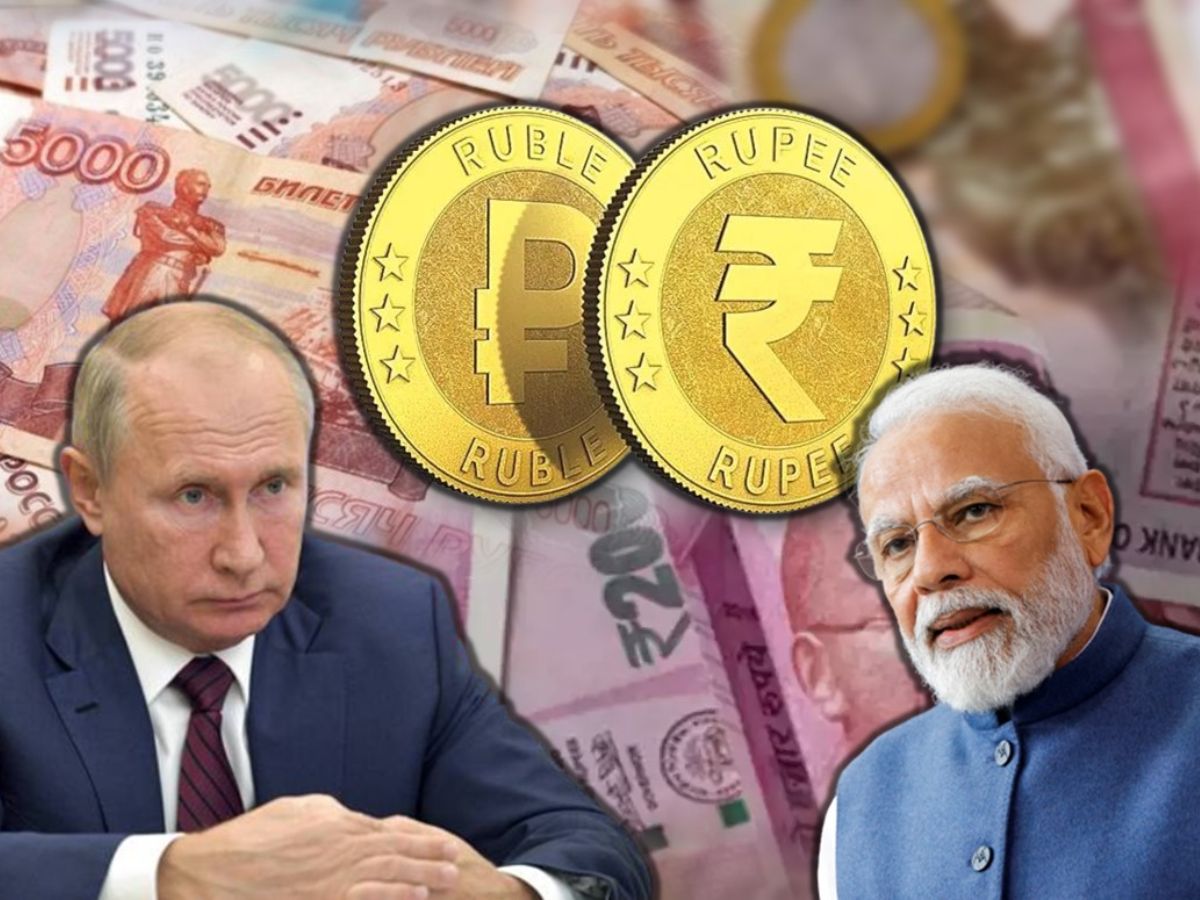
President Vladimir Vladimirovich Putin of the Russian Federation must be aware that it was the Rupee-Ruble trade agreement of 1953 that opened the sluice gates of the immense volume of exports from Moscow to New Delhi. The Rupee-Ruble agreement established a close relationship between the two countries, so much so that when the Soviet Union collapsed in 1991, India was the only country that repaid its debt to Russia to the extent that it paid back the full value of the ruble before the Soviet collapse. After that, the value of the ruble collapsed, and the few other countries that paid back the successor Russian Federation did so using the collapsing value of the ruble as the exchange value for repaying Soviet-era debt. The sacrifice of its own interests for the benefit of the Russian Federation was repaid by Russia in a contrary manner. Firmly in the pocket of oligarchs loyal to Washington rather than their own country, the new leader Boris Yeltsin gave the cold shoulder to India and its interests to please the US under President William Jefferson Clinton. Yeltsin, by his policy of assisting the US, impoverished the Russian population. Mafias seized control of the properties of the erstwhile Soviet Union, including the dwellings of millions, which in Soviet days was technically state property. Russian families, who for decades had led comfortable lives, suddenly found themselves on the street, their ruble savings worthless. No wonder President Putin described the collapse of the Soviet Union as the “worst disaster” that the Russians ever faced. In a country that in the past had abounded with disasters, this was a dramatic but perhaps factual statement. The leaders of neither Brazil nor South Africa mustered the courage to stand up to European bullying, as a consequence of which President Putin was forced to keep away from these countries. In contrast, Prime Minister Narendra Modi personally welcomed President Putin at the airport tarmac when he arrived in New Delhi on 4 December. The friendship between PM Modi and President Putin showed bullying by countries that were once dominant on the world stage but are so no longer. Small wonder that the Modi-Putin summit was front page news in Russophobic European capitals. They had worked hard since Russia invaded the Russian speaking territories of Ukraine on 24 February 2022 to make the international community shun Putin as they themselves were. In an evolving multipolar world, seeking to assert a dominance no longer extant is, to put it mildly, unwise. By the 23rd India-Russia Summit, Putin showed his detractors in some countries of Europe that he was far from being the global outcast they wanted him to be. Indeed, in a way they were the outsiders, their dictates ignored by much of the world. Not least by India, with its population being the world’s largest. Nor by China, which has the second largest population in the world. It is a matter of surprise that countries low in population and having a diminishing share of the overall GDP of the world should believe that they, and they alone, are the “international community”. Indeed, a recent President of the European Commission, Josep Borrell, went so far as to describe Europe as a “garden” and the rest of the world as a “jungle”. India has shown its reliability as a friend to Russia, and the best way of Moscow reciprocating would be to revive the Rupee-Ruble agreement in full. Asking for payments for its exports to India in currencies such as the RMB is not the sign of a reliable friend and partner. Going back to the days of the Rupee-Ruble agreement would be an unmistakable sign of the friendship between Russia and India. President Putin, the time for that is now.
773




