
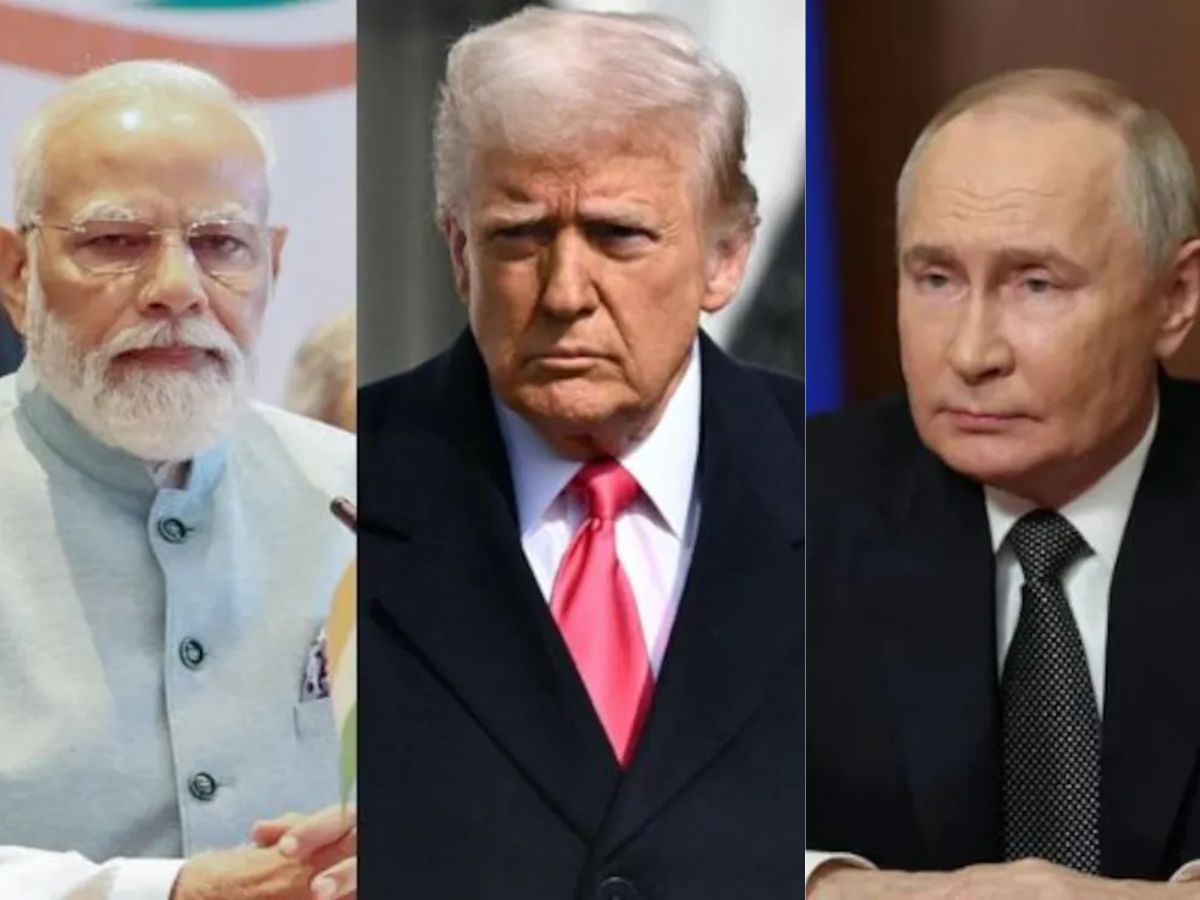
Although not stated so starkly, the strategic centrepoint of what may be termed the Real Donald Trump was to be the building of a strong US-India-Russia partnership. Somewhere along the way during the very first year of his second term as President of the United States, Trump appears to have lost the inner compass that had guided him so well during his 2024 candidacy and the initial months in his second term as US President. As a consequence, what may be termed the new avatar of President Trump has witnessed a bewildering array of U-turns that in substance are the opposite of the intentions expressed by Donald Trump during his magnificently courageous campaign to be the 47th US President since the founding of the country and giving it a Constitution by George Washington and his associates in 1787. Brushing off the calumny spread about him that the business tycoon was a “Russian agent”, Candidate Trump spoke of Russia and the US becoming partners, not foes, for the first time since the 1939-45 Great War between the Allies and the Axis. In that war, the USSR played the keystone role in defeating the once invincible Wehrmacht, the Nazi Germany army. The Wehrmacht got to the gates of Leningrad, Moscow and Stalingrad but were rebuffed at a great cost in Soviet lives. After Operation Barbarossa, the Nazi invasion of the Soviet Union, commenced on 22 June 1941, initially the Soviet forces were routed and either killed on the battlefield or later as Prisoners of War in their millions.
Although General Secretary Stalin was informed by a Soviet source of the date and time (3 am) of the Wehrmacht invasion a few days before, he dismissed it as a “provocation” planted by the British and ordered the immediate execution through firing squad of the bearer of the news. Stalin refused to move the immense Soviet army into defensive positions, for fear that such a mobilisation would be interpreted by Adolf Hitler as a prelude to war against Germany. Earlier, Stalin had executed some of the finest generals in the Soviet army, calling them “puppets of the German army”. Over two years of fighting the Nazis caused the crop of commanders to develop the steel needed to fight and win the “Great Patriotic War”.
It must be said to the credit of Stalin that he remained in Moscow even when the sound of approaching German artillery fire was heard within the Kremlin. He addressed the 1941 Annual National Day speech in November not from a bunker but from the ramparts of the Red Square itself. The troops marching in formation before him on that day marched on straight to the front. It was fortunate that the US had a President of the calibre of Franklin Delano Roosevelt, who ensured a copious flow of US weapons and other assistance to the Soviets. A less gifted individual would have been miserly in sanctioning such a flow, and as a consequence, the German armies may have been able to breach the gates of Moscow and enter Red Square. A combination of US weapons and Soviet armed forces personnel ensured the loss of the initiative in battle of the Wehrmacht by June 1944 and its defeat and surrender less than a year later.
Roosevelt ensured a partnership between the Soviets and the US that won the war. The pairing showed the value of such a partnership. Incidentally, during the war Roosevelt incurred the fury of Prime Minister Winston Spencer Churchill in what at the time was Great Britain (which subsequently became the United Kingdom after the colonies were lost.) by advocating the giving of freedom to India by the British. And it is in the wisdom of Roosevelt that we see for the first time a vision of the US, India and Russia teaming up. More than a century later, much the same vision was demonstrated by the incoming 47th President of the US, who as a consequence adopted a policy of friendship with Russia and a partnership with India. Such an objective was opposed by several European states led by leaders who continue to forget that Asia and not Europe is now the centre of geopolitical influence.
Since the delegitimization of the Russian language and the conversion of Russian-speaking Ukrainians into second class citizens in post-2014 Ukraine, much of Europe in the persona of its leaders have seen a continuation of the Cold War 1.0 reality, when the Soviet Union was the foe. Such a reversion into a no longer relevant past suits the real foe of the democracies during what is now Cold War 2.0, which is ongoing on several fronts. India is at the front line of this hybrid war, and yet some of the European leaders tether their minds to the past and fixate on Moscow rather than on Beijing as the adversary.
In his reaching out to Russia and a possible softening of his earlier hard line on India, it is discernible that traces of Trump in his earlier sharp and accurate strategic vision have become visible. The question is whether such a change is simply a false dawn, or truly represents a change from the present avatar to the Real Donald Trump once again. Should that happen, even the European powers now battling Russia through Ukraine would benefit. It is telling that the Foreign Minister of Poland, Radoslav Sikorski, is a descendant of Wladislav Sikorski, who in 1939, in effect, opened the gates of Warsaw to the Nazis by being adamant in refusing to permit the passage of Soviet troops to the west, although such crossings were essential if the efforts of Stalin to forge an alliance with the western powers against the Nazis were to succeed. By his extreme hawkishness on the Russians, Radoslav Sikorski is making the same mistake as his ancestor did, confusing the actual adversary as a friend and a potential valuable ally as the foe. Poland paid the price for the folly of Sikorski in September 1939, when the Nazi armies swept across Poland, killing and looting at will that beautiful country. Vladimir Putin, his patience getting exhausted, has publicly warned after European diatribes that “If Europe wants war with Russia, Europe will get the war”. The danger of a World War III would begin, as was warned several times by the Real Donald Trump during his 2014 campaign for the Presidency. Such a war would be a disaster for the world, just as a US-India-Russia partnership would make such a war impossible for adversary powers. A triumvirate that would be invincible in peace and war, and hence deter adversary powers from a kinetic attack. The errors of the first four decades of the 20th century need to avoid being repeated in the 21st.
What the world needs is the re-emergence of the Real Donald Trump, who sheds his inexplicable new avatar, and hopefully, such a change will happen. Despite a few doubtful choices, several in the Cabinet chosen by President Trump are outstanding in their intellect and understanding of present-day geopolitical reality. They include Vice-President J.D. Vance, Secretary of State Marco Rubio, Director of National Intelligence Lt-Col Tulsi Gabbard and Donald Trump Jr, who served Trump bravely and strongly during his days of persecution by the Biden administration. They need to assist the President to shed his present avatar, which is a one-way ticket to political oblivion and obloquy, and ensure that the Real Donald Trump returns. And his historic achievement will be an US-India-Russia partnership. Only Trump in his pre-avatar period can bring about such an alliance, which will be set to dominate the geopolitics of the 21st century and in the process, ensure a more peaceful, more prosperous world.




