
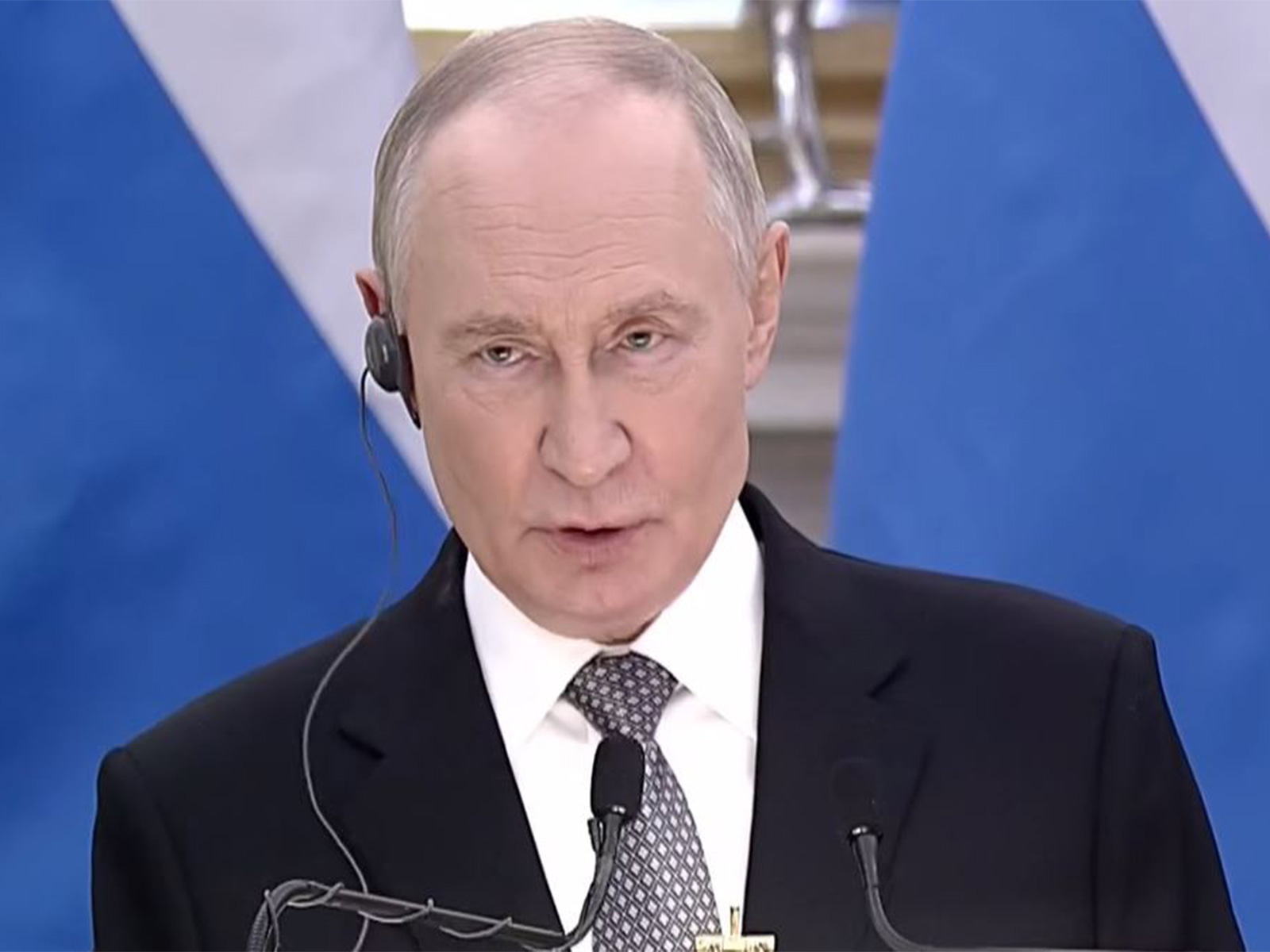
LONDON: I often wondered what was going on behind those eyes staring at me from across the table all those years ago. It was spring 1994 and I was in St Petersburg with a group of colleagues from our Moscow embassy meeting the mayor’s team to arrange the royal visit of our future King. Sitting across the table was the newly appointed deputy mayor, Vladimir Putin, whom we knew to be a KGB agent who had returned to his home-base from Dresden following the sudden collapse of the Berlin Wall.
Putin revealed nothing about himself throughout all those meetings, a trait he continued as he rose to the top in Russia over the course of the next six years. Western commentators often portray Putin as irrational or bloodthirsty, a dictator obsessed with restoring an empire at any cost. But to those of us who study Russian political culture and security doctrine, Putin’s worldview is deeply structured. It’s shaped by decades of grievances, Soviet-era strategic thinking, and a personal mission to restore what he considers Russia’s rightful place in history.
Putin frequently speaks of the collapse of the Soviet Union as the “greatest geopolitical catastrophe” of the 20th century. In speeches, essays, and televised appearances, he returns again and again to the idea that Russia was humiliated, its people scattered, and its borders mutilated. These views are not fringe in Russia’s political elite; instead, they anchor an ideology that blends nationalism, resentment, and the nostalgia of a fallen superpower.
From this perspective, the invasion of Ukraine, though catastrophic, appears to Putin as a necessary correction of historical injustice, not wanton brutality. He sees himself less as a conqueror than as a restorer.
When Vladimir Putin ordered the full-scale invasion of Ukraine in February 2022, the world watched in horror as missiles lit up the skies above Kyiv, Kharkiv, and Mariupol. Cities burned, families fled, and Europe faced its largest land war since 1945. To many, the devastation felt like the work of a leader hell-bent on conquest, someone willing to let millions die in pursuit of territorial ambition. The question has resurfaced through each phase of the war: What makes Vladimir Putin willing to unleash such destruction? The answer is both more complex and, in many ways, more troubling than a simple lust for conquest.
To outsiders, NATO’s eastward expansion is a network of defensive alliances. To Putin, it’s a creeping encirclement. Russian military and intelligence institutions have long taught that Western influence near Russia’s borders represents an existential threat, a worldview which predates Putin and reflects decades of Cold War training. Controlling neighbouring territory is not simply desirable, it is essential for survival.
Russian strategic doctrine emphasises buffer zones, spheres of influence, and the notion that instability in neighbouring states inevitably spills into Russia. When Ukraine leaned West after 2014, the Kremlin interpreted it as a sign that NATO, or Washington more directly, was pulling the country away from Moscow’s orbit. The Maidan Revolution was framed not as a popular uprising, which of course it was, but as a Western-backed coup, which it most definitely wasn’t.
In this worldview, military force becomes a tool for regime preservation, not mere conquest. Russian officials may be aware that war brings civilian suffering, but they view the alternative of Western influence on their doorstep as a greater risk.
While strategy and ideology matter, internal politics are equally crucial in understanding why Putin’s decisions have taken such devastating form. Putin’s regime is authoritarian, but not omnipotent. It rests on a delicate balance of elite loyalty, public support, and personal control. From Vlad’s point of view, foreign conflict can be a powerful political mechanism, as it rallies patriotic fervour, suppresses dissent, and justifies tightening the screws on civil society.
The Kremlin’s political messaging to the world has portrayed Russia as a besieged fortress facing down a corrupt and aggressive West. In this environment, war becomes a rallying point, and even when battlefield realities turn grim, the narrative can be maintained by restricting independent media, labelling critics as traitors, and framing every sacrifice as heroic. In short, the political incentives for Putin point toward escalation, not restraint.
Understanding Putin’s motivations does not require ascribing to him a desire for mass killing. Rather, his decisions show a remarkable willingness to tolerate civilian suffering in pursuit of geopolitical goals, something which stems from a governing logic in which human life, especially life outside Russia’s borders, is secondary to historical destiny and strategic necessity.
Looking back over the past 25 years, Putin’s approach to war has been consistent. In Chechnya, the Kremlin flattened Grozny to suppress separatist rebellion. In Syria, Russian bombers targeted civilian infrastructure to preserve Bashar al-Assad’s regime. The method is brutal, but in Putin’s view, effective.
The tragedy of Ukraine is that the Kremlin assumed the same logic would apply: quick strikes, political collapse leading to a compliant government. Instead, Ukraine resisted fiercely, and Russia doubled down, converting a short, decisive operation into a grinding war of attrition, which has now lasted almost four years. Millions have been displaced, thousands killed, and entire cities destroyed, but the Kremlin frames these outcomes as the unfortunate cost of defending Russia’s security and restoring its rightful borders. The cruelty is real, but in Putin’s calculus, suffering is a strategic variable, not a deterrent.
Political scientists studying authoritarian systems note a disturbing pattern in this behaviour. When leaders lack checks and balances, their capacity for catastrophic decisions increases dramatically. Without institutional constraints, miscalculations become more frequent, risks grow, and the human cost escalates. Russia today operates within a “personalist authoritarian” model; one where power is concentrated around a single leader, decision-making is opaque, and dissent is suppressed.
In such systems, leaders often overestimate their military’s capabilities and underestimate resistance. They frequently misread foreign intentions, and once conflict starts, they prioritise regime survival over human life. Putin’s Ukraine gamble fits this pattern. It reflects not personal bloodlust but structural dangers inherent in unchecked power.
The temptation to view Putin as simply mad or evil is understandable, as the scale of destruction invites moral outrage. But this framing obscures more than it clarifies. It reduces complex geopolitical behaviour to caricature, making it easier to dismiss the underlying causes.
More importantly, framing Putin as irrational undermines the international community’s ability to respond effectively. If a leader is seen as a madman, containment and negotiation seem futile. If he is seen as a strategic actor, albeit a ruthless one, then his behaviour can be predicted, analysed, and countered. Putin’s actions become more intelligible when viewed through the lens of strategy and political necessity: his ideology is extreme, his methods brutal, but his logic is coherent within the system he commands.
Ultimately, the question is not whether Putin wants to kill millions for a slither of land, but whether he is willing to make decisions that will foreseeably cause enormous suffering. The answer, tragically, is yes. Not out of personal malice, but because the political and strategic goals he pursues, and the narrative he has built around them, are prioritised above human life.
To Putin, the suffering is collateral to a larger mission, that of protecting Russia’s sphere of influence, preserving his regime, rewriting history, and resisting what he sees as Western domination. This worldview does not require sadism; it merely requires a willingness to sacrifice others for ideological ends.
The world now faces a Russia led by a man deeply committed to a geopolitical vision incompatible with its neighbours’ sovereignty. As long as Putin remains in power, the logic that has driven Russia’s wars will persist. Ukrainians will continue to bear the brunt of this struggle, but the implications ripple across Europe, the Middle East, and global security structures.
Understanding Putin’s motivations is not about excusing his actions, it is about recognising the structural and ideological forces that drive them. Only then can policymakers craft strategies that limit the suffering and prevent future catastrophes. Putin may not desire the death of millions, but he has shown a willingness to risk it. In the hard calculus of authoritarian geopolitics, human life is expendable. And that, more than personal bloodlust, explains the devastation that has reshaped Europe.
John Dobson is a former British diplomat, who also worked in UK Prime Minister John Major’s office between 1995 and 1998. He is currently a visiting fellow at the University of Plymouth.




