
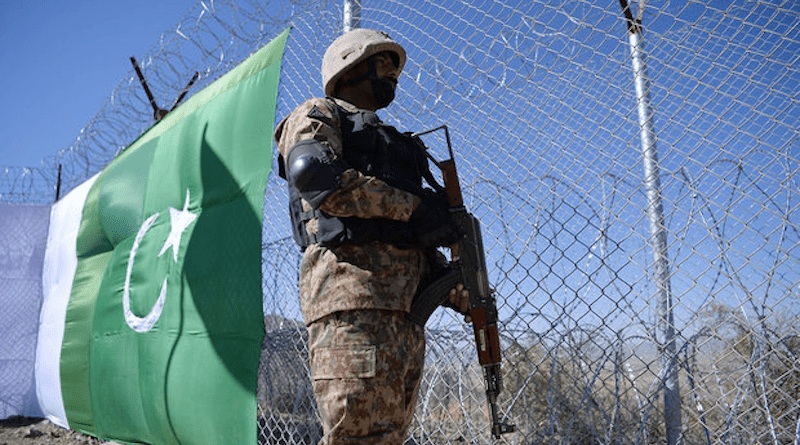
New Delhi: The Pakistan-Afghanistan border standoff has escalated, with recent heavy exchanges of fire, casualties on both sides, the destruction of a key border crossing, and the complete collapse of a fragile ceasefire agreement. On December 5-6, 2025, intense overnight clashes involving artillery and mortar fire erupted along the Chaman-Spin Boldak border, one of the busiest crossings on the border which connects the Afghan city of Kandahar with Chaman and Quetta in Pakistan. The fighting occurred just days after a round of peace talks in Saudi Arabia ended without progress and a temporary ceasefire, agreed upon in October after earlier deadly clashes, completely unravelled. The “Friendship Gate,” a crucial border crossing point for trade and civilian movement, was destroyed in the recent fighting, further exacerbating the crisis. Both nations continue to blame each other for initiating the violence.
The core issue remains Pakistan’s accusation that the Afghan Taliban government is providing safe haven to the Tehreek-e-Taliban Pakistan (TTP), a militant group responsible for a surge in terrorist attacks within Pakistan. Pakistan asserts that the TTP uses Afghan soil to launch a rising number of deadly attacks on Pakistani security forces and civilians. The Afghan government denies these allegations and, in turn, accuses Pakistan of its own security failures and violations of Afghan territory as Pakistan carries out airstrikes inside Afghanistan to target hideouts of the Tehreek-e-Taliban Pakistan.
The Pak-Afghan relationship is mired in deep historical mistrust, with both sides accusing the other of using proxy militant groups for strategic leverage. Afghanistan has never formally recognized the Durand Line—a 2,640 km border drawn during the British colonial era—as a permanent international boundary. Pakistan, which has nearly completed fencing the border to control movement and prevent militancy, views the line as a settled international frontier, leading to frequent skirmishes over border posts and construction activities.
Pakistan’s policy of forcibly deporting Afghan refugees has also significantly escalated tensions with Afghanistan by directly linking the refugee issue to security disputes and crossborder hostility. Pakistani officials accuse Afghan nationals of being involved in a surge of violence and suicide bombings within Pakistan, an allegation the Afghan government denies. The mass, abrupt nature of the deportations has created a severe humanitarian crisis in Afghanistan, overwhelming an already strained infrastructure and leaving returnees without adequate food, shelter, or medical support, especially during harsh winter conditions.
Afghan officials and human rights activists argue that Pakistan is using vulnerable refugees as “political pawns” to exert leverage over the Taliban government. The reported mistreatment during the crackdown, including midnight detentions, separation of families, and confiscation of property, has generated widespread anti-Pakistan sentiment across Afghan society and leadership. In essence, Pakistan’s policy has shifted the relationship from erstwhile cautious cooperation to overt hostility, with the refugee population becoming the primary victim of the strained diplomatic and security dynamics.
The economic impact of the crisis is also very significant. The frequent border closures (such as at Torkham and Chaman crossings) have severely disrupted cross-border trade, leading to significant financial losses for businesses and the rotting of perishable goods, dealing a heavy blow to both economies. Pakistani exports of medicines and agricultural goods have collapsed, while manufacturers relying on Afghan coal face steep price increases. Afghanistan has advised its traders to seek alternative routes through Iran and Central Asia.
The ongoing conflict and trade disruptions have exacerbated the existing humanitarian crisis in Afghanistan, where more than 64% of the population lives in poverty. The crisis has made it necessary for Afghanistan to strengthen ties with India, a development Pakistan views with suspicion. Pakistan’s Defence Minister had accused the Afghan Taliban government of “fighting a proxy war” on behalf of India, to which the spokesperson for India’s Ministry of External Affairs responded by saying that “Pakistan is infuriated with Afghanistan exercising sovereignty over its own territories”!
India has explicitly stated its commitment to the sovereignty and independence of Afghanistan and continues its long-standing commitment to Afghanistan’s development, providing humanitarian assistance (food and medical supplies) and continuing work on infrastructure projects. This aid is aimed at building goodwill with the Afghan people and government, bypassing Pakistan which has historically blocked direct land access. India utilizes alternative trade routes like the Chabahar Port in Iran to access Afghanistan, circumventing Pakistani restrictions.
India is pursuing a policy of pragmatic engagement with the Taliban-led government in Kabul to counter Pakistan’s influence and ensure regional stability. India has explicitly stated its commitment to the sovereignty and independence of Afghanistan. Despite not formally recognizing the Taliban government, India has re-opened its embassy in Kabul and has engaged in high-level talks with Afghan Foreign Minister Amir Khan Muttaqi. This shift in policy is seen as a strategic move to ensure that Indian interests in Afghanistan are protected.
The deteriorating relationship between Afghanistan and Pakistan is not merely a bilateral issue, but a major fault line that is reconfiguring alliances, disrupting economic projects, and increasing the risk of a wider regional conflict that could draw in major global powers. Sustainable peace will likely require a fundamental shift from security-centric policies to a cooperative framework involving political dialogue, mutual respect for sovereignty, and regional cooperation. Without such a shift, instability, militancy, and border skirmishes are likely to continue, impacting not just trade and humanitarian relief efforts but also the geopolitical situation in the region.
Summing up, PakistanAfghanistan relations are volatile and are likely to remain strained. The current situation is characterized by a “trust deficit” and a cycle of violence that diplomatic efforts have so far been unable to resolve, leaving the relationship in a highly unstable state. While both countries recognize the high cost of prolonged hostilities, deep-rooted historical and security issues continue to hinder lasting peace. Mediators like Qatar, Turkey, and Saudi Arabia have secured temporary ceasefires but a long-term resolution remains elusive as fundamental disagreements persist and diplomatic talks frequently end in impasse.
* Prabhu Dayal is a retired Indian ambassador.




