
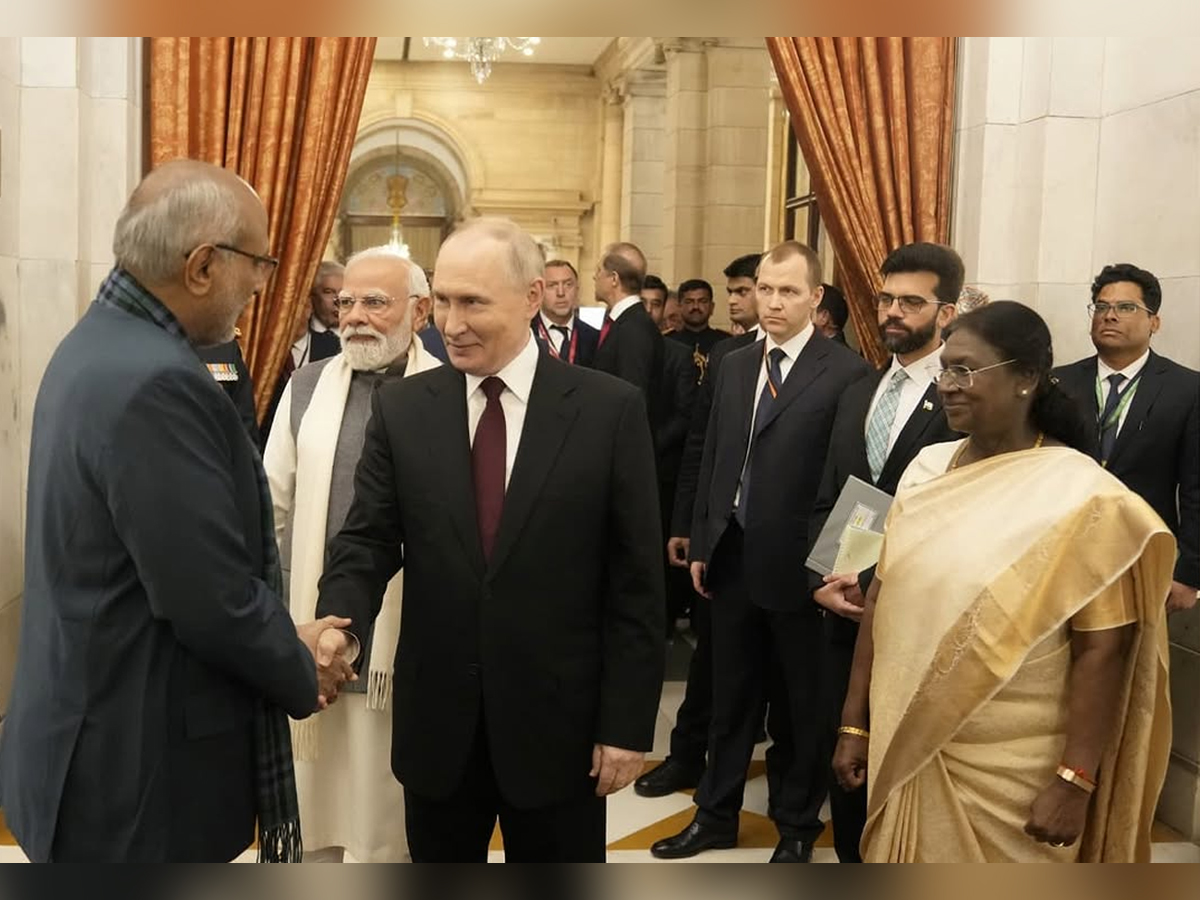
New Delhi: Russian President Vladimir Putin’s 10th annual bilateral Summit with the Indian PM in Delhi (Dec 4-5, 2025), first since Russia invaded Ukraine (Feb 24, 2022) seems to have gone off well. It was watched with as much interest in the US and its Western allies and Beijing as in India. If the objective was to demonstrate to the world the legacy of the 75-year-long India-Soviet/ Russia relationship, it was “mission accomplished”. If President Putin and Prime Minister Narendra Modi’s joint ride in Tianjin during the SCO summit caused some disquiet and dismay in the US and the EU, the Indian PM’s decision to receive the Russian President at the airport with a bear hug and travel with him in a Toyota Fortuner instead of a car manufactured in Europe would have given them a rude shock.
PM Modi likened the stable and steady relationship since Independence to the “Pole Star”. The Russian side reminded India of their countless vetoes in the UN on J&K and the crucial help extended in crisis situations like the 1962 Chinse aggression, 1965 attack by Pakistan and 1971 intimidation by the US with the deployment of the 7th fleet in the Bay of Bengal, as well as the resilient defence ties including transfer of technology for manufacturing Brahmos missiles. Strategically, at this juncture, both Russia and India need each other thanks to the policies of Donald Trump. So, understandably, each side would highlight the takeaways from the visit as it suits it and helps further its national interests.
At a time when the US and the EU have enhanced their sanctions against Russia and Putin can’t travel to over 100 countries on account of a Verdict of the International Court of Justice, naïvely thinking that these will force Russia to end the Ukrainian conflict, a high profile visit to India, the largest democracy, tipped to become the third largest economy after a couple of years, vindicates that, contrary to the claims by Western countries, Russia is not isolated internationally. And India, facing the highest rate of US tariffs—50% including 25% punitive duties for importing Russia’s discounted oil and blamed for funding the Russian aggression in Ukraine—has reiterated her strategic autonomy of decisions making; it hasn’t buckled under American and Western pressure. The message of Modi’s hugs and joint car ride with Putin must not have been lost on DJT. On December 6, External Affairs Minister, S. Jaishankar, said, “India-Russia relationship has been among the steadiest big relationships… this visit was in many ways about reimagining the relationship.” He also stressed, “I think for any country to expect to have a veto or say in how we develop our relations with others is not a reasonable proposition… We talk about what is called strategic autonomy and that continues and I can’t imagine why anybody would have reasons to expect the contrary.” Some analysts believe, while India considers her relations with the US most significant for fulfilling her ambitious domestic agenda of economic transformation and playing a global role befitting her rising stature and tries to deepen her relations with the EU, Japan, South Korea, Australia and the Global South, her strong and timetested ties with Russia are an essential pivot for pursuing her strategic autonomy. On the eve of Putin’s visit, a majority of national dailies and prime time TV debates in India were projecting big ticket announcements about the supply of two more platforms of S-400 air defence system, possible talks about S-500, SU-57 stealth fighter and joint production of defence equipment. A 5-year strategic program related to critical spheres was announced at the Economic Forum attended by both Putin and Modi. They talked of taking the trade to US$100 billion by 2030. But there was no big-ticket announcement.
Did the media get it all wrong? Or the long shadows of Donald Trump both on India and Russia, in different spheres, might have warranted a noncombative and unprovocative approach in India-Russia relationship. India-Russia bilateral trade has been dominated by the Russian oil, gas and defence exports; heavily in favour of Russia. Last year, Russian exports were valued at around US$64 billion while Indian exports were worth US$5 billion, less than India’s exports to Bangladesh. Before 2021, Indian import of oil from Russia was valued at around US$2-3 billion. This figure shot to US$25.5 billion in 2022, US$ 46.6 billion in2023 and 52.7 billion in 2024 accounting for 37.3% of Indian crude imports.Both sides are aware of this imbalance and are determined to diversify bilateral trade; a 60-member business delegation had accompanied President Putin. According to a press release of the MEA, the MOUs were signed dealing with migration and mobility, health and food safety, maritime cooperation and polar waters, fertilisers, customs and commerce, academic collaboration and media collaboration.
India has decided to grant 30 days e-visa to Russian tourists on gratis and reciprocal basis.While 60-70% of the defence equipment and platforms used by India: tanks, jet fighter, submarines and aircraft carriers, air defence system are still of Russian origin, imports from Russia in 2024 had come down to 37% compared to 76% in 2009 thanks to the diversification of our defence imports from UK, France, Germany, Israel and South Africa.
Two reactors of Kudankulam nuclear plant set up with Russian collaboration are already in operation. The two sides aim to broaden cooperation in nuclear energy. Speaking with journalists, Putin said that building smaller modular reactors and floating NPPS could be relevant for India.
While Putin expressed Russia’s readiness to ensure uninterrupted energy supplies and in his interview with two Indian journalists mentioned that the USA has been importing nuclear fuel from Russia so “why India shouldn’t have the same privilege”, India seems inclined to scale down the import of Russian crude drastically to get 25% punitive US tariff off the table; private oil refineries have stopped imports from Russia.Unquestionably, Rusia has earned the deep trust of India thanks to its unwavering support. However, beyond energy and defence sectors, Russia’s ability to offer critical and emerging technologies which India needs for leapfrogging her economic development is extremely limited. Therefore, souring her relations with the US for cosiness with Russia will be ill-advised. India’s national interest will be well served if we tango with both. And we are doing a pretty good job of this.
Surendra Kumar is a retired ambassador of India




