
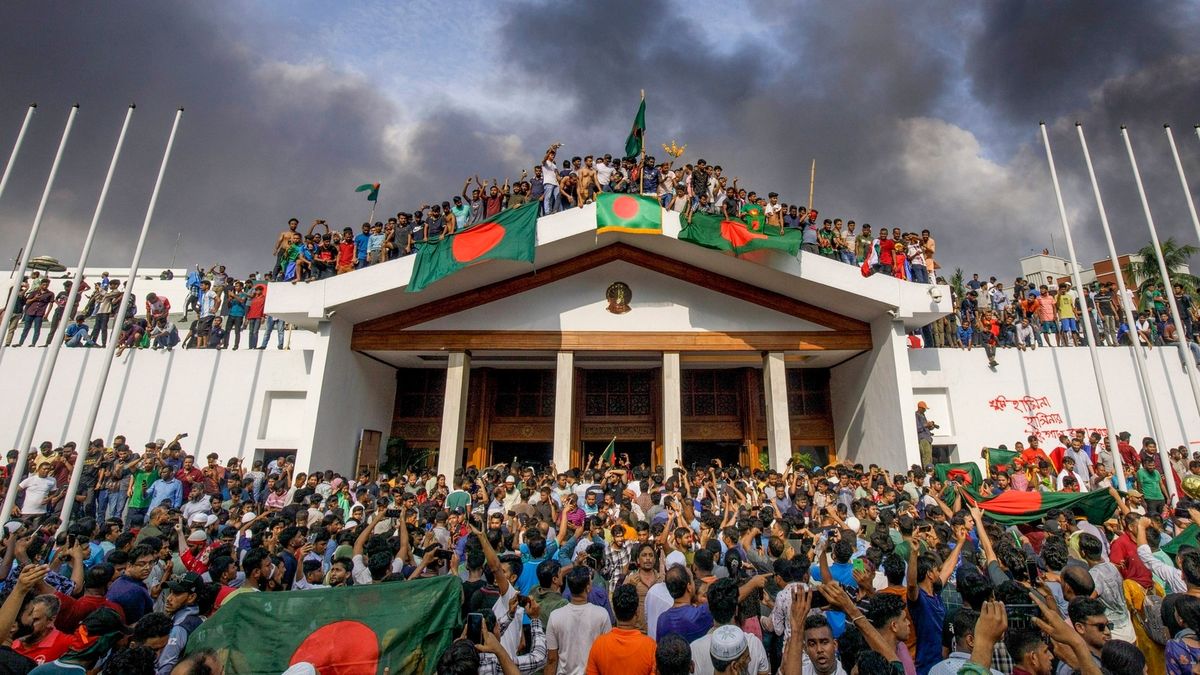
The contemporary political crisis in Bangladesh, culminating in the 2004 ‘Monsoon Revolution’ and the subsequent 2025 sentencing of former Prime Minister Sheikh Hasina to death, is not a sudden eruption of civil unrest but the manifestation of a deep-seated ideological war that began at the nation’s inception.
This conflict pits the secular-nationalist vision of the “pro-liberation” forces against a resilient and increasingly powerful Islamist and pro-Pakistan contingent that has viewed the creation of Bangladesh with Indian military assistance as a historical anomaly and a betrayal of Islamic unity.
The recent fall of the Awami League government and the resurgence of Jamaat-e-Islami represent a fundamental “turning of the tables,” where the judicial and political mechanisms once used to suppress anti-liberation forces have been redirected against the family and followers of the country’s founding father, Sheikh Mujibur Rahman. This transition is underpinned by a multi-fold hatred towards India ranging from economic grievances to religious antagonism and is facilitating a strategic pivot toward a regional axis involving Pakistan, China, and Turkey.
India-Bangladesh frictions in 2024-25 over Sheikh Hasina’s ouster, her death sentence, and Dhaka’s pressure on New Delhi are the latest phase of a much older struggle that runs back to 1971 and the unresolved contest between Mujib’s pro India, secular nationalism and the Razakar-Jamaat, pan-islamist project.
The current assertiveness of Jamaat-e-Islami and its allies and the visible courting of Dhaka by Pakistan and China, suggest that the anti-India, Islamist current in Bangladeshi politics has re-emerged as a central structuring force that any future government, including a BNP-led one, will find hard to ignore.
From the start, the Bangladesh Liberation War contained two incompatible visions of statehood: a secular, Bengali nationalist republic aligned with India, and an Islamic, Pakistan-linked “New Medina” style project. Sheikh Mujibur Rahman and the Awami League articulated a majoritarian Bengali nationalism grounded in language, culture and relative secularism, which both challenged West Pakistani domination and resisted a pan-Islamist identity that erased Bengali specificity.
Opposing this, the Razakar paramilitaries, largely mobilised through Jamaat-e-Islami and allied Islamist networks, supported the Pakistan Army’s attempt to crush Bengali nationalism on the explicit argument that it would weaken Islam and fragment the ummah. This ideological cleavage was not fully resolved by the military defeat of Pakistan in December 1971. The physical surrender of Pakistani forces occurred, but the ideological infrastructure that had justified collaboration survived in underground networks, religious institutions and parts of the bureaucracy.
The roots of the current anti-India sentiment are deeply embedded in the procedural and symbolic occurrences of the 1971 surrender of the Pakistani Eastern Command. While the official history celebrates the collaboration between the Indian military and the Mukti Bahini (Bengali freedom fighters), a parallel narrative emerged among those who remained loyal to the concept of a unified Pakistan—the Razakars, Al-Badr, and Al-Shams militias. For these groups, the victory was not one of liberation but of Indian annexation through a “vassal state” proxy.
A primary source of historical grievance cited by anti-India factions is the iconic photograph of the surrender ceremony on December 16, 1971. The image depicts Lieutenant General A.A.K. Niazi of Pakistan signing the Instrument of Surrender in the presence of India’s Lieutenant General Jagjit Singh Aurora. The notable absence of high-ranking Bangladeshi military leadership from this central frame has been weaponized for decades to suggest that India intended to marginalize the role of the Mukti Bahini. The absence of Colonel M.A.G. Osmani, the Commander-in-Chief of the Bangladesh Forces, is the centrepiece of this controversy.
While the official explanation remains that Osmani’s helicopter was fired upon en route to the ceremony, resulting in serious injuries to his Chief of Staff, Lieutenant Colonel M.A. Rab, and Sheikh Mujibur Rahman’s eldest son, Sheikh Kamal, sceptics have long alleged a more sinister motive. These “riddles” suggest that the Indian military high command may have failed to ensure Osmani’s presence to secure India’s role as the sole signatory and primary victor. This perception of being cheated out of the moment of triumph has fuelled the argument that Bangladesh was merely recovering territory for India rather than achieving true sovereignty.
Beyond the surrender ceremony, the behaviour of the Indian Army in the immediate aftermath of the war left a lasting impression on certain segments of the population. Some participants in the liberation war later claimed that the Indian Army’s conduct suggested they treated Bangladesh as a colony. The main grievance was the removal of Pakistani military assets and industrial equipment to India, which was viewed by pro-Pakistan elements as “looting”. These early frictions provided the ideological fodder for the Razakars and their supporters to argue that India had broken the unity of the Muslim Ummah only to exploit the newly formed nation.
In a sense, it is the heirs of this kind of conspiracy makers that today insist that Sharif Osman Hadi, the independent, vigorously anti-India, young politician who was a leading light of the protests that ousted Hasina, was murdered by India forces—even though all evidence suggests he was murdered by one of his rival compatriots.
During their period of political rehabilitation (1975-2008), Jamaat-e-Islami and its allies did not merely focus on elections; they built a robust socio-economic infrastructure. This included the establishment of the Islami Bank and a vast network of NGOs and educational institutions. By the time the Awami League returned to power in 2009, the “anti-liberation” forces had become a deeply entrenched economic power, capable of sustaining their ideological mission through internal funding and support from Pakistan and West Asian networks.
The return of Sheikh Hasina in 2009 signalled the beginning of a decisive and often brutal attempt to dismantle the leadership of the pro-Pakistan Islamist right. Centring her mandate on the “spirit of 1971,” Hasina established the International Crimes Tribunal (ICT) to try those responsible for the 1971 war crimes. The ICT proceedings led to the conviction and execution of several top-tier Jamaat-e-Islami leaders who had served as Razakar commanders or Al-Badr leaders in 1971. While the trials were celebrated by secularists and actively supported by India as a blow against extremism, they were condemned by Pakistan and human rights groups for failing to meet international fair trial standards. For the Jamaat and the Razakar sections of society, these executions were viewed as a confirmation of the “1971 war” against their ideology, this time conducted through a “kangaroo court” established by Hasina under Indian guidance.
The mass protests that toppled Sheikh Hasina in August 2024 represented a seismic shift in the national psyche, where the generational memory of 1971 was weaponized against the very party that claimed to own it. The protests, initially about civil service quotas, escalated when Hasina used the “Razakar” slur to describe the student protesters. In a move that shocked the Awami League establishment, the protesters adopted the slur as a slogan of defiance: “Tui ke? Ami ke? Razakar! Razakar!” (Who are you? Who am I? Razakar! Razakar!) . This did not necessarily mean the students supported the 1971 genocide, but rather that they rejected the “pro-liberation” label as a justification for modern-day authoritarianism.
However, this psychological break provided the perfect opening for the Jamaat-e-Islami and its student wing, Islami Chhatra Shibir, to integrate their street power into the movement. The fall of the Raju Memorial and other statues of Mujibur Rahman signalled the symbolic end of the “Mujib family” dominance and the return of the Islamist narrative.
By 2025, the judicial machinery of Bangladesh underwent a complete reversal. The International Crimes Tribunal-1 (ICT-1), now operating under the interim government of Muhammad Yunus, turned its focus onto Sheikh Hasina and her ministers. On November 17, 2025, the tribunal sentenced Sheikh Hasina and former Home Minister Asaduzzaman Khan Kamal to death in absentia for crimes against humanity. The charges were based on the violent crackdown on the 2024 protests, which resulted in an estimated 1400 deaths. The prosecution’s use of a leaked audio recording, where Hasina allegedly stated she had a “license to kill” because she faced over 220 legal cases, was pivotal in the contempt and crimes against humanity cases.
This “turning of the tables” serves as a historical mirror to the war crimes trials of 2013; whereas Hasina once executed Jamaat leaders for 1971, the state now seeks her execution for 2024, with the full backing of the newly empowered Islamist factions.
The animosity toward India has evolved from purely historical grievances to a sophisticated, multi-layered movement encompassing economic, religious, and territorial dimensions. The economic dimension of the hatred is fuelled by a perceived “transactional relationship” between the Modi and Hasina governments that favoured Indian interests. Critics point to several key irritants. India’s exports to Bangladesh reached $13.8 billion in 2022, while Bangladeshi’s exports struggled to reach $2 billion, creating a massive imbalance. Energy agreements with the Adani Group are seen as emblematic of “personalized diplomacy” that exploited Bangladeshi’s energy vulnerabilities. The killing of Bangladeshi civilians at the border by Indian forces remains a persistent source of rage.
The boycott campaign has targeted Indian FMCG brands like Marico, Emami, and Asian Paints, which historically held a 15% share of the Bangladeshi market. By late 2024, many stores were forced to remove these products from their shelves due to public pressure and fear of reprisal.
The rise of the BJP in India has provided a potent foil for Islamist groups in Bangladesh to frame their struggle in religious terms; India is increasingly depicted as the “land of infidels” (mushriks) whose influence must be purged to maintain the purity of the Islamic nation. This narrative has led to a surge in attacks on the Hindu minority in Bangladesh, who are seen as a “fifth column” for Indian interests.
In April 2025, a controversial map depicting a “Greater Bangladesh” appeared at Dhaka University, sparking strategic alarm in New Delhi. The map includes the Indian states of West Bengal, Odisha, Bihar, Jharkhand, and the entire “Seven Sisters” of the Northeast. While official sources claimed the map was a historical reference to the Bengal Sultanate, security analysts view it as a sophisticated psychological warfare campaign backed by Turkish and Pakistani intelligence to destabilize India’s eastern flank.
The assassination of Sharif Osman Hadi in December 2025 has turned him into a “martyr” for this irredentist cause. Hadi, a prominent anti-India voice and spokesperson for Inqilab Mancha, had publicly shared “Greater Bangladesh” maps on social media shortly before he was shot. His death triggered massive anti-India protests and calls to “free” India’s northeastern states from New Delhi’s control.
The fall of the Awami League has removed the primary barrier to the return of significant Pakistani and Chinese influence in Bangladesh. Under the Yunus administration, the country has rapidly shifted its diplomatic and security priorities. The year 2025 marked the most significant milestone in Bangladesh-Pakistan relations since the 1971 war. This “bonhomie” with Pakistan is viewed by India as a direct threat to its internal security, particularly in the Northeast. The visit of Pakistani high-ranking officials like Foreign Minister Ishaq Dar and General Sahir Shamshad Mirza to Dhaka in 2025 underscores this new strategic alliance.
China has capitalized on the political transition by deepening its “pincer movement” around India. With bilateral trade exceeding $25 billion and 700 Chinese companies generating over 500,000 jobs, Beijing has become the indispensable economic partner for post-Hasina Bangladesh. Furthermore, Bangladesh remains China’s second-largest weapons buyer in South Asia, sourcing everything from infantry equipment to digital surveillance systems from Beijing.
The most critical insight into the future of Bangladesh is the emergence of Jamaat-e-Islami as the de facto street power and ideological driver of the state. Many analysts now view Jamaat-e-Islami as the South Asian equivalent of the Muslim Brotherhood. Even if the Bangladesh Nationalist Party (BNP) wins the next general elections, tentatively scheduled for February 2026, it will remain beholden to Jamaat’s organizational depth and street mobilization capacity. Jamaat’s victory in student union elections across 500 major campuses in 2025 has demonstrated its appeal to a new generation that seeks “sovereignty and dignity” over traditional secular-nationalism.
In 2025, Jamaat-e-Islami began an unprecedented global diplomatic outreach. U.S. embassy officials and delegates from 19 other countries held formal meetings with Jamaat leaders, signalling a recognition of the party as a future governing force. The Trump administration even granted a visa to Jamaat head Dr. Shafiqur Rahman for a tour of the United States in late 2025. This outreach is reminiscent of early Western engagement with the Muslim Brotherhood in Egypt, driven by a desire for “stability” and “counter-terrorism cooperation” with an organization that remains fundamentally committed to Sharia rule.
The crisis in Bangladesh is not a temporary lapse in democracy but a permanent realignment of the state away from the Indian sphere of influence and toward a more radical, Islamist, and pro-Pakistan identity. The hatred toward India is now an institutionalized component of Bangladeshi statecraft, supported by the strategic interests of China and Pakistan. As the “Muslim Brotherhood” of South Asia prepares to take its first government, India faces its greatest strategic challenge since 1971—a challenge that will not go away soon, as the demographic and ideological shift in Bangladesh has reached a point of no return. The region must now prepare for a Bangladesh that acts as a staging ground for Islamist politics and regional irredentism, forever severing the “special relationship” that India once believed it had secured in the fields of East Bengal half a century ago.
(Hindol Sengupta is professor of international relations, and director of the India institute, at the O. P. Jindal Global University.)




