
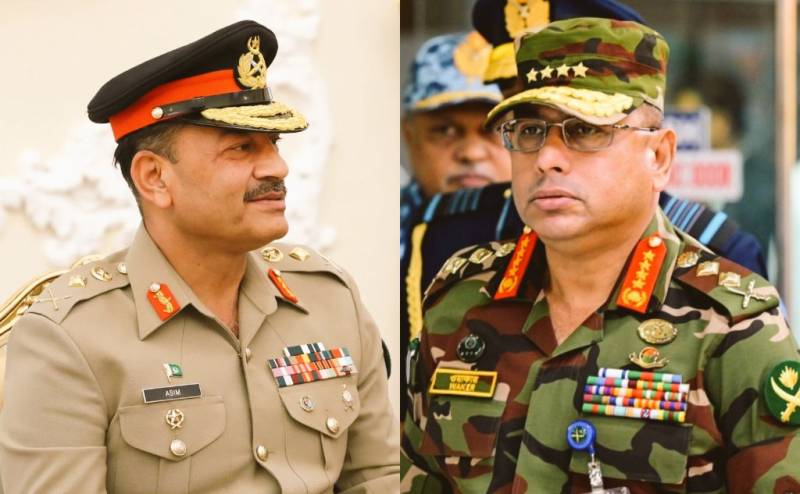
NEW DELHI: Pakistan and Bangladesh have, over the past few months, quietly rebuilt and expanded defence and security engagement at a level not seen in decades, reopening institutional channels that had remained largely dormant since the early 2010s. The reset has been driven by a combination of foreign ministry level consultations, senior military interactions, and formal defence cooperation language used by both sides, creating the conditions for closer coordination between Pakistan’s Inter-Services Intelligence (ISI) and Bangladesh’s principal intelligence arms, particularly the Directorate General of Forces Intelligence (DGFI) and National Security Intelligence (NSI).
In April 2025, the two countries resumed foreign secretary-level bilateral consultations after a gap of nearly 15 years, a move officially acknowledged by Pakistan’s Ministry of Foreign Affairs and reported by international news agencies. The talks covered the full spectrum of bilateral relations, including security related issues, marking a decisive political signal to normalise and expand engagement. This diplomatic reopening was followed, sources said, by senior military level exchanges, including visits and meetings involving Pakistan’s top military leadership and Bangladesh’s civilian and defence authorities. Chatters within Pakistan’s military described these interactions as focused on enhancing cooperation in defence and security domains, language that, in regional practice, typically encompasses intelligence coordination, threat assessments, and liaison-level engagement.
While neither government has publicly announced a formal intelligence-sharing agreement, officials familiar with regional security processes note that sustained defence cooperation without intelligence contact is structurally improbable. In South Asian military-diplomatic practice, intelligence agencies are routinely embedded in defence cooperation frameworks through liaison officers, information exchanges, and joint threat briefings, even when such arrangements are not formally disclosed. Officials said that parallel to official defence engagement, strategic and security-linked institutions from both countries have signed memorandums of understanding, including between Pakistan’s Institute of Strategic Studies Islamabad and Bangladesh-based strategic research bodies. Though civilian in nature, these arrangements serve as auxiliary channels for policy convergence.
These developments, officials observed, represent the most consolidated Pakistan-Bangladesh security alignment since Bangladesh’s independence, reversing a long period in which Dhaka had kept Islamabad at arm’s length, particularly in intelligence and internal security matters. Security officials and regional analysts assess that the reactivation of Pakistan-Bangladesh security channels has significant downstream implications, particularly for India’s eastern security environment. According to these assessments, deeper coordination between the ISI and Bangladeshi intelligence agencies could, if left unchecked, reduce institutional resistance within Bangladesh to Pakistan-origin terror networks that have historically been linked to anti-India activities.
Bangladesh’s geography, porous borders, and established financial and logistics routes make it a sensitive theatre for illicit transnational activity. Officials warn that such an alignment could, over time, create permissive conditions for the revival or protection of anti-India extremist and terror linked elements operating from or through Bangladeshi territory. Expansion of hawala and informal financial networks facilitating cross-border movement of funds is a major cause of deliberation among the security offices. Also, the future use of Bangladesh as a logistics or staging ground rather than a direct operational base, allowing plausible deniability, is also not being ruled in case such a partnership develops. There is, however, no public evidence at this stage that Bangladesh has formally endorsed or enabled such activities. Analysts stress that the concern lies in institutional drift, not declared policy.
Officials said that the significance of recent months lies less in any single agreement and more in the speed and breadth of engagement between Islamabad and Dhaka. Officials following the development in the region said that the reopening of diplomatic talks, the normalisation of defence cooperation, and the visible comfort between military establishments and intelligence agencies together suggest a structural shift. For now, what is clear is that Pakistan and Bangladesh have rebuilt security bridges that had remained largely dismantled for years.




