
Washington, D.C: The Trump administration’s approach to foreign policy has, in capitals across the world, triggered fear, anger and above all confusion about direction and methods. The “deconstruction” has been easy to see, with the absorption of USAID into State, the recalling of Ambassadors and more.
With the release of the National Security Strategy, and a detailed look at how one key relationship is being handled, we might now be able to start to see what the “reconstruction” looks like. And, if it’s an indication of things to come, some capitals—not including Beijing—might be less worried.
On December 23, the United States and Palau signed a series of agreements that give insight into how Washington is looking at, as the recently released National Security Strategy put it, “building alliances and strengthening partnerships in the Indo-Pacific that will be the bedrock of security and prosperity long into the future.”
Deputy Secretary of State Christopher Landau was personally involved in the discussions, and reportedly is taking a keen interest in the Indo-Pacific, including the Pacific Islands.
The agreement getting the most attention is Palau agreeing to take up to 75 people ordered removed from the United States (but not to their home countries). More on that later. It is the other agreements that are more important to Palau, and U.S. security.
Palau is just east of the Philippines and south of Guam. It is one of the United States’ closest partners. While an independent country, it is also one of the U.S. Freely Associated States (FAS) and its 18,000 or so citizens are allowed to live and work in the United States, and serve in the U.S. military.
Palau also recognizes Taiwan as an independent country, and is seeing new U.S. Department of War investment, including in locations that saw some of the fiercest fighting of World War II, such as the Palauan island of Peleliu.
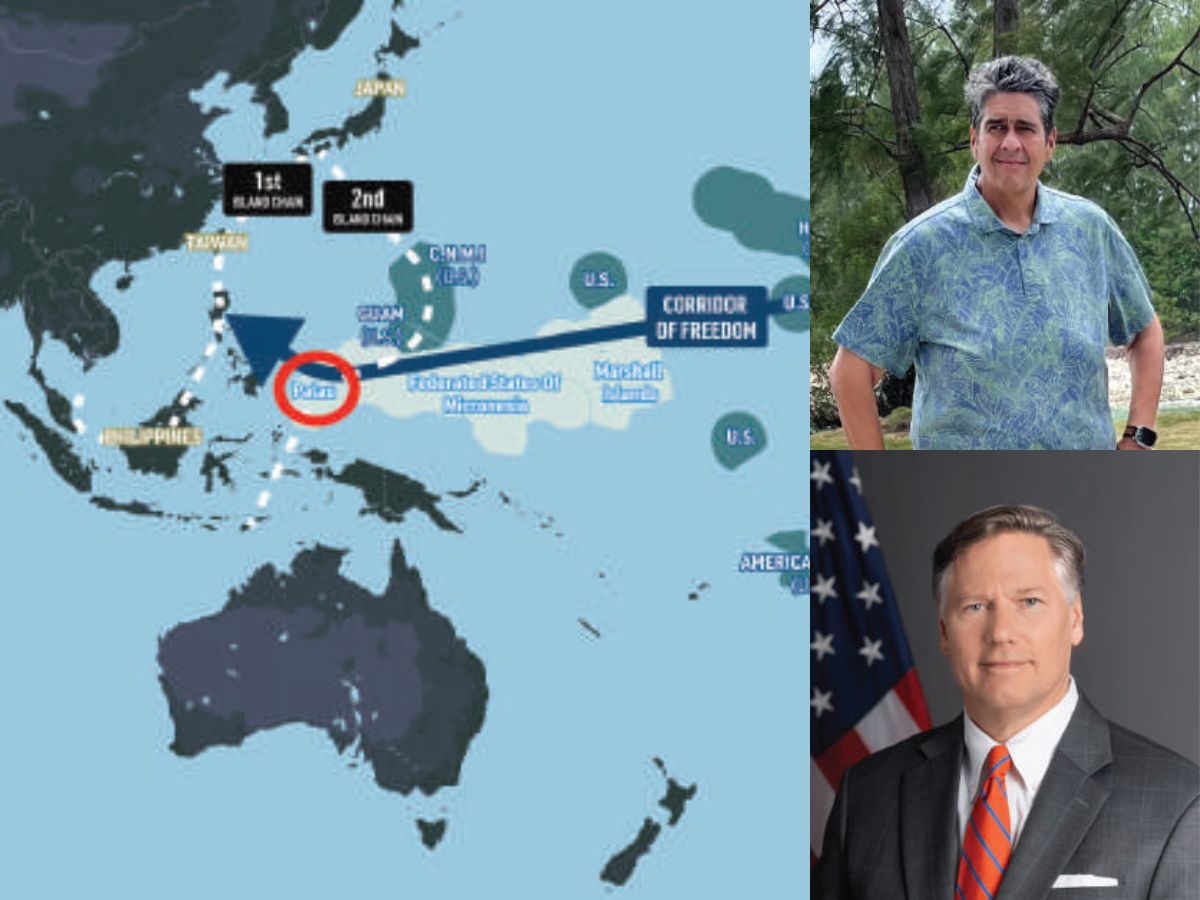
From a U.S. security perspective, Palau, along with the two other FAS (Federated States of Micronesia and the Marshall Islands), create what is supposed to be a secure east-west “corridor of freedom” across the centre of the Pacific from Hawaii to the U.S. territories of Guam and the Northern Marianas. In the context of the White House’s focus on “hemispheric defense”, the FAS should be considered “western hemisphere adjacent” and core to U.S. security, in part because they give access to parts of the American homeland that are vulnerably on the Asian frontier.
CHINESE TARGETING PALAU
China has Palau in its crosshairs for a range of reasons. If Chinese leader Xi Jinping is to achieve his goal of taking Taiwan—especially by force—Palau (along with the other FAS, American territories and states in the region such as the Philippines and Japan) must be neutralized as a threat. In particular, the corridor of freedom must be blocked, making it much more difficult for the United States to even reach the first and second island chains.
That doesn’t necessarily mean military attack. Chinese attacks could be through political warfare, including, as the Philippines Army Chief of Staff General Romeo Brawner Jr. describes it, a range of illegal, coercive, aggressive and deceptive (ICAD) activities.
China has already tried to use economic coercion—including building up and then crashing the Palauan tourism sector—to try to force Palau to derecognize Taiwan. It has also likely been involved in cyber-attacks on Palau, and Chinese organized crime is rampant, and has been linked to political corruption.
The administration of Palauan President Surangel Whipps Jr. has been actively trying to defend Palau, including expelling relatively large numbers of Chinese criminals from the country. But it is overmatched.
One of the new agreements with the United States is designed to help counter these Chinese political warfare attacks on Palau.
According to sources, the United States will send law enforcement advisors for one year to support Palau’s ability to tackle corruption and disrupt drug trafficking. It will also send a cyber security advisor to help protect Palau’s critical communications infrastructure and a maritime security advisor to help secure Palau’s exclusive economic zone. There is also support for Palau’s investment screening capacity, and customs and immigration enforcement. And, when appropriate, the United States will sanction individuals to disrupt transnational crime and corruption affecting Palau.
The initial cost to the United States is $2.2 million—exactly the sort of low-cost counter to China’s ability to disrupt and degrade the economy, politics and society of a key U.S. ally that is needed. This is fighting smart. As the National Security Strategy puts it, “As the United States rejects the ill-fated concept of global domination for itself, we must prevent the global, and in some cases even regional, domination of others.”
A common misperception is that because a country is in Free Association with the United States, the United States can dictate its foreign policy. It can’t. In November, Palau’s neighbour, the Federated States of Micronesia (FSM), another U.S. Freely Associated State, signed an agreement with China to “upgrade economic partnership” and “promote high-level opening up.” Close to three years ago then president of FSM, David Panuelo, warned that Chinese political warfare was affecting the ability of FSM to made sovereign decisions.
These agreements with the United States, conversely, will help Palau defend its own sovereignty, in keeping with another line from the National Security Strategy: “The United States will put our own interests first and, in our relations with other nations, encourage them to prioritize their own interests as well.”
Other agreements signed are said to reflect even more clearly Palauan priorities and go beyond blocking China’s ability to wage society and economy degrading “entropic warfare” on Palau, by helping Palau build societal resilience. These include committing to help Palau build a new hospital, a $6 million grant to stabilize Palau’s civil service pension plan and working with Palau to improve its ability to respond to natural disasters.
This last is more strategic than it might seem. China has been active in positioning its military as a responder in cases of natural disasters in the Pacific Islands. Should Palau find itself in that desperate situation, Whipps wants to ensure friends should arrive first.
As for the agreement for Palau to take in a maximum of 75 people, the details show there are a range of conditions that must be met before any are accepted. According to sources, these include: the files of those involved will be sent to Palau first for approval; none will have known criminal convictions; and all will have passports (so identifiable and able to travel).
Once in Palau, they will live freely in the community and be allowed to work. Palau, with a population of around 18,000, currently has around 6,000 foreign workers and it is expected the new arrivals will easily get jobs. The United States is giving Palau around $7.5 million for the costs associated with housing, etc. The U.S. projects a large majority will soon return to their home countries.
Combined, these agreements are designed to help the United States deal with a politically sensitive issue while helping Palau reinforce its social and economic stability. It is also designed to create enduring law enforcement and security cooperation pathways with the United States that will help Palau block Chinese efforts to destabilize the nation, while building Palauan sovereignty.
If this “block and build” model of cooperation is replicated by the United States, we may see a new way of operating that has a chance of blocking some of the most corrosive aspects of Chinese illegal, coercive, aggressive and deceptive activities, while building real resilience. It may also just be a one-off. Either way, this one is worth watching.




