
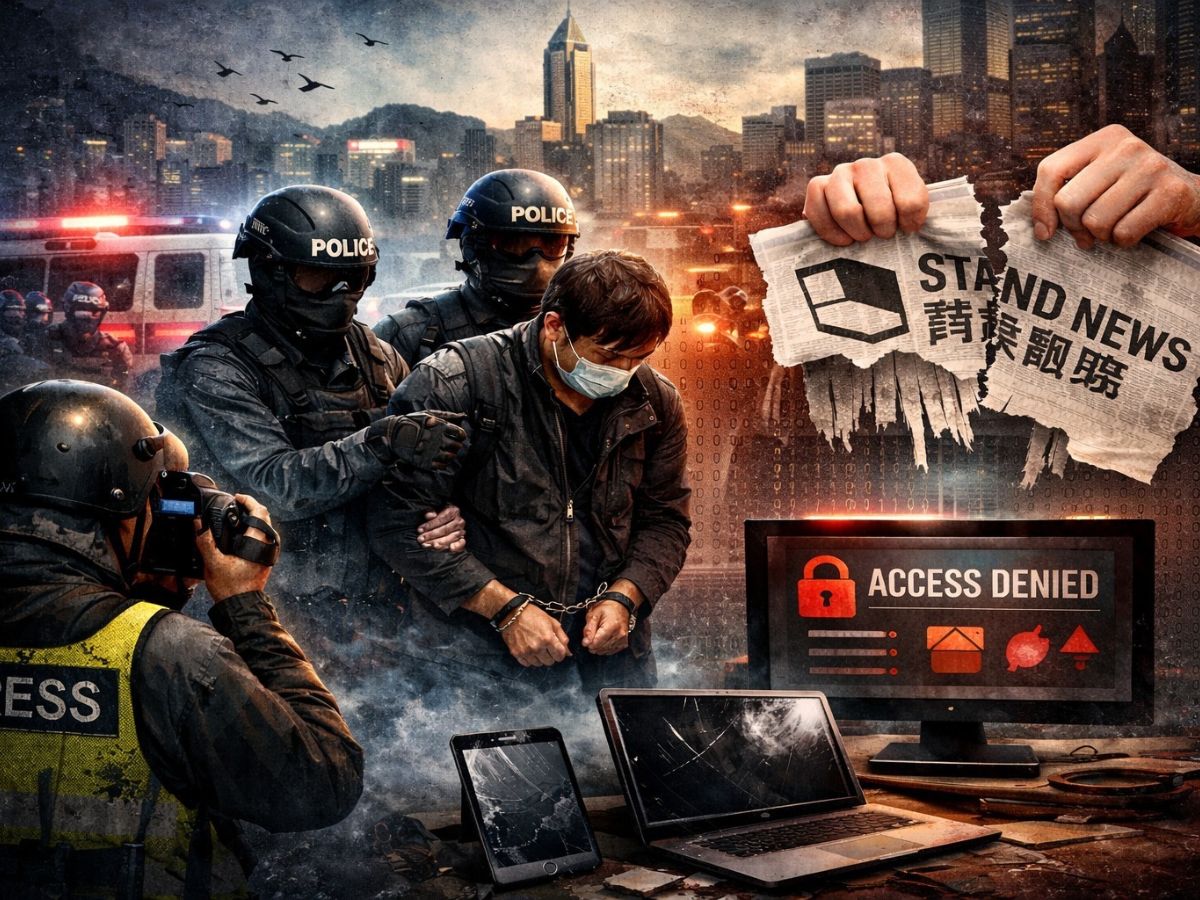
In Hong Kong on December 29, 2021, the shutdown of Stand News unfolded like a carefully staged display of power. The facts of the day point to an operation designed not just to enforce the law, but to be seen enforcing it publicly and without ambiguity.
More than 200 police officers were deployed to raid the newsroom. Senior editors and board members were arrested. Journalistic materials were seized. Within hours, the outlet’s website and social media presence were erased, and an announcement declared the immediate cessation of operations. By nightfall, one of Hong Kong’s last remaining pro-democracy news platforms had been wiped from the public sphere.
The scale and choreography of the operation were a demonstrative act of state authority, designed to send a message to Hong Kongers at large.
Power as performance
The use of more than 200 officers against a media organisation was operationally unnecessary. There was no armed standoff, no threat to public safety, and no crowd that had to be controlled. The decision to deploy such numbers meant that the raid was, in fact, intended to be noticed by journalists, editors, publishers, and the wider public.
The message being relayed was that independent journalism was disfavoured and going to be policed.
Speed as coercion
Equally striking was the pace at which events unfolded. Arrests, asset freezes, and operational paralysis occurred almost simultaneously. The freezing of approximately HK$61 million in assets ensured that Stand News could not continue publishing, pay staff, or even mount an effective legal defence. Closure followed within hours as a function of state action, not judicial process.
This chronology of events is problematic. Enforcement is supposed to come after judicial determination. However, in this case, the necessity of proving guilt became irrelevant as Stand News had already been punished like a criminal syndicate. The outcome of silencing was achieved before the law had been tested.
The rapid erasure of Stand News’s digital footprint reinforced this dynamic. Articles, archives, and social media posts disappeared almost instantly. Years of reporting vanished overnight, demonstrating how quickly information can be removed when state power is applied without restraint.
The effect was not confined to one outlet. It established a precedent that could be replicated with equal speed against others.
A targeted warning
Stand News was not chosen at random. After the forced closure of Apple Daily earlier in 2021, it had emerged as one of the most prominent remaining platforms carrying pro-democracy perspectives. Its readership was substantial, its reporting influential, and its existence symbolic.
By acting against Stand News, authorities ensured maximum signalling value. The target was large enough to be noticed, but vulnerable enough to be eliminated swiftly. The operation communicated that prominence offered no protection, and that moderation or professionalism would not shield an outlet from coercive action.
The consequences were immediate. Within days, Citizen News, another independent outlet, announced it would shut down voluntarily, citing concern for staff safety amid a deteriorating media environment. The closure was not ordered. It was induced.
This is how demonstrative repression functions. The state does not need to act against every target. It needs only to act visibly against a few.
Normalising fear
The Stand News operation also reshaped the psychological environment in which journalism in Hong Kong now takes place. The raid signalled that legal compliance, transparency, and long-standing practice no longer guarantee safety. What matters instead is alignment with an increasingly narrow definition of permissible discourse.
For journalists still working in the city, the implications were clear. Publishing sensitive material could expose not only the organisation, but individuals, to arrest, surveillance, and financial ruin. The risks were no longer abstract or hypothetical. They had been demonstrated in real time.
This environment produces self-censorship not through explicit bans, but through rational calculation. Editors weigh the costs of publication against the likelihood of enforcement. Reporters avoid topics that could draw attention. Stories go unwritten not because they are prohibited, but because the consequences of writing them have been made unmistakably severe.
The effectiveness of this approach lies precisely in its visibility. Fear is most efficient when it is grounded in observed reality rather than speculation.
Law enforcement or political theatre?
Officials have maintained that the Stand News raid was a lawful action taken in accordance with existing statutes, and that press freedom remains protected so long as it is not used as a cover for illegal activity. Formally, this defence rests on the idea that the operation targeted criminal conduct, not journalism.
Yet the facts complicate that claim. The use of a mass police deployment, the immediate freezing of assets, and the erasure of an outlet’s entire digital presence suggest objectives that extend beyond evidence gathering or prosecution. These are measures that achieve irreversible outcomes regardless of legal verdicts.
The distinction matters. When law enforcement becomes indistinguishable from political theatre, its function changes. It no longer merely enforces rules. It disciplines behaviour.
In this context, the Stand News raid was a live demonstration of what would happen if another media outlet fell outside accepted boundaries.
Converging with mainland practice
The method employed against Stand News was no exception to practices long observed in mainland China. The same visible enforcement actions are used to enforce ideological compliance and deter dissent in the mainland. In those settings, arrests and closures often function as reminders of state authority.
Hong Kong’s adoption of similar tactics was a major red flag. The city’s media environment, once defined by its distance from such practices, was shown to have eroded beyond repair.
By importing a model that relies on spectacle, speed, and overwhelming force, authorities have narrowed the gap between Hong Kong’s governance style and that of the mainland. The convergence is not merely legal or institutional. It is performative.
An erasure designed to be remembered
Paradoxically, the swiftness with which Stand News was erased has ensured that its closure will be remembered. The operation’s visibility guaranteed that journalists, civil society actors, and international observers would understand its significance.
That understanding was likely the point.
The raid demonstrated that independent media could be eliminated decisively, publicly, and without prolonged legal contestation. It showed that the costs of non-alignment are immediate and personal. And it established a template for future action should further enforcement be deemed necessary.
In silencing Stand News, the authorities did more than shut down a newsroom. They staged a warning. The facts of that warning—the numbers, the speed, the erasure—continue to shape the behaviour of Hong Kong’s media landscape long after the officers left the building.




