
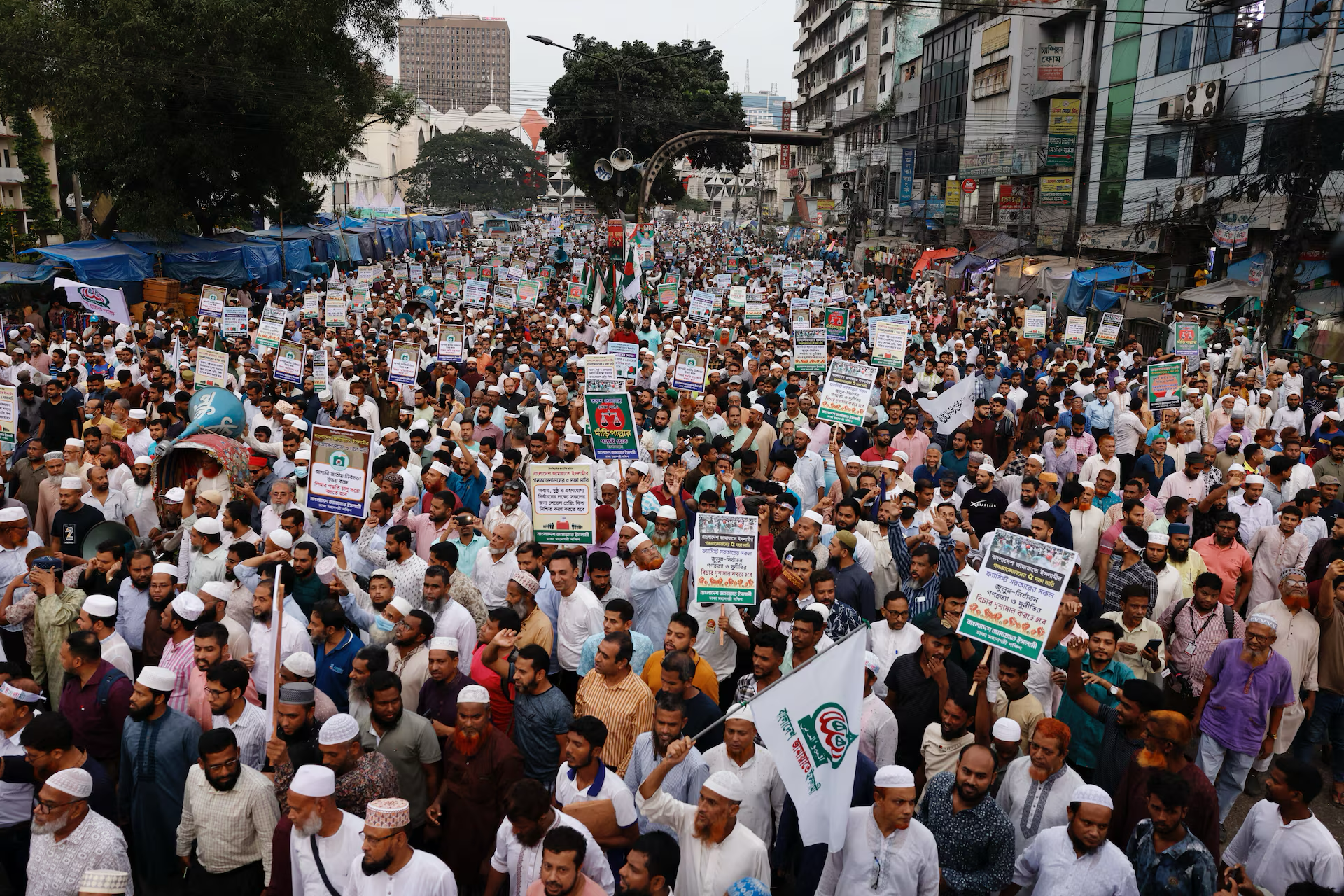
NEW DELHI: Multiple inputs indicate that Pakistan’s Inter-Services Intelligence (ISI) has executed a sustained political influence operation in Bangladesh aimed at repositioning Jamaat-e-Islami as the dominant force in the post-Sheikh Hasina order, culminating in the party’s emergence as the anchor of a broad opposition alliance ahead of the 12 February parliamentary election.
Sources familiar with the assessments say the operation was contrived and activated well before Sheikh Hasina fled to India in August last year, challenging the assumption that Jamaat’s resurgence is merely the byproduct of a sudden political vacuum. Instead, they describe a phased strategy designed to return Jamaat to power through coalition-building rather than overt confrontation.
According to these inputs, Jamaat leaders were initially instructed to maintain a low public profile during the early phase of the mass anti-government agitation, despite having the organisational depth and street-level capacity to dominate protests. The tactical intent, sources say, was to allow Gen-Z student leaders and the newly formed National Citizen Party (NCP) to spearhead the movement, giving it a spontaneous, youth-driven and ostensibly non-ideological character that would attract broader domestic legitimacy and reduce international scrutiny. This phase of restraint continued until Hasina’s departure.
Once the prime minister exited the country, Jamaat-linked groups moved rapidly into the open, activating political networks, asserting organisational control and repositioning the party from the margins to the centre of opposition politics.
Last week, the Liberal Democratic Party (LDP), led by freedom fighter and long-time BNP ally Col (retd) Oli Ahmed, formally joined the Jamaat-e-Islami-led electoral alliance. The National Citizen Party, founded by leaders of the July mass uprising, has also entered the bloc, taking its strength to 10 parties and triggering a deep internal crisis within the student-led formation, with dissent over ideological compromise and seat-sharing.
Alliance insiders say negotiations are ongoing with additional parties, including the Amar Bangladesh Party and the Bangladesh Labour Party, while several smaller groups dissatisfied with seat-sharing offers from the BNP have been holding marathon meetings with Jamaat. The final composition of the alliance is expected to be confirmed on Monday, the last day for filing nomination papers.
Beyond Jamaat, LDP and NCP, the alliance already includes Islami Andolan Bangladesh, Bangladesh Khelafat Majlis, Khelafat Majlis, Nezam-e-Islam Party, Bangladesh Khelafat Andolan, Bangladesh Development Party and Jatiya Ganatantrik Party (Jagpa). This suggests that parties with nationalist, development-oriented and student-origin identities are aligning with Jamaat not out of doctrinal convergence, but out of political calculation, underscoring Jamaat’s emergence as the principal broker of opposition politics.
Announcing the expansion at a press conference at the National Press Club in Dhaka, Jamaat Ameer Shafiqur Rahman framed the coalition as a response to a “difficult turning point in national life” and spoke of a shared commitment to building a corruption-free Bangladesh, employing deliberately broad language that downplayed ideological markers and projected Jamaat as a system-stabilising force.
Jamaat’s resurgence carries weight because it is the only major political force in Bangladesh that the state itself systematically sought to marginalise for over a decade. The party opposed Bangladesh’s independence in 1971 and aligned with the Pakistani military during the Liberation War. Its cadres were linked to auxiliary forces such as Razakar, Al-Badr and Al-Shams, accused of mass atrocities and targeted killings of intellectuals.
It was this legacy that drove Sheikh Hasina’s governments to cancel Jamaat’s registration, prosecute its top leadership under the International Crimes Tribunal and restrict its organisational activities. The policy was framed not merely as political retribution but as a matter of constitutional fidelity and internal security, with the state arguing that Jamaat’s ideological foundations were incompatible with Bangladesh’s liberation narrative.
For India, Jamaat’s return to centre stage has long been viewed as a strategic red flag. Jamaat’s worldview has consistently opposed India’s role in Bangladesh’s liberation and framed New Delhi as a hegemonic adversary. Periods of Jamaat influence in Dhaka have coincided with weakened counterterrorism cooperation and expanded operational space for anti-India elements, particularly along the eastern border.
Under Sheikh Hasina, India and Bangladesh achieved unprecedented intelligence and security coordination, dismantling insurgent sanctuaries and curbing cross-border militancy. Indian security assessments warn that a Jamaat-influenced government would likely recalibrate Dhaka’s regional posture, diluting alignment with India while reopening space for Pakistani influence operations in eastern South Asia.
The developments also raise an unresolved question about the role of external actors beyond Pakistan. The Sunday Guardian had earlier reported that US-linked ‘democracy promotion’ agencies, including the National Endowment for Democracy, USAID and the International Republican Institute, were involved in long-term political engagement aimed at weakening the Sheikh Hasina government well before her exit.
What remains unclear is whether these US-led initiatives factored in the downstream consequences of Hasina’s removal, particularly the possibility that the political vacuum would be filled not by liberal or centrist forces but by Jamaat-e-Islami, the most ideologically entrenched organisation in the opposition space. There is no public evidence of coordination between US agencies and Jamaat, nor any indication that Washington intended to facilitate Jamaat’s return.
However, the sequence of events highlights the blind spot which external efforts focused on regime change may not have adequately accounted for: who was best positioned to capitalise on the aftermath. Taken together, the trajectory suggests that Jamaat’s rise is not an electoral accident but the execution of a long-planned return.
While US-linked initiatives appear to have focused on political change without clear regard to political composition, Pakistan’s ISI, according to security inputs, appears to have planned explicitly for Jamaat’s consolidation once the field cleared. By the time nominations close, Jamaat is expected to stand not as a marginal Islamist party but as the central architect of a potential post-election governing arrangement. In effect, the objective attributed to the ISI operation appears close to fruition: bringing Jamaat-e-Islami from the margins to the helm without firing a shot.




