
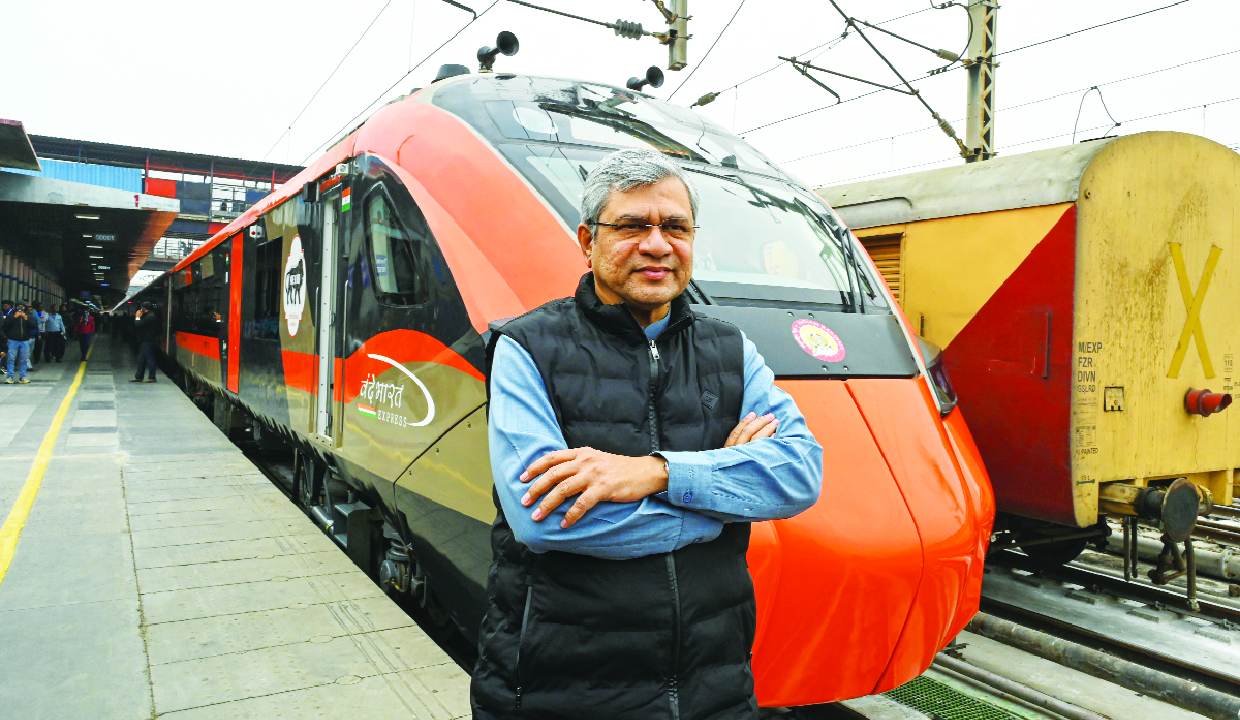
NEW DELHI: Ahead of the upcoming assembly elections, Assam and West Bengal will get the country’s first Vande Bharat sleeper train. Prime Minister Narendra Modi is likely to flag off the Vande Bharat sleeper train on January 17 or 18, 2026.
The train will run from Guwahati in Assam to Kolkata in West Bengal. It will reduce the travel time between Guwahati and Kolkata by approximately 3 hours. Railway Minister Ashwini Vaishnaw inspected this train at New Delhi Railway station on Saturday. After the running of this train, Kamrup Metropolitan and Bongaigaon districts of Assam state and Coochbehar, Jalpaiguri, Maldah, Murshidabad, Purba Bardhaman, Hooghly, Howrah districts of West Bengal state will be benefited.
FEATURES OF FIRST VANDE BHARAT TRAIN
- Total coaches: 16 (11 coaches 3 Tier, 4 coaches 2 Tier, 1 coach 1st AC).
- Passenger capacity: 823 (3AC-611, 2AC-188, and 1st AC-24).
- Semi-high-speed train with design speed up to 180 kmph.
- Ergonomically designed berths with improved cushioning.
- Automatic doors with vestibules for smooth movement.
- Enhanced ride comfort with superior suspension and noise reduction.
- Kavach & Emergency talk back system
- Driver cab with advanced controls and safety systems.
- Disinfectant technology to maintain high sanitation.
- Aerodynamic exterior looks & Automatic exterior passenger door.
FARE STRUCTURE
- Third AC (3AC) class with meals: Rs 2,300 (Rs 2.40/km).
- Second AC (2AC) class with meals: Rs 3,000 (Rs 3.0/km).
- First AC (1AC) class with meals: Rs 3,600 (Rs 3.80/km).
Recently, the Indian Railway successfully completed the final high-speed trial of this indigenously built Vande Bharat sleeper train at a speed of 180 kmph. Its acceleration is better than other trains. Vaishnaw said, “The introduction of 4 more Vande Bharat sleeper trains in the next 6 months and 12 new Vande Bharat sleeper trains by the end of this year.” He also said that the cost of 1 coach of this train is less than that of a metro coach. A single coach of the Vande Bharat sleeper train costs between Rs 8 crore and Rs 8.5 crore, while a single metro coach costs between Rs 10 crore and Rs 12 crore. Moreover, Indian Railways is also exporting trains and related equipment. To date, railway products worth Rs 7,000 crore have been exported, and the target is to export Indian railway products worth Rs 50,000 crore by 2030.




