
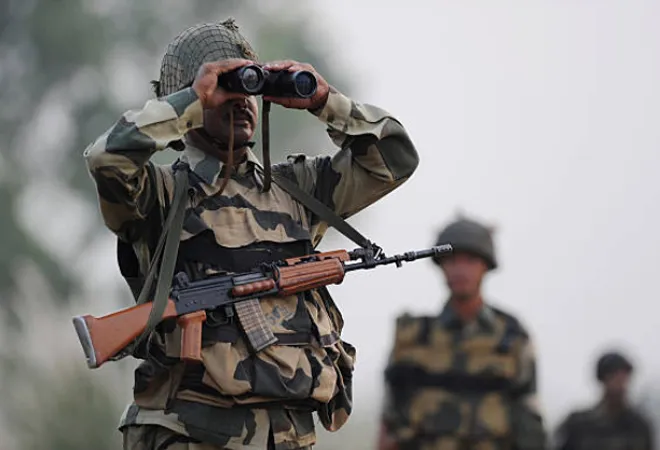
NEW DELHI: The present turbulence around Bangladesh cannot be read as a sudden break from the past. It belongs to a landscape shaped by history, memory, and geography, where tension rarely appears without precedent and rarely disappears without trace. What seemed to end in 1971 did not conclude. It paused. That pause is shifting again, not in spectacle, but through a slow, persistent movement that is felt across the border and will sooner rather than later have repercussions inside the eastern arc of India.
This is not a moment for loud assertion or emotional display. It is a moment for steadiness. The region between the delta, the river valleys and the hills has always responded sharply to political change. Instability here does not remain confined to one territory. It changes how communities interpret one another. It revives uncertainties that have never fully gone away. It also reminds us that the space between confidence and miscalculation is narrower than public rhetoric tends to admit.
To look at events in Bangladesh only as governmental change or street turbulence is to flatten their depth. Memory there has never entirely settled. Narratives compete, legitimacy is contested, and the past returns not as nostalgia, but as pressure. Those pressures do not stop at the international boundary. They are read instantly in Assam, Tripura, Mizoram, Meghalaya, and the entire length of West Bengal, where identity has long been shaped by movement, fear of displacement, and the constant awareness that politics across the border is never entirely distant.
The frontier here is not a separation line. It is a shared emotional and historical field. That reality requires composure, not theatre. India’s responsibility in such a moment is not to claim control through language, but to hold the ground through restraint. Escalation may arrive through a single incident. Drift arrives when mistrust becomes routine and anxiety begins to define expectation. Both are dangerous. Both must be resisted.
JAMAAT ECOSYSTEM: READING THE RISK CORRECTLY
The most serious fault line inside Bangladesh does not lie in electoral formations alone. It lies in the ecosystem clustered around the hard-core Jamaat network. This is not simply a political presence. It is a layered ideological structure that moves through student organisations, mosque committees, charitable bodies, diaspora outreach, and digital mobilisation, with linkages that stretch quietly across regions and generations. It is patient, disciplined, and rarely loud until the ground beneath it is ready.
Such an ecosystem cannot be countered symbolically. It has to be approached as a structural reality. India’s posture must remain calm and unsentimental. Overreaction converts it into a moral cause. Neglect allows it to deepen roots. The correct vantage is one of close observation combined with institutional patience. Avoid turning it into a public object of obsession. Avoid allowing it to disappear from view.
There must, however, be clarity where clarity is essential. Violence, armed facilitation, cross-border sanctuary, and covert enabling networks cannot be treated as grey areas. Such boundaries should be conveyed directly and firmly, not through posture, but through consequence that is understood without spectacle. Ideological confrontation rarely weakens belief. It hardens it. What can be weakened are the arteries that enable mobilisation. Funding nodes, NGO covers, travel and recruitment pathways, communication hubs, and logistical scaffolding. When these are thinned, capability shrinks without creating an image of persecution that strengthens narrative power.
This is perhaps the greatest challenge that is today being faced by our covert agencies, and they must deliver amidst the shadows. They have done so in the past, and they must do so again. India’s practical leverage does not reside in public political space. It resides in institutions that continue to function even when atmospheres grow tense. Intelligence coordination, border vigilance, financial scrutiny, energy and transit management. It is in these spaces that continuity endures, and where cooperation survives even when the political environment is uneasy.
There is also an inward dimension that demands maturity. Jamaat derives strength from grievance narratives that cross borders. Internal cohesion inside India must therefore be shielded from becoming symbolic material for external ideological mobilisation. Confidence within is the first form of insulation without. Jamaat will not disappear from Bangladesh. The objective is not elimination. It is containment, fragmentation, and the steady narrowing of its operating space. Whenever it is forced to choose between ideological absolutism and political accommodation, it fractures. Fractures can be managed. That requires time, discipline and absence of drama.
LANGUAGE, RESTRAINT, AND THE VALUE OF QUIET CHANNELS
Moments of uncertainty are easily overtaken by language. Public commentary travels faster than policy, and often shapes response before facts can settle. Bangladesh is especially sensitive to tone when spoken to from outside. What appears assertive in Delhi may register as condescension in Dhaka. The result is reflex hardening, not accommodation.
Even podcasts originating in India, though governed by the principle of free speech, must understand what is at stake and not just pontificate and fan linguistic narratives for the sake of TRPs. India must recognise that even such commentary shapes atmospheres in Dhaka, and must be alive to the costs of careless amplification. India’s influence has historically been most effective when it has been exercised without noise. Through continuity among institutions, through private communication, and through relationships that are built slowly and maintained deliberately. In such an environment, restraint is not silence. It is proportion. The task now is to keep doors open and keep temperature low.
INTERESTS BEYOND LEADERSHIPS
Governments change. Geography endures. India must resist appearing aligned with one political dispensation or opposed to another. The relationship matters because of outcomes, not personalities. Minority security, stability along the frontier, transit and riverine connectivity, counter-terror cooperation, and the insulation of the Northeast from spillover insecurity are long-term interests. These are preserved best when rooted in institutions that survive electoral shifts. Seen from the borderlands, the question is not who governs Dhaka. It is whether uncertainty crosses the borders. The more the engagement remains institutional, the more resilient it becomes.
ECONOMICS AS A FIELD OF INFLUENCE
Influence in this relationship is carried not by emotion but by structure. Trade flows, power supply arrangements, grid integration, transport corridors, port access, and labour and market linkages form the underlying architecture through which trust, pressure, and reassurance travel. These instruments are effective when calibrated with care. Sudden withdrawal provokes anxiety and grievance. Blank generosity dilutes leverage. Sequencing, pacing, and conditional reciprocity yield the greatest strategic effect while preserving dignity on both sides. Quiet adjustment influences behaviour more deeply than public reprimand.
SECURING THE EAST FROM WITHIN
The vulnerability of this moment does not exist solely outside India’s territory. It begins within it. The states along the eastern arc have carried a heavier emotional and demographic burden than most of the country recognises. Migration, economic unevenness, political churn, and unresolved historical experience have shaped their sense of fragility. When instability rises across the border, unease does not arrive abstractly. It arrives through neighbourhood conversation, rumour, memory, and expectation.
Stability cannot rely on goodwill elsewhere. It must rest on competence here. Border systems must be credible. Intelligence networks must possess continuity rather than transience. Security forces must feel supported rather than isolated. Communities must see that administration is attentive to their fears rather than dismissive of them. Deterrence in this landscape is built as much through confidence as through force.
It is here that a deeper institutional question becomes unavoidable. There has been much discussion within the Armed Forces about unified theatre commands, integrated fighting systems, and joint positioning. With Bangladesh signalling a willingness to become another instrument in the wider strategic competition of the subcontinent, the need now is to streamline the entire security architecture along the East into a cohesive defensive system. Officers with real ground-level experience must be placed in roles where their understanding shapes posture. Senior tenures must be long enough for commanders to know their formations intimately, and to think beyond administrative rotation. Turf divisions have weakened capacity for far too long. This is not criticism, because much has improved. It is guidance on what still remains unfinished. The instability gathering across this frontier may yet evolve into the most serious challenge in the region, for India cannot afford conditions that resemble a three and a half front scenario. Preparedness here is not a call to arms. It is a call to realism.
CHINA AND THE QUESTION OF RELIABILITY
Bangladesh’s engagement with China emerges from economic aspiration, infrastructure need, and strategic diversification. It is neither accidental nor personal. India will not benefit by treating it as betrayal or competition in symbolic space. The real contest lies in reliability. China may offer capital and rapid delivery; India must offer proximity, predictability, and a relationship that does not add friction when political weather shifts. Reliability is remembered longer than financial advantage, and it shapes choices made under stress.
NARRATIVE CARE AND DANGER OF COLLAPSING CATEGORIES
There is another danger that lies not in Bangladesh, but within India’s own habits of response. Symbolic gestures that cut sporting ties, cultural exchange, or routine contact may appear decisive. In reality, they shrink space for moderation and strengthen the argument of those who claim inevitability of hostility. Folding Bangladesh into the same mental category as Pakistan may feel rhetorically convenient, but it erases history, geography, and lived interdependence. It also traps policy in positions that are difficult to reverse. Connections between people often act as quiet stabilisers. Removing them does not isolate extremists. It vindicates them. Where signalling is required, it should be subtle, contextual, and reversible, rather than declarative and final.
HOLDING THE LINE
The eastern frontier stands today on a fragile balance. It is held together by memory, by the presence of institutions that know its temperament, and by the assurance that crises can be managed without amplifying fear. This is not a theatre for display. Military action here would not express strength. It would admit failure across political, institutional, and strategic levels. The greatest cost would be borne by those already living closest to uncertainty.
And the bigger question still remains unanswered. If military action in any form is resorted to, what then after that? Bangladesh is not a problem to be solved. It is a relationship that demands patience, steadiness, and a long memory. 1971 belongs to history. It cannot be lived as sentiment. The less India reacts with wounded sentiment, the more space it retains to act with quiet purpose. This moment calls for firmness without noise, confidence without bravado, and clarity that does not exaggerate the danger it seeks to prevent.
Without illusion. Without spectacle. Without remorse. And without pity.
Shiv Kunal Verma is the author of various military history books and heads the Fortress India movement.




