
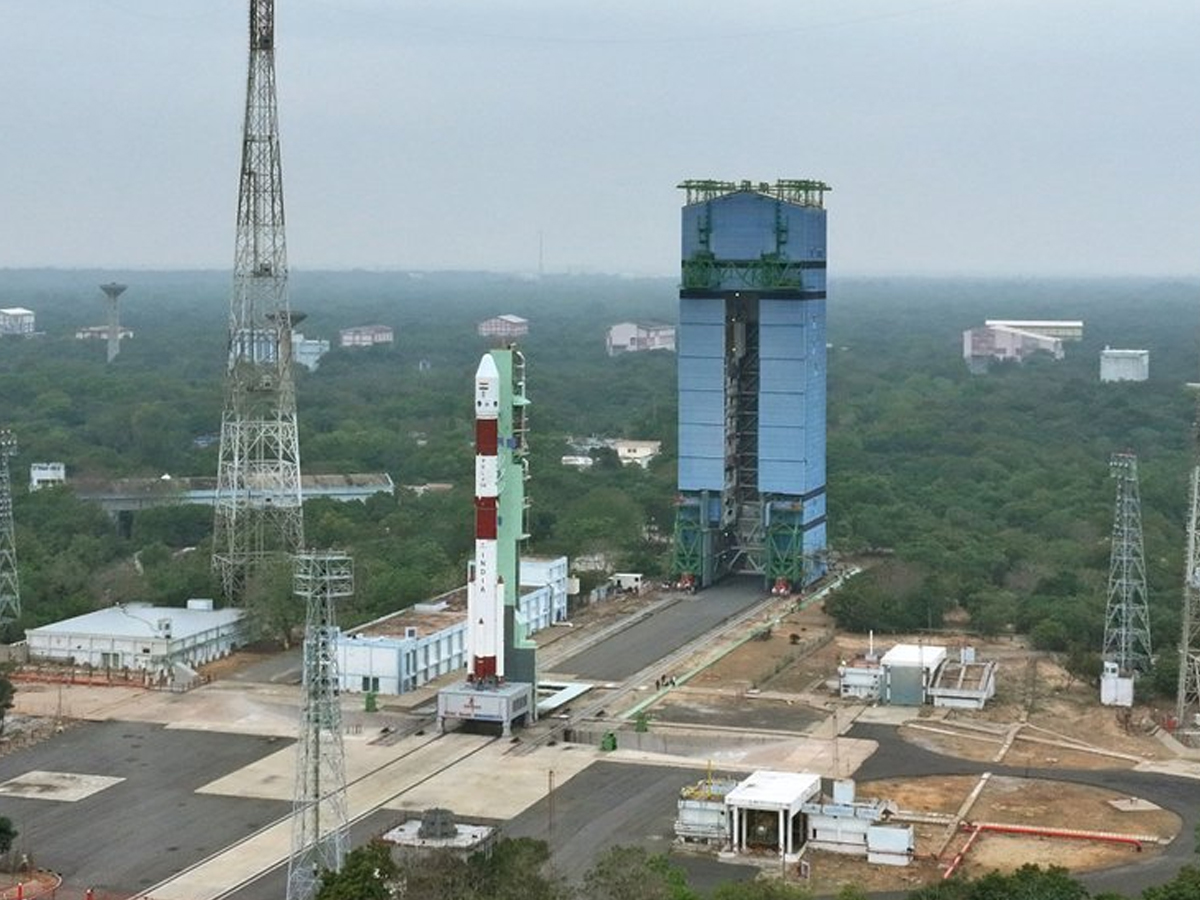
India’s space programme faced fresh uncertainty on Monday after ISRO’s Polar Satellite Launch Vehicle PSLV-C62 ran into a critical anomaly during its third stage, clouding the fate of 16 satellites it was meant to place in orbit. The incident marks another challenge for ISRO’s most reliable launch vehicle and has triggered an intensive technical investigation.
The 44.4-metre-tall rocket lifted off at 10:18 am from the Satish Dhawan Space Centre, Sriharikota, carrying the EOS-N1 (Anvesha) Earth observation satellite along with 15 co-passenger satellites from India and abroad. The mission aimed to deploy them into a 512-kilometre Sun-Synchronous Orbit in just under 20 minutes.
What Went Wrong During the PSLV-C62 Launch?
The launch initially progressed as planned. ISRO’s live telecast showed smooth performance through the first and second stages, and the third stage ignited on schedule. Trouble emerged only near the end of the third stage, when engineers noticed abnormal behaviour in the vehicle.
ISRO Chairman V Narayanan explained the sequence from Mission Control.
“The PSLV is a four-stage vehicle with two solid stages and two liquid stages. The performance of the vehicle up to the end of the third stage was expected. Close to the end of the third stage we are seeing more disturbance in the vehicle and subsequently, there was a deviation observed in the flight path,” Narayanan said.
That deviation prevented the rocket from maintaining the precise trajectory needed for satellite deployment.
ISRO Confirms Anomaly, Analysis Underway
Roughly half an hour after liftoff, ISRO officially acknowledged the issue. In a post on X, the space agency said:
“The PSLV-C62 mission encountered an anomaly during end of the PS3 stage. A detailed analysis has been initiated.”
Because of the deviation, ISRO could not immediately confirm whether the satellites separated successfully or entered their intended orbit.
What Happened to EOS-N1 and the Other Satellites?
As of now, the status of EOS-N1 and the 15 other satellites remains uncertain. ISRO teams are analysing telemetry and tracking data from multiple ground stations to determine whether any of the payloads survived the off-nominal flight.
Narayanan told reporters, “Today, we attempted the PSLV-C62/EOS-N1 mission… the mission could not proceed in the expected flight path. That is the information right now available.”
He added that more clarity would emerge once engineers complete the data review.
Why This Setback Worries ISRO
The incident has drawn attention because it follows a similar third-stage issue during a PSLV mission in May 2025. Back-to-back problems involving the same stage raise concerns for ISRO, given PSLV’s long-standing reputation as its most dependable launcher.
Often described as ISRO’s “workhorse rocket,” PSLV has completed over 60 missions, including landmark launches to the Moon and Mars and commercial satellite deployments for dozens of countries. Failures have been rare—but consecutive anomalies now put added pressure on the agency to identify and fix the root cause.
What Happens Next for PSLV and ISRO?
For now, ISRO remains focused on data analysis and fault identification. Engineers will study flight telemetry, sensor readings, and tracking inputs to pinpoint what triggered the disturbance in the third stage.
The findings will be critical not only for understanding the fate of the 16 satellites but also for ensuring confidence in future PSLV missions. Until then, the space agency faces a tense wait as it works to safeguard the reliability of one of India’s most trusted launch vehicles.




