
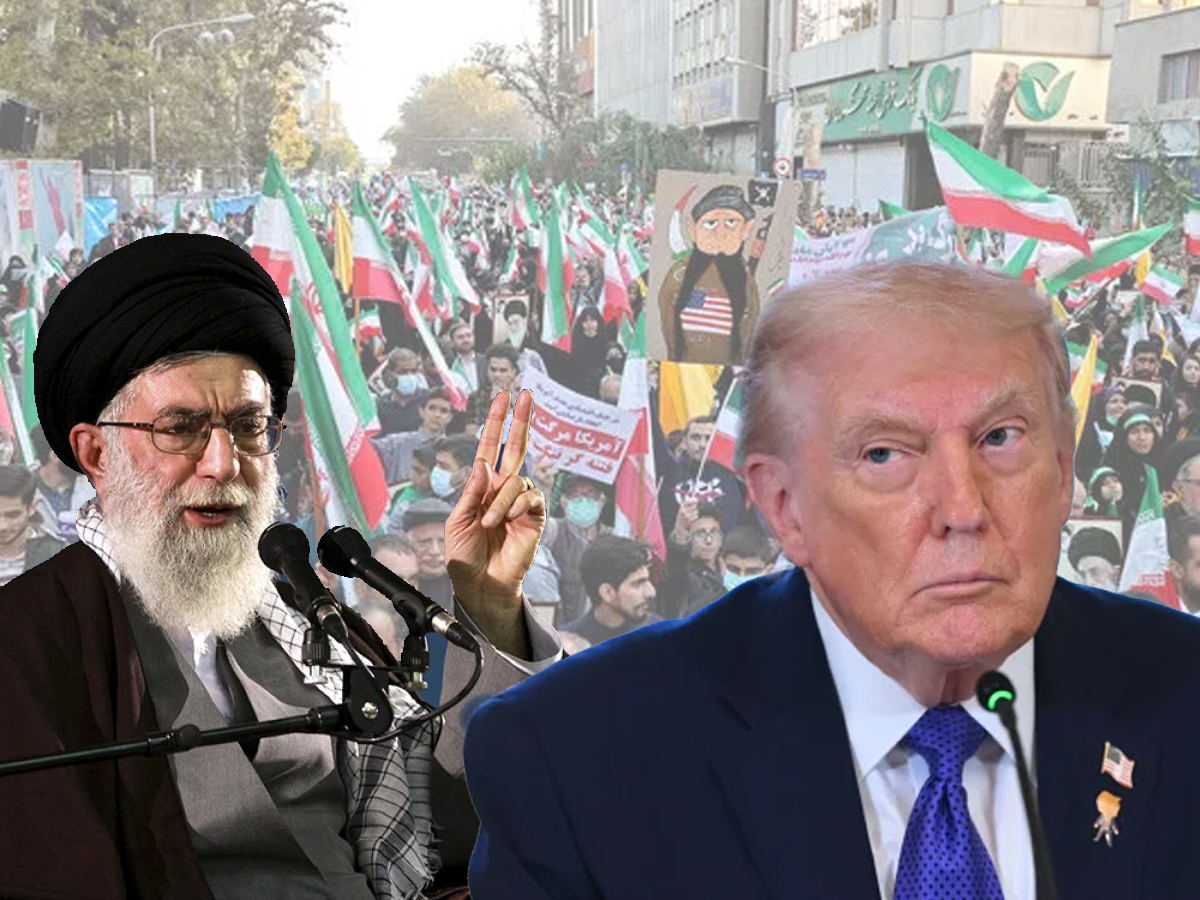
Tensions around Iran escalated sharply this week as deadly nationwide protests, rising US military activity, and fears of imminent intervention converged into a fast-moving international crisis. What began as domestic unrest over economic collapse has now spilled into global aviation disruptions and geopolitical uncertainty, underlining Iran’s central role in regional and global stability.
US Pulls Personnel as Military Signals Intensify
The first major signal of escalation came from Washington. A US official, speaking on condition of anonymity, said the United States was pulling some personnel from key bases in the region as a precaution due to heightened tensions.
Soon after, a Western military official warned of possible action, stating, “All the signals are that a US attack is imminent, but that is also how this administration behaves to keep everyone on their toes. Unpredictability is part of the strategy.”
Despite these warnings, President Donald Trump struck a more cautious tone at the White House, suggesting a wait-and-see approach toward the unfolding crisis. However, behind the scenes, uncertainty remained high. Two European officials said US military intervention could come within the next 24 hours, while an Israeli official indicated that Trump appeared to have decided to intervene, though details on timing and scope were unclear.
Iran Protest Death Toll Sparks Global Alarm
As diplomatic and military tension grew, the human cost inside Iran continued to rise. Iran Human Rights (IHRNGO) said that 19 days of nationwide anti-government protests have left at least 3,428 protesters dead, with thousands more injured.
According to the NGO, sources within Iran’s Ministry of Health and Medical Education confirmed that between January 8 and January 12 alone, the deaths of at least 3,379 protesters were officially registered. The figures have intensified international outrage and sharpened scrutiny of Tehran’s crackdown.
Iran Protests: US Moves Carrier Strike Group to the Middle East
Concerns deepened further after reports emerged that the US was repositioning major military assets. A News Nation journalist reported that a US carrier strike group was moving from the South China Sea to the CENTCOM area of responsibility.
The journalist wrote, “US MILITARY HARDWARE MOVING TO THE MIDDLE EAST AMID TENSIONS WITH IRAN… The U.S. is moving a carrier strike group from the South China Sea to the CENTCOM area of responsibility, a source with knowledge tells me @NewsNation…That will take a week or so to complete.”
The move added to fears that Washington was preparing for a broader confrontation as the situation inside Iran deteriorated.
What Is Happening in Iran?
The current crisis traces back to late December 2025, when protests erupted after the Iranian rial plunged to historic lows. The currency collapse triggered sharp inflation and soaring living costs, pushing millions of Iranians into financial distress.
Demonstrations quickly spread across all 31 provinces, drawing participation from students, workers, shopkeepers, and professionals. In response, the Iranian regime, led by Supreme Leader Ayatollah Ali Khamenei, imposed one of the most extensive internet blackouts in recent years, severely restricting communication and independent reporting.
Warnings from the Trump-led US administration over Iran’s nuclear ambitions and human rights record soon transformed the unrest from a domestic crisis into a major international flashpoint.
Iran Shuts Airspace Amid Rising Tensions
As fears of escalation mounted, Iran took the extraordinary step of temporarily shutting its airspace early Thursday. The Tehran Flight Information Region (FIR) was closed to all flights around 3:45 am IST, forcing airlines to reroute aircraft and triggering delays on key international routes linking India with West Asia and Europe.
“During the closure, no overflights were permitted. Only international civil flights arriving into or departing from Iran with prior permission from the Iran Civil Aviation Authority (CAA) were allowed,” an official said.
Another official added, “Delhi ACC (Area Control Centre) was informed of the closure by Lahore ACC (OPLA), which cited military escalation as the reason.”
At the time, no formal NOTAM had been issued, creating confusion among air traffic controllers and airlines.
Iran Airspace Closed: Flights Diverted as Critical Route Disrupted
The closure had immediate operational consequences for flights using air traffic service route G452, a critical corridor for aircraft flying from north and west India toward Iran, the Gulf, Turkey, and Europe.
“Preliminary information came in from Lahore ACC stating that aircraft operating on G452 were rerouted through Pakistan’s airspace to avoid Iranian airspace,” a ministry official said.
One aircraft already on the route, IRM086 of Mahan Air operating from China to Tehran, had to be diverted mid-flight. For Delhi ACC, the disruption required rapid coordination with neighbouring airspace authorities to manage congestion and last-minute rerouting.
Iran later reopened its airspace, with a NOTAM confirming that normal operations resumed at 7:03 am.
Iran Airspace Closed: Why Is Iran’s Airspace Crucial for Airlines?
Iran lies on a key East–West aviation corridor, making its airspace vital for global airlines. The Europe–Asia air route across the Middle East passes directly over Iran, offering the shortest and most fuel-efficient great-circle paths between continents.
Flights between Europe and South Asia, Southeast Asia, and East Asia rely heavily on Iranian airspace. Rerouting around Iran can add several hours of flying time and significantly higher fuel costs, impacting airline schedules and fares worldwide.
Iran’s airspace also carries a grim historical reminder. In 2020, a passenger jet was mistakenly shot down amid heightened military alert, killing everyone onboard—a tragedy that continues to influence aviation risk assessments.
Iran Airspace Closed: Airlines Acknowledge Disruptions
Air India acknowledged the impact of the airspace shutdown in a post on X, stating,
“Due to the emerging situation in Iran, the subsequent closure of its airspace, and in view of the safety of our passengers, Air India flights overflying the region are now using an alternative routing, which may lead to delays. Some Air India flights where currently rerouting is not possible are being cancelled.”
The airline added,
“Air India regrets the inconvenience caused to passengers due to this unforeseen disruption. Safety of our passengers and crew remains the top priority.”
Iran Crisis: Crisis with Global Stakes
Iran’s temporary airspace shutdown highlights how domestic unrest, military posturing, and geopolitical rivalries can rapidly disrupt global systems. With protest deaths mounting, US military assets moving closer, and airlines forced to reroute, the crisis in Iran has moved far beyond its borders.
As the situation continues to unfold, the world watches closely, aware that the next decision—whether political, military, or diplomatic—could have far-reaching consequences well beyond Iran itself.




