
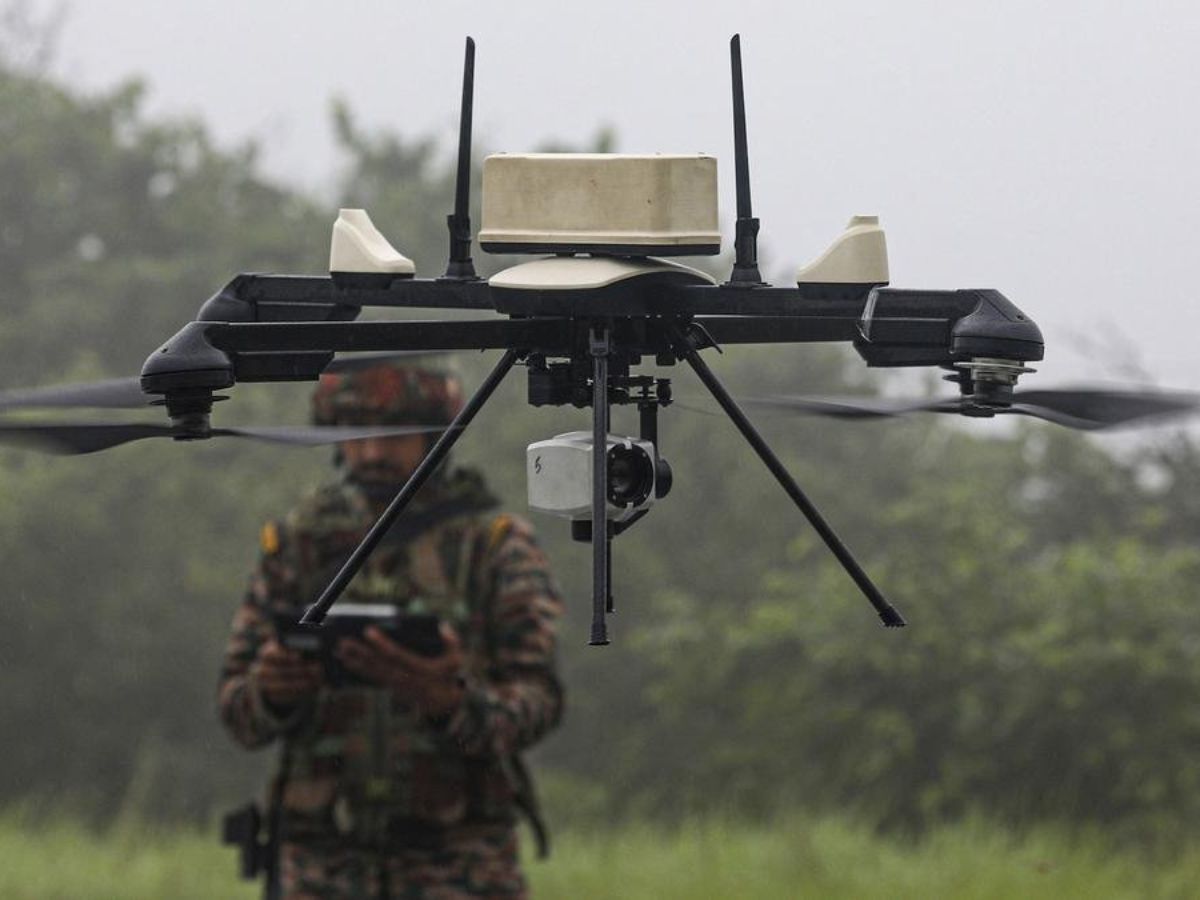
The most lethal battlespace today is not high above the clouds, but the crowded airspace that determines whether soldiers can advance, hold ground, or survive.
Modern wars are still decided on land. Territory is seized, populations are controlled, and political outcomes are imposed by ground forces.
Yet the ability of armies to manoeuvre, sustain themselves, and fight is now determined less by control of the skies at high altitude and more by dominance of a narrow vertical band just above the battlefield.
This layer, commonly described in Western military literature as the air littoral, has emerged as the most contested and lethal battlespace of contemporary warfare.
The New Killing Zone Above the Battlefield
The air littoral is not a new concept, but recent conflicts have elevated its importance. Stretching roughly from ground level up to a few thousand metres, it is where drones, attack helicopters, close air support aircraft, artillery-fired air defences, and ground-based missile systems converge.
Control of this space decides whether infantry can move without being detected, whether armour can survive, and whether logistics columns can function. Without it, land combat becomes slow, costly, and often impossible.
Defining the Air Littoral
The term “air littoral” is used in professional military literature, notably in the US Army War College’s Parameters journal, to describe the airspace that is tightly coupled to land combat.
Unlike strategic airspace, which supports long-range strike and air superiority missions, the air littoral is crowded, reactive, and deadly. It is characterised by short engagement ranges, rapid sensor-to-shooter loops, and constant interaction with ground forces.
In this layer, the traditional distinction between air and land warfare collapses. Small unmanned aerial systems (UAS), loitering munitions, man-portable air defence systems (MANPADS), short-range air defence (SHORAD), electronic warfare, and tube and rocket artillery all operate in overlapping envelopes.
The result is a battlespace where even fleeting exposure can be fatal.
Western military commentary increasingly stresses that control of the air littoral does not mean eliminating all threats. Instead, it means achieving enough dominance to allow friendly ground forces to manoeuvre, resupply, and fight while denying the same freedom to the adversary.
Why the Air Littoral Now Dominates Warfare
Three trends have pushed the air littoral to the centre of modern conflict.
First is the proliferation of drones. Commercially derived quadcopters, tactical reconnaissance UAVs, and armed loitering munitions have become ubiquitous.
These systems operate primarily in the air littoral, providing real-time surveillance, artillery spotting, and precision strike capabilities to even small units.
Open-source analyses of recent conflicts show that the majority of battlefield casualties are now linked, directly or indirectly, to drone-enabled targeting.
Second is the democratisation of air defence. MANPADS and vehicle-mounted SHORAD systems are no longer confined to major militaries.
Their widespread availability has pushed manned aircraft to higher altitudes, reducing responsiveness and increasing reliance on stand-off munitions.
Attack helicopters, once dominant in close battle, now face severe survivability challenges unless supported by suppression of enemy air defences and electronic warfare.
Third is the compression of the sensor-shooter cycle. Modern armies can detect, identify, and strike targets in minutes or even seconds.
Artillery linked to drones, networked air defences, and integrated command systems mean that any movement in the air littoral is quickly contested.
This makes the space above advancing troops as dangerous as the ground they occupy.
Air Littoral as an Enabler of Land Warfare
A central mistake in popular discussions of air power is treating it as an independent war-winning instrument. Professional military doctrine is more sober. Air power, drones, and air defence are enablers, tools that shape conditions for ground forces rather than replace them.
Control of the air littoral determines whether infantry can cross open ground without being annihilated by precision fires. It decides whether armoured units can mass for breakthrough or must disperse and crawl forward. It shapes logistics, dictating whether supply convoys move by day or night, by road or track, or at all.
Western doctrinal papers increasingly emphasise that land manoeuvre without air littoral control results in static warfare. Units dig in, camouflage, and fight for inches rather than kilometres. Conversely, even limited dominance — achieved through layered air defence, counter-drone measures, and persistent surveillance — can restore mobility and tempo.
Drones, Helicopters, and the Vertical Battle
The air littoral is where different vertical capabilities intersect. Drones provide eyes and increasingly weapons. Helicopters offer mobility, firepower, and rapid response. Artillery and missiles reach upward, while electronic warfare seeks to blind and disrupt.
Modern conflicts show that none of these systems can operate alone. Drones without electronic protection are jammed or shot down.
Helicopters without suppression of air defences suffer heavy losses. Air defence without sensors is blind. Success comes from integration, which Western militaries describe as combined arms in the vertical dimension.
This has direct implications for force design. Rather than investing exclusively in high-end aircraft or long-range strike, militaries are rediscovering the importance of SHORAD units, counter-UAS capabilities, and low-altitude sensors embedded with brigades and battalions.
Lessons for India and Contemporary Militaries
For India, the air littoral has particular relevance. Along contested borders, whether in mountainous terrain or open plains, the ability to protect ground forces from drones and low-flying threats will shape future operations.
Indigenous efforts in air defence, electronic warfare, and UAV development directly address this challenge.
Professional military assessments consistently warn that neglecting the air littoral creates vulnerabilities that adversaries can exploit cheaply and at scale.
Conversely, investing in layered defences, resilient communications, and joint training between air and land forces enhances deterrence and battlefield effectiveness.
Why Wars Are Still Decided on Land
Despite technological change, the fundamental truth remains: wars are decided by who controls the ground. Cities, roads, high ground, and populations cannot be held from the air alone. What has changed is the cost of trying to seize or hold that ground without controlling the airspace immediately above it.
The air littoral is where air power becomes intimate, violent, and decisive. It is not glamorous like high-altitude dogfights or long-range strikes, but it is where modern armies live or die. Dominance here does not guarantee victory, but failure guarantees stalemate or defeat.
The Decisive Layer of Future Wars
The air littoral has emerged as the most contested layer of modern warfare because it directly shapes land combat outcomes. It is where drones hunt, missiles stalk, and artillery reaches upward. It is where air power stops being strategic and becomes tactical, an enabler of soldiers on the ground.
As professional military literature makes clear, the future of warfare will not be decided solely by who has the best aircraft or the longest-range missiles.
It will be decided by who can control the crowded, lethal airspace just above the battlefield; and thereby allow their land forces to move, survive, and fight.




