
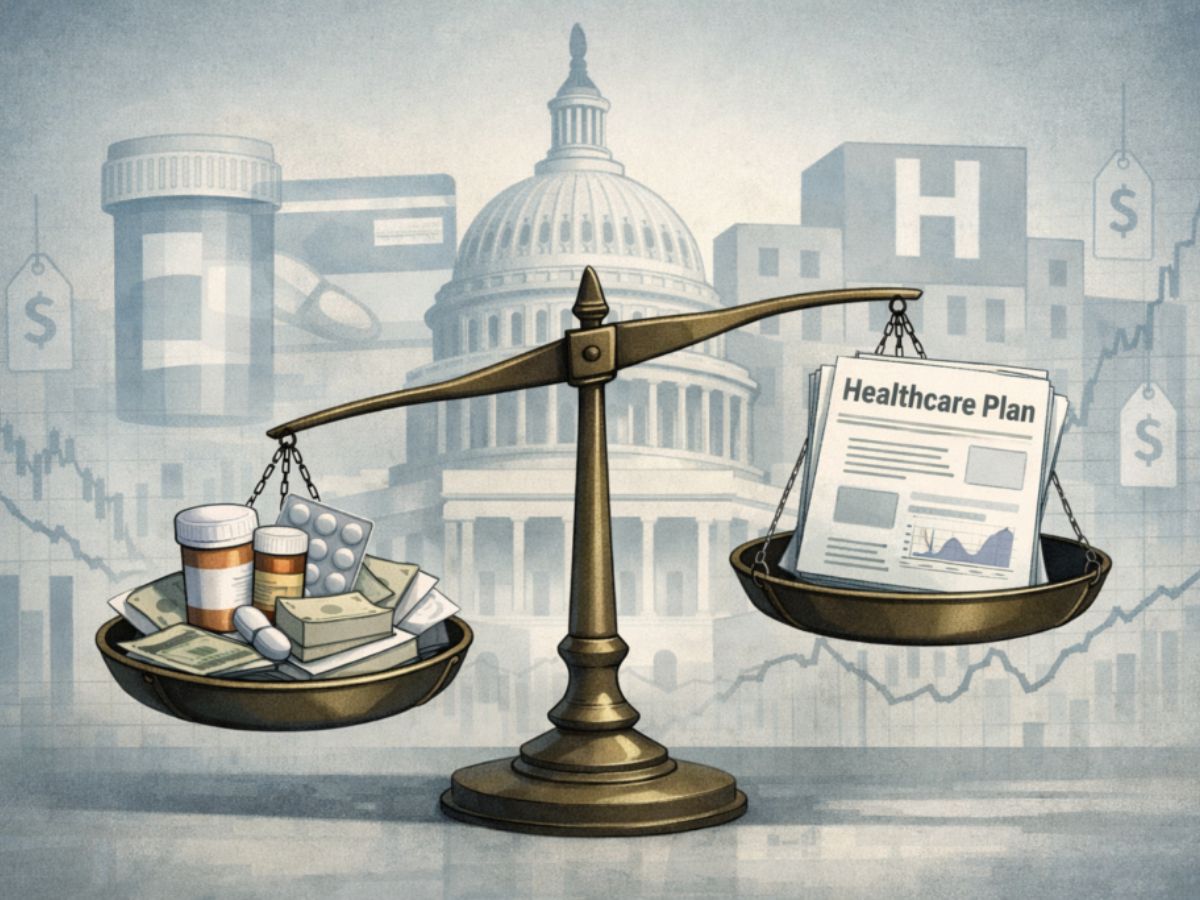
Washington, D.C.: On 15 January 2026, President Donald J. Trump released “The Great Healthcare Plan” from the White House—a comprehensive framework aimed at slashing prescription drug prices, lowering insurance premiums, holding large insurance companies accountable, and enforcing price transparency. As co-authors of the Amazon bestselling book “Beyond the COVID-19 Pandemic: Envisioning a Better World by Transforming the Future of Healthcare”, we extend our congratulations to President Trump for this bold initiative.
What is particularly noteworthy for global observers is that our 2020 book, authored independently by two non-U.S. figures with extensive international experience, outlined remarkably similar reforms years ahead of this announcement. Informed by the Covid-19 pandemic’s global lessons, our work proposed patient-centred changes that now appear to echo in U.S. policy.

ALIGNING VISIONS: A COMPARATIVE ANALYSIS
Together, we envisioned a transformed future for healthcare, prioritizing affordability, equity, and transparency—principles that transcend national borders and hold relevance for India’s ongoing efforts to expand universal access through initiatives like Ayushman Bharat (see table).
THE ‘SAFETYNET’ AND DECOUPLING INSURANCE
A central recommendation in our book was the establishment of a “SafetyNet” system to guarantee essential care while decoupling health insurance from employment—a model inherited from mid-20thcentury wage controls that has constrained choice and escalated costs (pages 145-146, 161-166, 174). We advocated redirecting resources directly to individuals to promote personalized coverage and market competition. President Trump’s plan mirrors this by instructing to “Send the Money Directly to the American People,” redirecting billions in subsidies from large insurers to eligible citizens for insurance of their choice.
PRESCRIPTION DRUG PRICING REFORM
Our critique focused on barriers to negotiation and unchecked markups, using examples like insulin costs soaring from $35 to over $400 per vial (pages 54-56, 166). The plan advances these by codifying most-favored-nation pricing—aligning U.S. prices with lower international rates—grandfathering voluntary negotiations, and expanding over-the-counter access. For Indian readers, this emphasis underscores the potential benefits of transparency in curbing monopolistic practices worldwide.
TRANSPARENCY AS A PILLAR OF TRUST
Transparency formed another pillar of our analysis, addressing opaque hospital chargemasters and insurance operations (page 53). The plan mandates “plain-English” comparisons, disclosure of overhead versus claims, claim denial rates, and public price posting for Medicare/Medicaid providers—steps that prevent surprise bills and empower consumers. Such accountability could inspire similar reforms in diverse systems, promoting efficiency and trust.
A STRATEGIC OPPORTUNITY FOR INDOU. S. COLLABORATION
This policy shift creates a historic opening for Indian pharmaceutical leaders, hospital networks, and digital health innovators to become strategic partners in the U.S. healthcare transformation. As the “Great Healthcare Plan” seeks to implement “most-favorednation” pricing and slash drug costs, India’s pharmaceutical industry—the global leader in high-quality, affordable generics—is uniquely positioned to stabilize the U.S. supply chain and provide the cost-effective medications central to this reform. Furthermore, Indian hospital groups and health-tech firms can collaborate by sharing “frugal innovation” models and digital infrastructure insights gained from Ayushman Bharat, offering the U.S. proven frameworks for price transparency and large-scale data management. By aligning India’s manufacturing prowess and clinical expertise with the American demand for affordability and transparency, both nations can move toward a bilateral “SafetyNet” that ensures resilient, patient-centered care and fosters a new era of global health security.
For Indian hospital groups (e.g., Apollo, Fortis, Narayana Health) and health-tech firms already utilizing the high-volume, low-margin, and digitally integrated models of Ayushman Bharat, this represents a prime “export” opportunity. By adapting existing “frugal innovation” frameworks, Indian entities can help U.S. systems meet these new transparency benchmarks while reducing administrative overhead.
KEY ADAPTATION STRATEGIES
-
Transitioning from ‘Chargemasters’ to ‘Digital Shoppable Packages’: The U.S. Requirement: Providers must prominently post “plain-English” fees for services. The 2026 updates to Machine Readable Files (MRF) require executive accountability for data accuracy and specific “percentile allowed amount” reporting. Indian Adaptation: Indian hospitals excel in fixedprice package billing (common in medical tourism and Ayushman Bharat). Action: Adapt Indian “allinclusive” surgical package models (e.g., Cardiac Bypass or Hip Replacement) into U.S.-compliant “Shoppable Services” dashboards. Use the Ayushman Bharat National Health Claims Exchange (HCX) logic to create standardized, machine-readable bundles that translate complex CPT/DRG codes into consumer terms like “Total Cost for Standard Knee Replacement.”
-
Leveraging ai for ‘plain-English’ claim adjudication & transparency: The U.S. Requirement: Insurers and Medicare/Medicaid providers must now publish claim denial rates and wait times for routine care.Indian Adaptation: The National Health Authority (NHA) in India recently implemented AI-led checks that prevent fraud while ensuring “blind” claim processing. Action: Deploy Indiandeveloped AI “Explainability” layers. These tools can take a “denied claim” and automatically generate a plain-language explanation for the patient, fulfilling the U.S. requirement for transparency while identifying systemic bottlenecks in real-time.
-
Implementing the ‘bilateral Safetynet’ data standard: The U.S. Requirement: The “Great Healthcare Plan” emphasizes redirecting subsidies directly to individuals via Health Savings Accounts (HSAs), requiring consumers to “shop” for care. Indian Adaptation: India’s Unified Health Interface (UHI)—the “UPI of healthcare”—allows patients to discover, book, and pay for services across different providers on a single app. Action: Build a “Trans-Atlantic Transparency Bridge.” Indian health-tech firms can provide the backend for U.S. “Health Wallets” (HSAs), using the UHI framework to offer realtime price comparisons and “plain-English” provider ratings based on wait times and outcomes.
CONCLUSION
As the White House calls on Congress to enact this framework into law—amid rising 2026 premiums averaging $1,904 compared to $888 in 2025 due to expiring subsidies—the urgency is evident. President Trump’s plan builds on first-term successes like insulin affordability. We commend this patient-focused direction and urge swift legislative action.
This convergence highlights a powerful truth: independent, globally informed analysis can anticipate major policy shifts. Our book, drawing from pandemic lessons and international models, serves as a blueprint for such transformation. It remains available in India at https://amzn.in/d/1SC7lqN for readers seeking deeper insights into healthcare’s future.
The 2026 U.S. reforms move healthcare from a “black box” of corporate jargon to a consumerdriven marketplace. Indian hospital groups, by virtue of their experience with Ayushman Bharat’s scale and transparency, are not just participants in this new era—they are the architects of the technology and delivery models required to make it work.
-
Prof (Dr) Joseph M. Chalil is a bestselling author, awardwinning global healthcare executive, and faculty in Complex Health Systems at Nova Southeastern University. Follow him on X at @Dr_Chalil. Ambassador Pradeep K. Kapur is a distinguished diplomat with a career advising Indian Prime Ministers and engaging global leaders. Together, they have authored two bestselling books: “Beyond the COVID-19 Pandemic: Envisioning a Better World by Transforming the Future of Healthcare” and “India Beyond The Pandemic: A Sustainable Path Towards Global Quality Healthcare.”




