
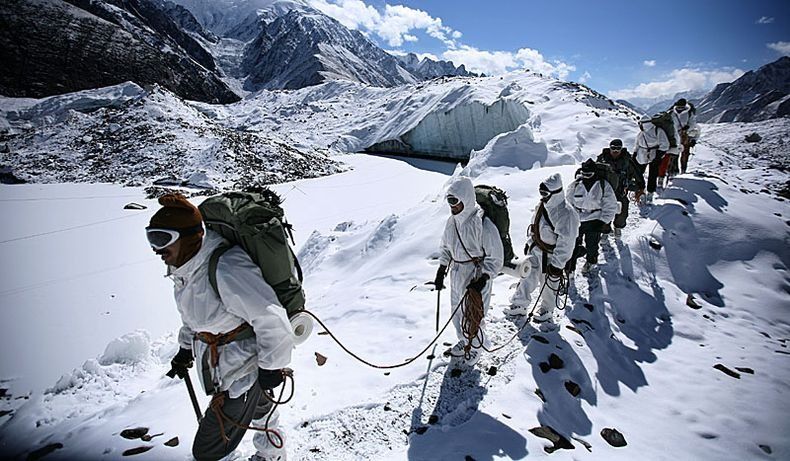
SIACHEN: In extreme weather conditions, the Indian Armed Forces remain on the highest alert along the borders. The Sunday Guardian visited the world’s second-highest battlefield, Siachen, to report on the ground situation of Indian forces deployed in one of the harshest terrains on Earth.
Temperatures in Siachen routinely fall between minus 40 and minus 60 degrees Celsius, while at night they can drop further to minus 50 to minus 60 degrees. Surviving and operating in such conditions demands extraordinary physical and mental strength.
After reaching the Indian Army base camp in Siachen, everyone must undergo medical check-ups, as the region is a high-altitude zone where health risks are common. Our team was first taken to the Army Hospital, where doctors conducted medical examinations, including blood pressure and oxygen-level tests, before granting clearance.
Following the medical process, we were taken to the Siachen Training Centre, where jawans carry out warm-up exercises. Life in Siachen is extremely tough. To move towards the forward posts, soldiers deployed here must complete a rigorous 21-day training programme. Only after completing this programme are they considered ready to operate in Siachen’s extreme conditions.
There are mainly two types of terrain in Siachen: rocky mountains and massive glaciers. To survive here, jawans must continuously train their bodies to adjust to the harsh atmosphere and unpredictable environment.
Every day begins early. Jawans start their training by walking long distances through steep, rocky mountain terrain. This is followed by mountain climbing exercises on extremely dangerous and uneven slopes. After completing this phase, they move to another location where the real challenge begins: the glaciers.
In chilling cold conditions, where temperatures remain around minus 40 degrees and can drop to minus 60 degrees inside glaciers, jawans climb huge walls of ice. Every step is a struggle against nature.
Life in Siachen is full of risks. In the past, many jawans have lost their lives due to extreme weather conditions, and several have fallen into deep glaciers and been buried under heavy snow. To deal with such dangers, every jawan carries an Avalanche Victim Detector (AVD), a device used to locate personnel if they accidentally fall into glaciers. A special rescue team demonstrated how trapped jawans are traced under deep snow using different gadgets. The AVD plays a crucial role in locating victims and supporting rescue operations. In Siachen, one of the biggest challenges remains finding and bringing back a jawan who falls into a glacier.
Beyond the physical hardships, Siachen is also a land of deep faith. One of the strongest symbols of belief is OP Baba Mandir, located inside the Siachen base camp. In the early 1980s, Om Prakash was posted here during operations against Pakistani forces. He sacrificed his life while protecting his post, and his body was never found. The Indian Army later built a temple in his name: OP Baba Mandir. Jawans deployed in Siachen firmly believe that OP Baba warns them in dreams about enemy movement or untoward incidents before they happen. A separate room has been kept for OP Baba, where jawans report daily about their duties. Every soldier posted at Siachen first takes blessings at the temple before beginning service.
Since the Indian Army captured the Siachen Glacier, many brave soldiers have laid down their lives. To honour their sacrifice, the Army has built a war memorial at Siachen for all those who died in the line of duty. Every soldier deployed here pays tribute by laying a wreath in remembrance of the martyrs.
After completing the 21-day training programme, jawans are finally ready to move towards the forward posts. Only those who clear this extreme training earn the title of “Siachen Warriors.” Reaching these forward posts is itself a mission, taking nearly 10 to 15 days, and only when weather conditions are favourable.
This is the story of a jawan at Siachen — the highest and toughest battlefield in the world.




